The Breakthrough: AI Creates Living Organisms from Scratch
Stanford and Arc Institute design functional viral genomes with generative AI
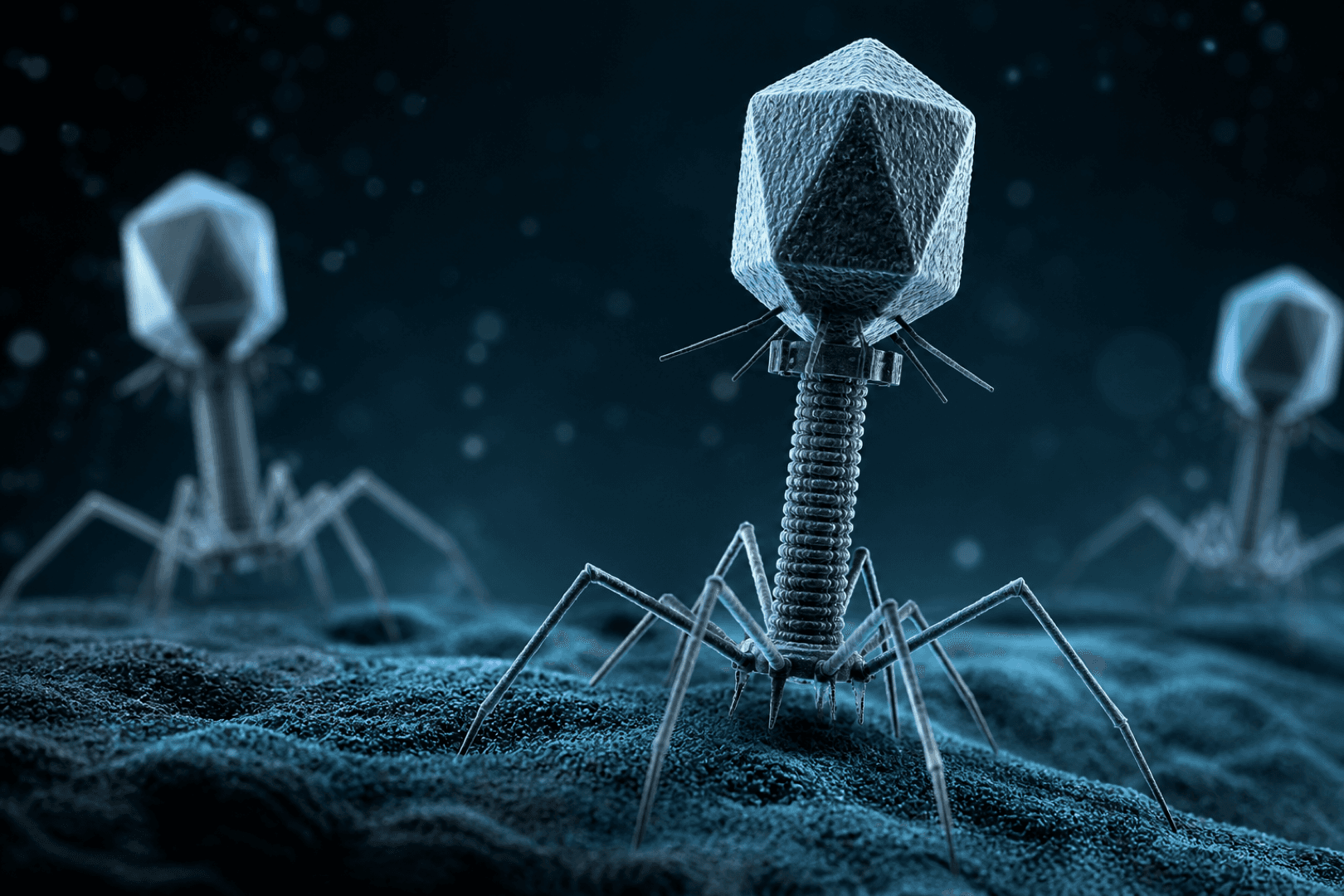
In August 2026, Stanford University and Arc Institute researchers achieved a historic first: using artificial intelligence to design completely new, functional viral genomes. Published in Science journal (Vol. 393, Issue 6811), this work represents the first time AI has created living biological entities capable of replication.
What They Did
The team combined genome language models with wet-lab synthesis to turn AI-generated sequences into viruses that could actually replicate. Here is how that pipeline unfolded.
Evo1 and Evo2 models
Used AI genome language models called Evo1 and Evo2 to design viral sequences.
2 million bacteriophages
Trained on genetic data from 2 million bacteriophages.
Thousands of designs
Generated thousands of potential viral genome designs.
302 synthesized
Selected 302 designs for laboratory synthesis.
16 functional bacteriophages
Successfully created 16 functional bacteriophages that could infect and kill E. coli bacteria.
Success rate: Only 5.3% (16 out of 302) of the synthesized genomes proved viable, showing how challenging it is to design functional life forms.
How the Technology Works
The Evo models work similarly to ChatGPT, but instead of predicting words, they predict genetic sequences.
Training Data
Broad genetic codes
Genetic codes from viruses, bacteria, plants, and humans.
Phage focus
Specifically trained on 2 million bacteriophage genomes.
Safety exclusion
Genetic code for human, animal, and plant-infecting viruses was intentionally excluded.
Process
| Step | What happens |
|---|---|
| 1. Learn | AI learns the "grammar of life" from natural genetic sequences. |
| 2. Generate | Generates novel genome designs (sequences of A, C, G, T nucleotides). |
| 3. Synthesize | Scientists synthesize these designs in the laboratory. |
| 4. Test | Test whether the synthetic viruses can replicate and function. |
"This is a next step in the complexity that's designable by generative AI, this is the first time generative AI has been used to design a complete genome, it's something that can replicate and have other functions inside cells… this was new territory for us," said Dr. Brian Hie, assistant professor at Stanford University.
Medical Promise: Fighting Superbugs
Breakthrough Results
Resistant E. coli
AI-designed bacteriophages successfully killed E. coli strains resistant to natural bacteriophages.
Phage cocktail
A cocktail of the generated phages rapidly overcame bacterial resistance.
New treatments
Potential to develop new treatments for antibiotic-resistant infections.
The Discovery Moment
PhD student Samuel King described testing the phages on petri dishes covered with bacteria: "We were starting to see these clear spots and it was just extremely exciting."
When the team saw the results, "the room spontaneously burst into applause," recalled Dr. Hie.
Antibiotic resistance is a growing global crisis. The ability to rapidly design new bacteriophages could provide a powerful weapon against drug-resistant superbugs. The researchers wrote that this could "transform phage therapy" and "expand biotechnological toolkits."
The Biosecurity Dilemma
Urgent Warnings from Experts
In an accompanying article in Science, Prof. Tom Inglesby and Dr. Mori Hanke from the Johns Hopkins Center for Health Security wrote:
"Although this is promising for life sciences applications, it also raises urgent biosafety and biosecurity questions. The ability to compose viral genomes using generative AI now exists; the governance to safely steer it does not."
The Stanford Team's Own Warning
The researchers acknowledged their work raised "important biosafety, biocontainment and biosecurity considerations" and urged others designing whole genomes to "consult both safety and security professionals throughout the project."
Specific Concerns
Potential for misuse
An AI trained on dangerous pathogens could design harmful viruses.
Governance gap
Current regulations don't address AI-generated biological threats.
Scaling risk
While bacteriophage genomes are tiny, the same approach could theoretically be applied to more complex organisms.
Prof. Tom Ellis (Imperial College London) noted: "This is literally the smallest and easiest genome to make," suggesting more complex and potentially dangerous genomes could follow.
However, Ellis also pointed out that safeguards are being developed: "Governments are working hard" on controls like restricting access to genetic data and having restrictions on making genomes that look dangerous.
What should NOT be done
Inglesby and Hanke specifically stated that work on pathogens that could infect humans, animals, or plants should not be pursued, warning such genomes "might encode new pathogens that cannot be contained by existing countermeasures."
What This Means for the Future
Scientific significance
- First demonstration that AI can design complete, functional genomes
- Proves generative AI can create biology beyond what exists in nature
- Opens door to synthetic biology applications
Medical applications
- Rapid design of phages for specific bacterial infections
- Potential treatments for antibiotic-resistant diseases
- Customized biological tools for biotechnology
Biosecurity challenges
- Need for international governance frameworks
- Mandatory screening of DNA synthesis orders
- Access controls for AI models trained on pathogen data
- Balance between scientific progress and safety
Looking Ahead
Stanford and Arc Institute's Evo models turned generative AI into a genome designer: of 302 synthesized candidates, 16 functional bacteriophages emerged — a 5.3% success rate that still included phages able to kill E. coli strains natural phages could not touch. The team excluded human-, animal-, and plant-infecting pathogen data from training, and the work appeared in Science on August 6, 2026.
The medical upside for antibiotic-resistant infections is real, but so is the biosecurity warning: the ability to compose viral genomes now exists, while governance to steer it does not. Bacteriophage genomes are the smallest and easiest step. How researchers, governments, and DNA-synthesis safeguards handle the next ones will define whether this breakthrough remains a tool against superbugs — or opens territory society is not ready to police.