Seedance 2.0 vs Kling 3.0 vs Sora 2 vs Veo 3.1: The Ultimate AI Video Generation Showdown (2026)
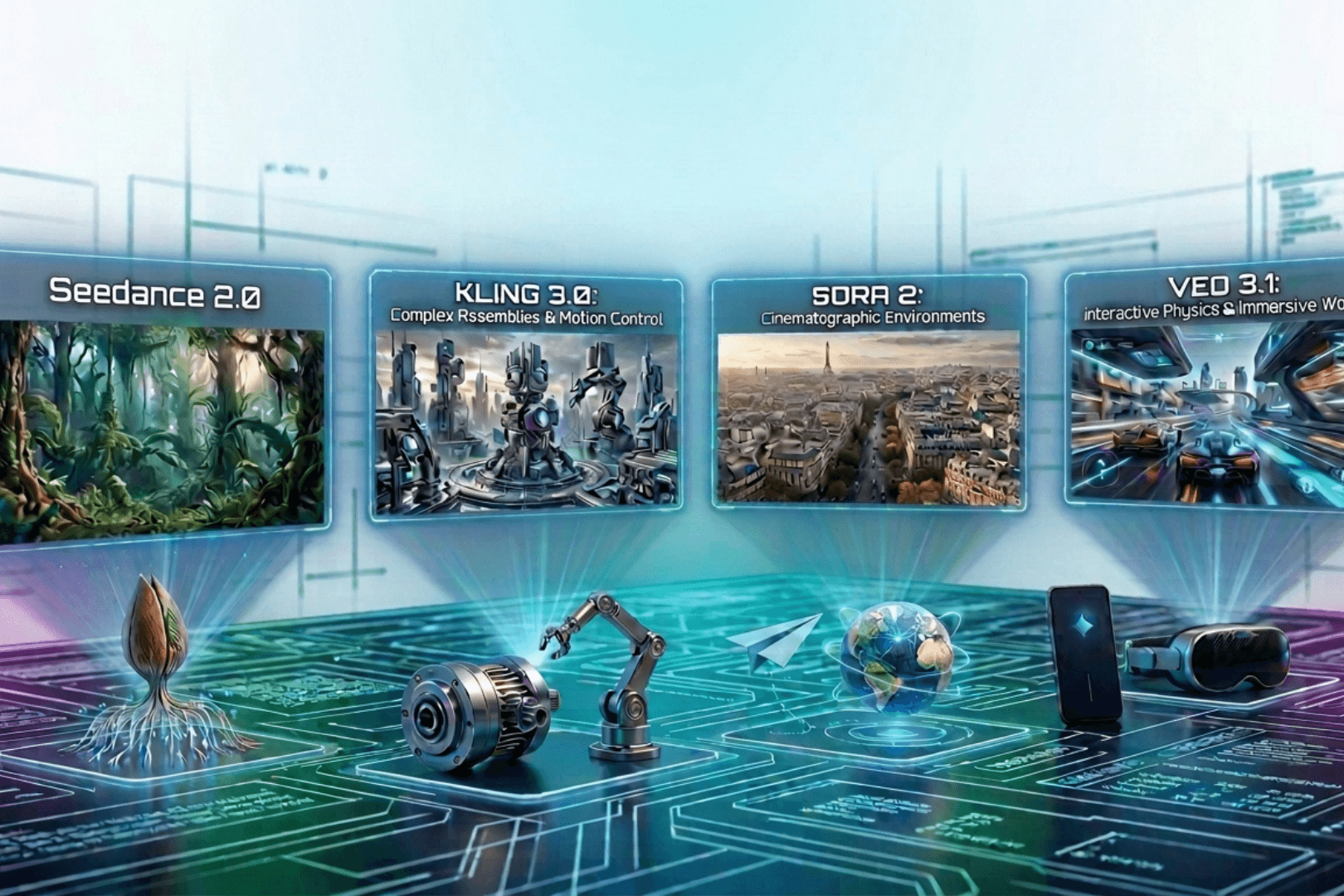
The race among AI video generators has never been tighter. Four major models — ByteDance's Seedance 2.0, Kuaishou's Kling 3.0, OpenAI's Sora 2, and Google's Veo 3.1 — are each pushing the boundaries of what creators can do in 2026. This guide breaks down how they differ and which one fits your workflow.
Quick Comparison
| Feature | Seedance 2.0 | Kling 3.0 | Sora 2 | Veo 3.1 |
|---|---|---|---|---|
| Developer | ByteDance | Kuaishou | OpenAI | |
| Max duration | 15s | 10s | 12s | 8s |
| Max resolution | 1080p | 1080p | 1080p | 1080p |
| Native audio | Yes | Yes | Yes | Yes |
| Image inputs | Up to 9 | 1–2 | 1 | 1–2 |
| Video inputs | Up to 3 | No | No | 1–2 |
| Audio inputs | Up to 3 | No | No | No |
| Key strength | Multimodal control | Motion quality | Physics accuracy | Cinematic quality |
| API availability | Full | Full | Limited | Full |
Seedance 2.0 — The Multimodal Director
ByteDance's Seedance 2.0 shifts the paradigm by accepting images, video, audio, and text in a single workflow. That gives creators strong compositional control without relying on text alone.
Key features
- Max duration: 15 seconds — the longest of the four.
- Multimodal references: up to 12 assets (9 images + 3 videos + 3 audio).
- Reference syntax so you can pin specific elements (character, camera move, rhythm) to different sources.
- Motion and camera replication from a reference video (dolly, tracking, editing rhythm).
- In-place video editing: swap characters, extend scenes, or apply style transfer without full regen.
- Beat-synced editing for music-video-style cuts.
Strengths: Unmatched control via multimodal inputs; longest clip length; great for production and remixing.
Limitations: Steeper learning curve and more inputs to manage.
Best for: Filmmakers, content teams, and anyone who needs precise, multi-source control.
Kling 3.0 — The Motion Quality Champion
Kuaishou's Kling 3.0 is often cited as the best balance of motion quality and cost in 2026. If you need reliable, high-quality output at scale without the highest price tag, it's a strong default.
Key features
- Max duration: 10 seconds; up to 1080p.
- Native audio support and full API access.
- Very smooth motion and realistic character movement.
- Tuned for social and short-form content.
Strengths: Best cost-to-quality ratio; consistent results at scale; strong motion fidelity.
Limitations: Text and image only (no video or audio inputs); shorter max duration than Seedance.
Best for: Social creators, marketers, and businesses that need high-quality video at volume.
Sora 2 — The Physics Accuracy Leader
OpenAI's Sora 2 still leads on physics simulation and temporal consistency. For realistic water, fire, gravity, or complex object interactions, it delivers results that others struggle to match.
Key features
- Max duration: 12 seconds; up to 1080p; native audio.
- Industry-leading physics for realistic simulations.
- Strong frame-to-frame consistency.
- Well-suited for scientific, architectural, and product visualization.
Strengths: Best physical accuracy; excellent for simulations and product demos; strong prompt adherence.
Limitations: Most restricted API of the four; single image input only; no video or audio references.
Best for: Scientists, architects, product designers, and anyone who needs physically accurate simulations.
Veo 3.1 — The Cinematic Quality King
Google's Veo 3.1 is the go-to for broadcast-ready, cinematic look. If the priority is film-grade visuals with professional color and composition, it stands out.
Key features
- Max duration: 8 seconds; up to 1080p; native audio.
- Full API; accepts 1–2 image or video inputs.
- Superior cinematic texture, lighting, and color science.
Strengths: Top visual and cinematic fidelity; ideal for film and advertising; strong grading and composition.
Limitations: Shortest max duration (8s); no audio input; some users report continuity issues in longer sequences.
Best for: Filmmakers, advertisers, and broadcast pros who put visual quality first.
Which Model Should You Choose?
| Your goal | Seedance 2.0 | Kling 3.0 | Sora 2 | Veo 3.1 |
|---|---|---|---|---|
| Maximum creative control | ||||
| Best cost-efficiency at scale | ||||
| Physics-accurate simulations | ||||
| Cinematic / broadcast quality | ||||
| Longest video duration | ||||
| Social media content | ||||
| Product / architectural viz | ||||
| Film & advertising production |
The Bottom Line
There is no single "best" AI video model in 2026 — each excels in a different niche. The most effective approach is to pick the right tool for each use case: Seedance for control and length, Kling for volume and cost, Sora for physics, and Veo for cinematic polish.
Evaluating AI video for your brand or production?
We can help you choose and integrate the right model for your workflow — from Seedance and Kling to Sora and Veo. Get in touch for strategy and implementation support.