CLI-Anything: Why a GitHub Repo with 21K Stars is Changing How AI Agents Use Software
What Is CLI-Anything?
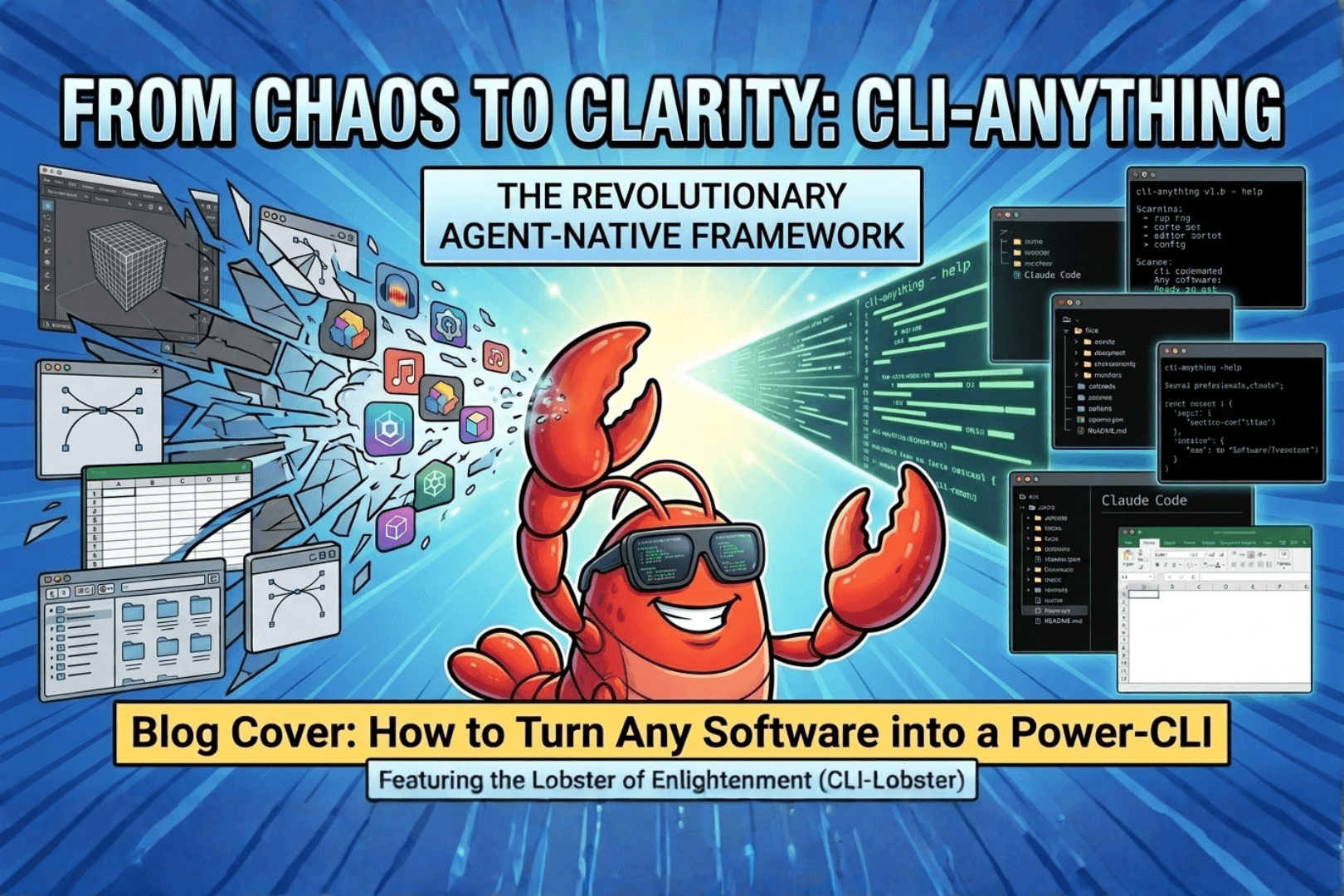
CLI-Anything is an open-source project from HKUDS (Hong Kong University of Data Science) that carries a bold, almost philosophical tagline: "Today's software serves humans. Tomorrow's users will be agents." At its core, it does one deceptively simple thing — it takes any existing software (GIMP, Blender, LibreOffice, OBS Studio, Audacity, and more) and wraps it in a structured Command Line Interface (CLI), making it fully operable by AI agents with a single command.
The Problem It Solves
To understand why this repo exploded to 21K stars, you need to understand the fundamental tension between AI agents and modern GUIs.
Graphical User Interfaces were designed for human eyes and human hands. They rely on visual metaphors — ribbons, floating panels, icons — that are intuitive for people but deeply hostile to autonomous agents. When an AI agent tries to use a GUI-based app, it must: snapshot the screen → feed it into a vision model → interpret the result → click something → repeat. This is slow, brittle, and error-prone.
Asking agents to navigate GUIs designed for humans is ridiculous. —The Register
CLI-Anything sidesteps this entirely. Instead of teaching an agent to click, it gives the agent a structured, text-based command interface — the natural language of LLMs. Commands are composable, self-describing via --help flags, and output clean JSON. This is exactly how agents want to interact with software.
How It Works: The 7-Phase Pipeline
Running /cli-anything ./gimp triggers a full automated pipeline:
| Phase | What Happens |
|---|---|
| 🔍 Analyze | Scans source code, maps GUI actions to APIs |
| 📐 Design | Architects command groups, state model, output formats |
| 🔨 Implement | Builds a real Click-based CLI with REPL, JSON output, undo/redo |
| 📋 Plan Tests | Creates a TEST.md with unit + E2E test plans |
| 🧪 Write Tests | Implements a comprehensive test suite |
| 📝 Document | Updates docs with test results |
| 📦 Publish | Creates setup.py, installs CLI to PATH |
This is not a toy wrapper. It generates production-grade CLIs with 1,298 passing tests across 8 real applications, including dual interaction modes: a stateful REPL for interactive sessions and subcommand mode for scripting pipelines.
Why It's So Meaningful
- It reframes the future of software interfaces. The project's thesis is that CLI is the universal interface for both humans and AI agents — structured, composable, lightweight, self-describing, and deterministic. In an age where Claude Code, Cursor, and OpenClaw run thousands of real workflows daily, this isn't a niche idea — it's infrastructure.
- It solves a real, painful problem without rebuilding everything. Rather than creating simplified clones of professional software or relying on fragile RPA-style click automation, CLI-Anything wraps the real application — preserving all its professional capabilities. You get GIMP's full power, accessible via a command line an agent can reliably call.
- It arrives at exactly the right moment. The broader AI agent ecosystem in 2026 is maturing. Coding agents genuinely work. The feedback loops are tight. CLI-Anything slots perfectly into this world: it provides the deterministic, reliable interfaces that make agents trustworthy in production environments. As one analysis notes, agents work best in "well-defined domains with clear success criteria" — and a structured CLI is precisely that.
- It's community-driven and growing fast. The CLI-Hub launched in March 2026 as a central registry where anyone can browse, install, and contribute new CLIs via a simple PR. The project supports Claude Code, OpenClaw, OpenCode, Codex, Qodercli, and more platforms — making it a genuine ecosystem, not just a one-off tool.
Summary
CLI-Anything is popular because it hits a perfect intersection: the right idea (CLI as agent interface), at the right time (the agent era), with the right execution (real pipelines, real tests, real software). It doesn't just solve a technical problem — it articulates a vision of what software should look like in a world where AI agents are first-class users.