Ideogram 4.0: The Best Open-Weight AI Image Model That's Closing the Gap on Closed Giants

Introduction: A New Era for Open-Weight Image Generation
For years, the AI image generation landscape has been a tale of two worlds — powerful closed-source models locked behind corporate APIs, and open-weight alternatives that, while flexible, consistently lagged behind in quality. That gap just got dramatically smaller. On June 3, 2026, Ideogram released Ideogram 4.0, its first-ever open-weight text-to-image model, and the AI community hasn't stopped talking about it since.
This isn't a fine-tune. It isn't a derivative. Ideogram 4.0 is a 9.3 billion parameter Diffusion Transformer trained from scratch, purpose-built to compete at the frontier of visual intelligence — and it's doing exactly that.
What Makes Ideogram 4.0 So Special?
It's Genuinely the Best Open-Weight Model Right Now
Let's start with the numbers, because they speak loudly. On the DesignArena leaderboard — a third-party image Elo ranking focused on design-oriented generation — Ideogram 4.0 ranks #1 among all open-weight models, sitting behind only closed proprietary models from OpenAI and Google. In the broader text-to-image arena, it places 9th overall and 1st in quality mode across all open-weight competitors.
The ContraLabs blind typography evaluation, judged by ten professional designers, is even more telling. Ideogram 4.0 was picked as the best model 47.9% of the time — well ahead of Gemini's Nano Banana 2 (30.0%), FLUX.2 [max] (15.5%), and Grok Imagine 1.0 (15.0%). When those same designers were asked "Would you use this in real client work?", Ideogram 4.0 scored 3.55 out of 5, significantly above all competitors.
A Groundbreaking Architecture Built From Scratch
Ideogram 4.0 is a 34-layer single-stream Diffusion Transformer (DiT) where text and image tokens share the same projections at every layer. What sets it apart architecturally is its text encoder: Qwen3-VL-8B-Instruct, a vision-language model, whose hidden states from 13 intermediate layers are concatenated along the feature dimension and fed into the DiT. This is a fundamentally different — and richer — approach to language understanding than most competing models.
The model also uses asymmetric classifier-free guidance (CFG), where the unconditional pass drops text tokens entirely rather than replacing them with padding. This speeds up sampling while allowing independent tuning of prompt adherence and image quality across the sampling trajectory.
Native 2K Resolution — No Upscaling Required
One of the most practical upgrades in Ideogram 4.0 is its ability to generate native 2K resolution images directly from inference. Most open-weight models top out at lower resolutions and rely on external upscaling pipelines to produce print-ready output. Ideogram 4.0 eliminates that bottleneck entirely, supporting resolutions from 256px to 2048px per side with flexible aspect ratios. For designers working on posters, packaging, and large-format print, this is a game-changer.
Structured JSON Prompting: Precision Like Never Before
Perhaps the most technically innovative feature of Ideogram 4.0 is its structured JSON prompting system. The model was trained exclusively on structured JSON captions — not plain text — meaning it natively understands compositional descriptions with per-element styling, bounding boxes, and color palettes.
What this unlocks in practice:
- Color palette conditioning: Specify up to 16 hex color codes per image (up to 5 per element), and the model steers the dominant color scheme directly from those values.
- Bounding-box layout control: Place any element — subjects, text, backgrounds — using normalized coordinates [y_min, x_min, y_max, x_max]. Headlines land exactly where your brief says they should.
- Typed text elements: Each text element carries both the literal string to render and a visual styling description, enabling multi-line, multi-font, multi-size in-image text in a single generation.
Plain text prompts still work beautifully. But the JSON interface moves Ideogram 4.0 from a generation experiment into a genuine production design tool.
Native Background Transparency
Ideogram 4.0 outputs images with native alpha channels, producing clean cutouts directly from inference — no separate background removal step required. For product photography, marketing assets, and e-commerce workflows, this removes a significant friction point that previously required manual masking or post-processing tools.
Best-in-Class Text Rendering
Ideogram has always led the field on in-image text rendering, and 4.0 raises the bar further. The model scores 0.97 on X-Omni English OCR accuracy and ranks #1 for open-weight models on text rendering benchmarks. Multilingual text rendering is also natively supported, making it the strongest open model for global design workflows.
How Does It Compare to Closed Models?
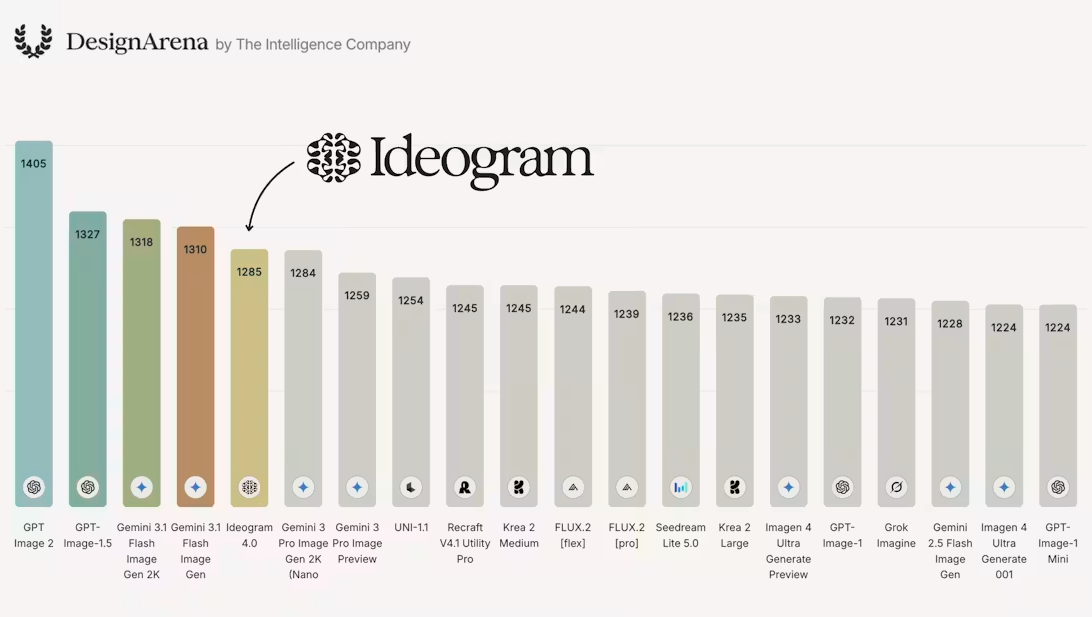
Honestly? It's closer than anything we've seen before from an open-weight model. Ideogram 4.0 outperforms Midjourney v8 in benchmark testing, lands roughly on par with FLUX.2, and trails only the top closed-source offerings from OpenAI (GPT-Image-2) and Google (Nano Banana 2).
That's the key headline: for the first time, an open-weight image model is operating in the same conversation as the best closed models in the world — not just catching up, but genuinely competing on design-critical tasks.
Who Can Use It and How?
Download & Run Locally
The weights are publicly available on Hugging Face in two quantizations:
- nf4 (fits on a single 24GB GPU, CUDA-supported via Diffusers)
- fp8 (broader hardware support)
The nf4 variant is natively supported in ComfyUI, making it immediately accessible to the local generation community.
API Access
Ideogram 4.0 is available via Ideogram's hosted API at three quality tiers:
- Turbo: $0.03/image
- Default: $0.06/image
- Quality: $0.10/image
Partner Platforms
The model is also live across a wide ecosystem of platforms including Hugging Face, fal, Runware, Magnific, Krea AI, Leonardo AI, Picsart, Cloudflare, Replicate, Gamma, Flora AI, and Kittl.
Licensing
Non-commercial use is free. Commercial deployments require a paid license scaled to usage.
Why This Matters for the Future of AI
Ideogram's philosophy is clear: openness drives innovation. As they put it, Chromium outran every closed browser engine, PyTorch became the dominant ML framework, and most of the internet runs on open-source software. The same pattern is now playing out in generative AI.
By releasing Ideogram 4.0 as open weights, Ideogram isn't just giving developers a powerful tool — they're inviting the global research community to build on, fine-tune, and push the frontier of visual intelligence forward together.
Final Verdict
Ideogram 4.0 is the most significant open-weight image model release since FLUX. It combines a novel architecture, industry-leading text rendering, native 2K output, precision JSON layout control, and transparent background generation into a single model that genuinely challenges the best closed systems in the world. If you're a developer, designer, or researcher who has been waiting for an open model powerful enough for serious production work — the wait is over.
Ready to Deploy Open-Weight AI Image Generation?
Need help evaluating Ideogram 4.0 or integrating open-weight image models into your design or product workflow? Our AI experts can guide model selection, deployment, and production pipelines.