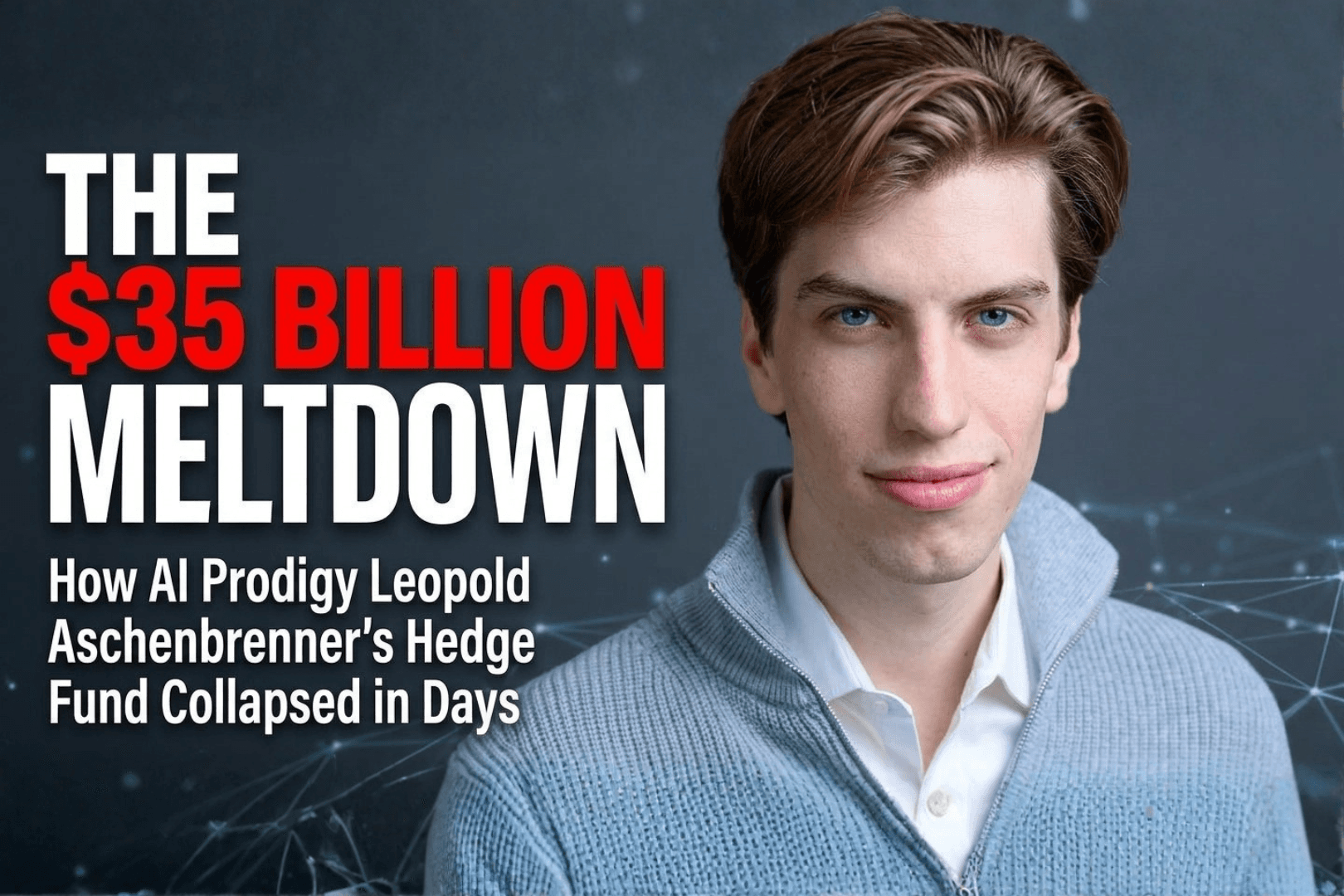
The $35 Billion Meltdown: How AI Prodigy Leopold Aschenbrenner's Hedge Fund Collapsed in Days
Introduction: The Fall of an AI Prophet
In what may be the most dramatic hedge fund collapse of 2026, Leopold Aschenbrenner—the 24-year-old former OpenAI researcher who captivated Silicon Valley with his AI manifesto—watched his $45 billion hedge fund empire crumble to just $10 billion in a matter of days. The fund, aptly named "Situational Awareness," ironically lacked awareness of its own precarious situation.
The Rise: From AI Prophet to Hedge Fund Manager
Leopold Aschenbrenner wasn't your typical hedge fund manager. At just 19, he was Columbia University's valedictorian, and by 2024, he had penned a sprawling 165-page essay titled "Situational Awareness" that became required reading in Silicon Valley tech circles. The manifesto positioned him as a visionary who could see the future of artificial superintelligence more clearly than almost anyone else.
Riding this wave of credibility, Aschenbrenner launched his hedge fund in July 2024, naming it after his viral essay. The timing couldn't have been better—or so it seemed. The AI boom was in full swing, and investors were desperate to get exposure to the next big thing. The fund's returns were nothing short of spectacular: more than 1,000% gains since inception, according to The Wall Street Journal.
By early July 2026, Situational Awareness had ballooned to $45 billion in assets under management, making it one of the fastest-growing hedge funds in history. Investors included sophisticated players like Jane Street, and the fund's quarterly filings were scrutinized by retail investors looking for hot AI stock tips.
The Strategy: Extreme Leverage on AI Infrastructure
Aschenbrenner's investment thesis was straightforward: bet big on the AI infrastructure boom, particularly semiconductor companies and AI compute providers that would power the next generation of artificial intelligence. His major holdings included SK Hynix, a leading memory chip manufacturer, and CoreWeave, a cloud computing company specializing in AI workloads.
But what made Situational Awareness different—and ultimately fatal—was its use of extreme leverage. Reports indicate the fund employed leverage ratios of up to 400%, meaning for every dollar of investor capital, the fund borrowed four more dollars to amplify its bets.
About two-thirds of the fund's holdings were in long and short positions in public equities, while the remaining third consisted of stakes in private companies, dominated by a multibillion-dollar investment in Anthropic, the AI safety company.
The Collapse: When Leverage Meets Reality
The unraveling began when semiconductor stocks started tumbling in late July 2026. As share prices of companies like SK Hynix declined, the fund's prime brokers issued margin calls—demands for additional collateral to cover the leveraged positions. With 400% leverage, even modest declines in stock prices created massive losses.
"A lot of people saw this blow-up as a matter of not if, but when," said Jerry Diao, who runs a Wall Street coaching firm. "Maybe his views on AI are correct in the long run, but in the public markets, you have to be prepared for the short-term."
Unable to meet the mounting margin calls, Aschenbrenner was forced into a fire sale. He canvassed his onetime rivals for a bailout, offering to sell more than $10 billion in leveraged positions at a steep discount.
The Rescue: Ken Griffin's Citadel Steps In
Enter Ken Griffin and his hedge fund giant, Citadel. In what some are calling the deal of the decade, Citadel acquired all of Situational Awareness's leveraged public stock positions at a significant discount. The fund, which had peaked at $45 billion earlier in the month, saw its assets plunge to around $10 billion after the forced sale.
The timing of the collapse was particularly awkward: it coincided with Aschenbrenner's wedding weekend. The hedge fund manager is engaged to Avital Balwit, chief of staff for Anthropic CEO Dario Amodei, according to Fortune.
The Criticism: Inexperience Meets Hubris
Critics were quick to point out that Aschenbrenner had zero experience managing money before launching his fund. Some noted his early work experience at FTX, where he helped now-disgraced founder Sam Bankman-Fried run a charity out of a Bahamas penthouse—a connection that raised eyebrows given FTX's spectacular collapse in 2022.
Former traders at global investment banks weren't surprised by the outcome. The combination of extreme leverage, concentrated positions, and inexperienced management created a perfect storm. In the volatile world of public markets, being right about the long-term thesis doesn't matter if you can't survive the short-term volatility.
The Aftermath: Lessons from a Modern Icarus
The collapse of Situational Awareness serves as a cautionary tale about the dangers of excessive leverage, even when the underlying investment thesis may be sound. Aschenbrenner's long-term views on AI may still prove correct, but his fund's inability to weather short-term market turbulence turned a paper loss into a permanent one.
Jim Cramer of CNBC called the forced selling "a clearing event," suggesting it might signal a bottom for the AI trade. Whether that proves true remains to be seen, but one thing is certain: Leopold Aschenbrenner's story will be studied in business schools as a case study in risk management—or the lack thereof.
The incident also raises broader questions about the AI investment boom. Are valuations sustainable? Is the infrastructure buildout happening too fast? And how many other highly leveraged funds are one market downturn away from a similar fate?
Conclusion: The Cost of Flying Too Close to the Sun
Leopold Aschenbrenner's meteoric rise and sudden fall encapsulates both the promise and peril of the AI era. His intellectual contributions to understanding artificial intelligence's trajectory remain valuable, but his attempt to translate that vision into investment returns through extreme leverage ended in disaster.
The hedge fund industry has seen many prodigies rise and fall, but few have done so as spectacularly—or as quickly—as Aschenbrenner. His story serves as a reminder that in financial markets, intelligence and vision must be tempered with experience, risk management, and humility.
As the dust settles on this $35 billion meltdown, one can't help but wonder: did Aschenbrenner's "Situational Awareness" extend to understanding the risks in his own portfolio? The answer, unfortunately, appears to be no.