NVIDIA Reportedly Agrees to Buy Hugging Face for $12.9 Billion — Why the 'GitHub of AI' Matters
Reported deal, not yet confirmed — what $12.9B would buy NVIDIA
What Was Reported
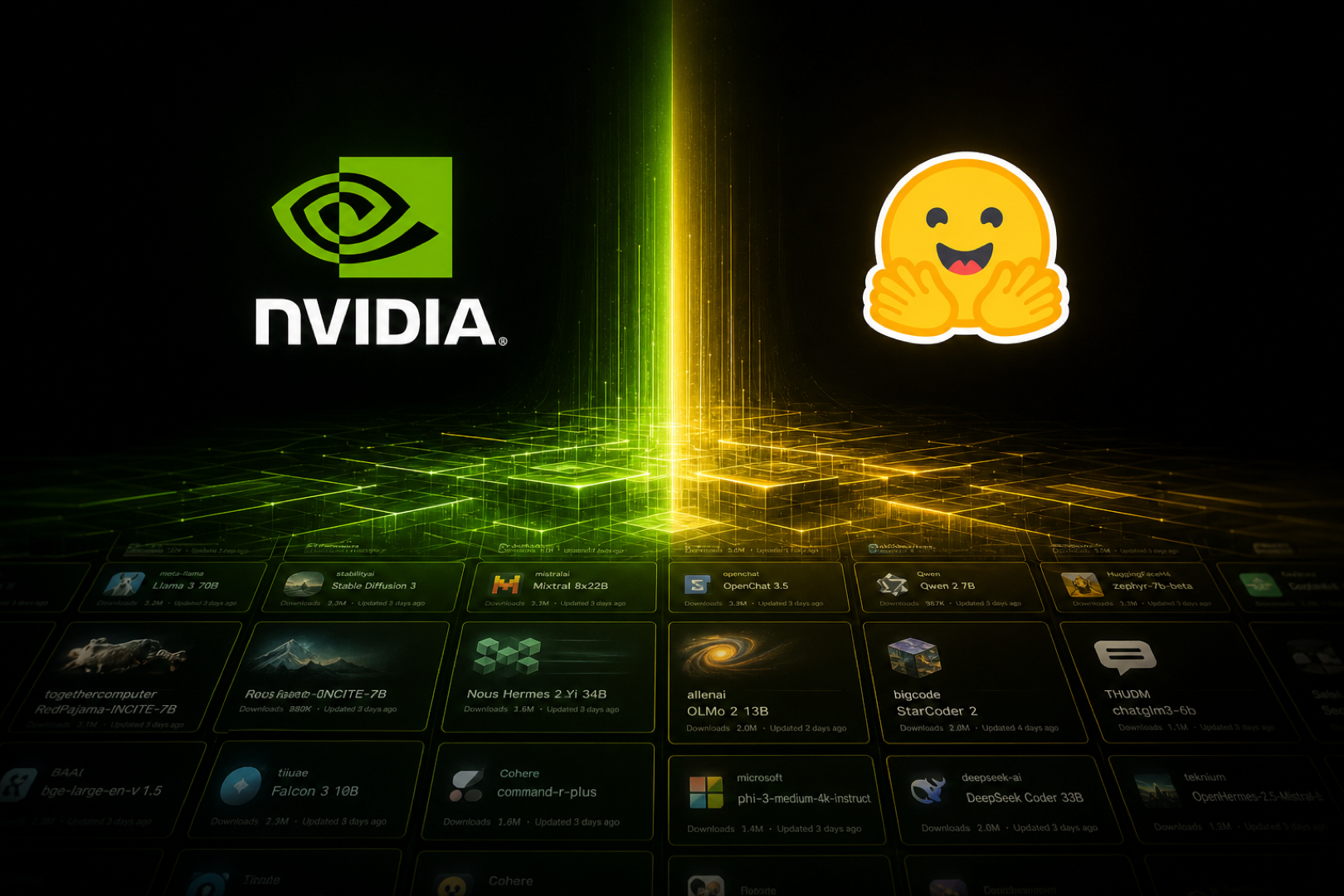
Late on Wednesday, August 26, 2026, The Information reported that NVIDIA had agreed to buy Hugging Face — the open-source AI platform often called the "GitHub of AI" — for $12.9 billion. TechCrunch, Reuters, and other outlets amplified the report. Neither NVIDIA nor Hugging Face has issued a public confirmation, and Business Insider separately noted that talks valuing the company above $13 billion might not yet have produced a signed agreement.
Treat this as a high-signal rumor with unfinished paperwork — not a closed transaction. Even so, the price, the timing, and the strategic logic are already reshaping how investors and builders think about the AI middleware layer.
Timeline: From $4.5B Unicorn to a $12.9B Headline
Hugging Face last raised about $235 million in 2023 at a $4.5 billion valuation, with Salesforce Ventures leading and backers that included Alphabet's GV, IBM Ventures, and NVIDIA itself. Late last year, according to the Financial Times, Hugging Face rejected a $500 million NVIDIA investment that would have valued the company near $7 billion — partly to avoid a single dominant investor steering the platform.
Over the weekend before the $12.9B report, Business Insider wrote that Hugging Face was exploring a sale with banker help at $13 billion or more. Days later, The Information said NVIDIA had agreed to the full acquisition. The Information also put recent annualized revenue near $150 million (up from roughly $100 million months earlier). CEO Clem Delangue told TechCrunch the company was "close to profitability." At ~80–85× that revenue run-rate, the bid only makes sense as infrastructure strategy — not a multiple of near-term earnings.
What Hugging Face Actually Is
Founded in 2016, Hugging Face is the default hub where developers publish, discover, test, and deploy open models and datasets. That makes it less a single AI product and more the distribution and collaboration layer for open-weight AI — the place where trends surface first and where millions of builders already work.
Owning that layer is different from shipping another foundation model. It means owning discovery, tooling, community trust, and a live feed of what the open ecosystem is training and shipping. In an industry where model margins compress, the pipes between models and users become the scarce asset.
NVIDIA's Strategic Playbook
Why would NVIDIA pay nearly $13 billion for a company still near profitability? Five interlocking reasons stand out across reporting from TechCrunch, The Information, and industry analysis:
- Open-model hedge: OpenAI, Google, Amazon, and Anthropic are building custom AI chips to reduce NVIDIA dependence. A thriving open-source alternative keeps more of the market on NVIDIA GPUs — which is also why NVIDIA has poured capital into its own open-weight efforts.
- Ecosystem lock-in up the stack: NVIDIA already powers much of the training and inference behind models hosted on Hugging Face. Buying the hub extends dominance from silicon into discovery, optimization, and deployment.
- Cloud re-entry: After reportedly scaling back DGX Cloud, owning Hugging Face — which already helps developers run models on rented compute — offers a ready-made path back into cloud distribution.
- Capacity safety valve: NVIDIA has large cloud commitments tied to customer deals. Unused capacity could be channeled to Hugging Face users instead of sitting idle.
- Middleware arms race: Stripe’s recent OpenRouter acquisition underscored that model-routing and hosting pipes are consolidating. Hugging Face is a larger, more community-central prize in the same category.
Jensen Huang has publicly championed open-model AI; Delangue has echoed that stance, including a joint letter urging U.S. support for open models. A full acquisition would convert that alignment from partnership rhetoric into hard ownership — something Hugging Face previously resisted when NVIDIA sought a dominant minority stake.
Why Hugging Face Might Say Yes Now
Rejecting a $7B-valued stake and entertaining a ~$13B buyout is not a contradiction. A minority check from a chip monopolist can feel like lost independence; a cash exit at nearly triple the 2023 valuation, with deeper pockets just as AI infrastructure rivals get absorbed, can feel like survival capital. For founders under community pressure to stay "neutral," selling the whole company can also be cleaner than living with one oversized board influence.
Risks: Neutrality, Antitrust, and Trust
The open-source community will ask whether Hugging Face remains a vendor-neutral town square or becomes an NVIDIA showroom. Rival chipmakers (AMD, Intel, and custom-silicon labs) may push regulators or customers if access feels tilted. Antitrust scrutiny is plausible given NVIDIA’s AI-hardware share. Talent and brand risk matter too: if developers migrate to alternative hubs, the strategic premium collapses.
Those risks do not cancel the logic of the bid — they define the conditions under which the deal either compounds NVIDIA’s moat or backfires into community backlash.
What to Watch Next
- Official statements from NVIDIA and Hugging Face — price, timing, and structure
- Any public commitment to keep hosting vendor-neutral and open-source accessible
- Regulatory signals in the U.S. and elsewhere on AI-platform consolidation
- Community reaction: model migration, fork talk, or enterprise policy changes
Bottom Line for Builders and Investors
If confirmed, a NVIDIA–Hugging Face deal would be less about buying revenue and more about buying the map of open AI: who trains what, which models win, and where compute demand flows next. It would push NVIDIA deeper into software distribution while hedging closed labs’ custom-chip strategies — at a valuation that only works if the hub stays central.
Until both companies speak, the story remains a reported agreement. The strategic thesis, however, is already clear: in the AI stack, controlling the pipes may matter as much as shipping the chips.
Sources
Reporting synthesized from The Information (via TechCrunch and Reuters pickups), Business Insider on sale talks, Financial Times on the earlier rejected NVIDIA stake, and related industry coverage as of late August 2026.
Stay in the loop
Keep up to date with the latest news and updates