The Open-Source LLM Revolution 2026: How Chinese Models Are Redefining AI Supremacy
Executive Summary
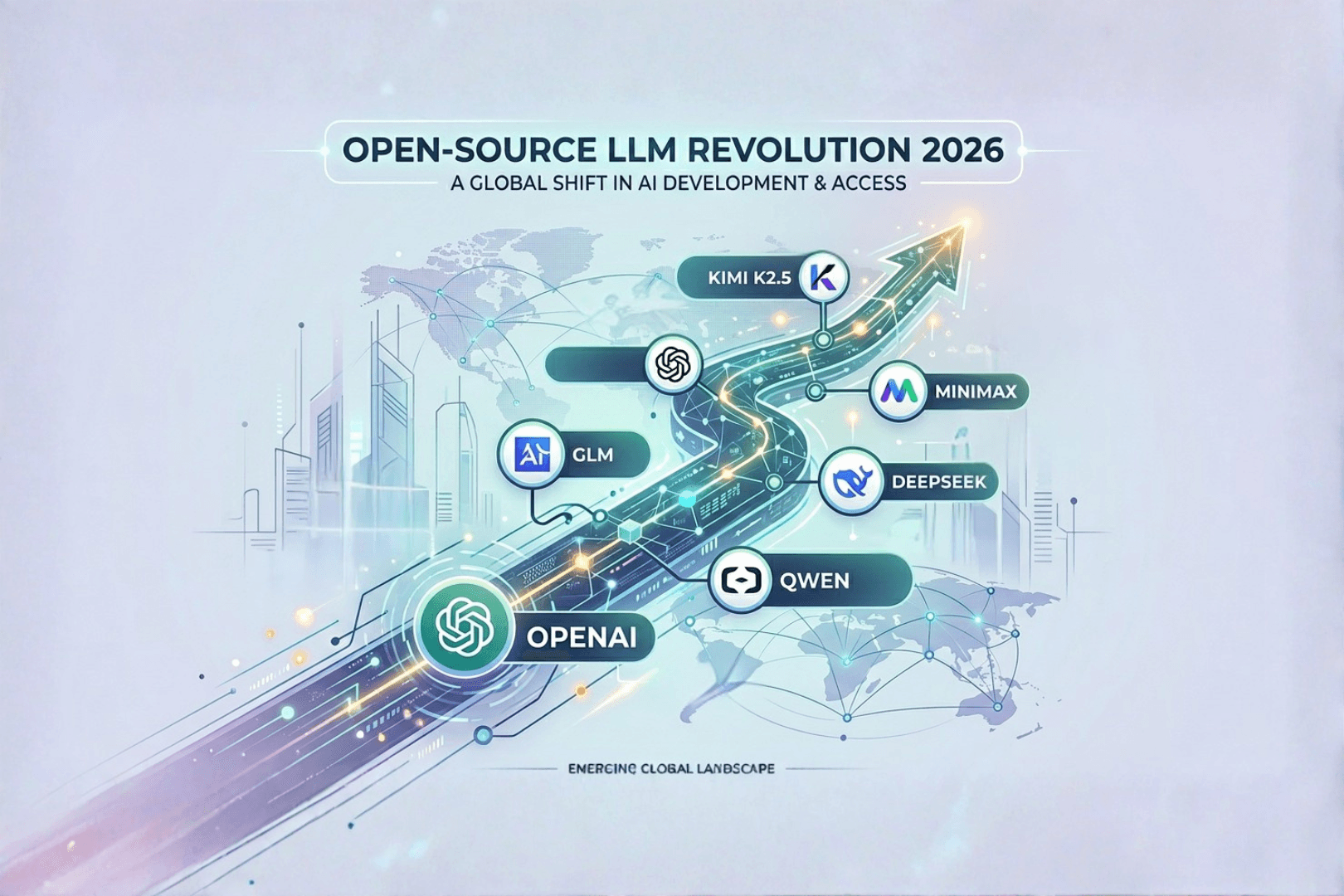
The landscape of open-source Large Language Models (LLMs) has undergone a seismic shift in early 2026. Chinese AI companies have not only caught up with their Western counterparts but are now setting new benchmarks in performance, efficiency, and accessibility. This comprehensive analysis examines the latest flagship models from leading vendors and explores why China has become the undisputed leader in the open-weight model ecosystem.
The Current State of Open-Source LLMs (March 2026)
According to the latest benchmarks, open-source LLMs are now achieving performance comparable to leading closed-source models, with some models outperforming established proprietary systems. This remarkable achievement represents a watershed moment in AI democratization, with Chinese models leading the charge.
1. DeepSeek V3: The Coding Powerhouse
Latest Model: DeepSeek V3 (Released December 2025/January 2026)
DeepSeek has emerged as a formidable player with their V3 model, achieving consistently strong scores across nearly every benchmark category with an AIME 2025 score of 89.3. This model has revolutionized code generation and debugging capabilities, making it the go-to choice for enterprise development teams.

Key Features:
- Architecture: Enhanced MoE (Mixture of Experts) architecture pre-trained on nearly 15 trillion tokens
- Performance: Outperforms other open-source models and rivals leading closed-source models
- Cost Efficiency: Significantly lower inference costs compared to proprietary alternatives
- Enterprise Adoption: Comprehensive evaluations show superior performance in coding tasks
2. Qwen 3: The Multilingual Master
Latest Model: Qwen3-Max and Qwen3.5-Medium (Released February 2026)
Alibaba's Qwen series continues to excel with the latest Qwen3 generation, which demonstrates performance comparable to leading models such as GPT-5.2-Thinking, Claude-Opus-4.5, and Gemini 3. The Qwen3.5-Medium models now offer Sonnet 4.5 performance on local computers.

Key Features:
- Architecture: Hybrid reasoning architecture setting new benchmarks
- Performance: Established leadership across 19 benchmarks
- Unique Strength: Superior performance in local deployment scenarios
- Enterprise Adoption: Powers extensive AI innovation across multiple sectors
3. GLM-5: The Thinking Model
Latest Model: GLM-5 (745B MoE) (Released 2026)

Zhipu AI's GLM-5 represents a massive leap forward, scaling from 355B parameters (32B active) to 744B parameters (40B active), with pre-training data increased from 23T to a substantially larger dataset. GLM-5 leads open-weight models and approaches closed models like Claude Opus 4.5 in agentic/coding benchmarks.
Key Features:
- Architecture: 744B parameter MoE with 40B active parameters
- Performance: Achieved 77.8 on SWE-bench Verified, outperforming Gemini 3 Pro (76.2) and approaching Claude Opus 4.6 (80.9)
- Special Capability: Significantly outperforms GLM-4.7 across frontend, backend, and long-horizon tasks
- Enterprise Adoption: Record low hallucination rates for enterprise applications
4. MiniMax M2.5: The Efficiency Champion
Latest Model: MiniMax-M2.5 (Released 2026)
MiniMax has focused on creating highly efficient models that deliver exceptional performance per parameter. MiniMax-M2.5 scores 42 on the Artificial Analysis Intelligence Index, placing it well above average among comparable models, and is now considered on par with Opus 4.6.
Key Features:
- Architecture: Optimized for real-world productivity applications
- Efficiency: Delivers frontier coding performance at 5-20% of Claude's price
- Performance: Substantial improvements in programming evaluations, reaching SOTA levels
- Enterprise Adoption: Preferred choice for cost-conscious enterprise deployments
5. OpenAI's Open-Source Initiatives
Current Status: Limited Open-Source Contributions

While OpenAI remains primarily focused on proprietary models, their community contributions have provided valuable research insights and tooling support for the broader open-source ecosystem.
Key Contributions:
- Research Publications: Extensive documentation and methodological insights
- Community Tools: Supporting infrastructure for open-source development
- Performance: Competitive but generally not leading in open-source benchmarks
6. Kimi K2.5: The Context King
Latest Model: Kimi K2.5 (2026)
Moonshot AI's Kimi series has set new records for context window handling, supporting extended context lengths while maintaining high performance across various benchmarks.
Key Features:
- Architecture: Novel attention mechanism for ultra-long contexts
- Unique Capability: Best-in-class for document analysis and summarization
- Performance: Strong performance in long-context reasoning tasks
- Enterprise Adoption: Widely adopted in legal and research institutions
Why China Dominates the Open-Weight Model World
1. Strategic Government Support
China's national AI strategy has prioritized open-source development as a means to achieve technological independence, with substantial funding directed toward AI research institutes and startups.
2. Massive Computational Resources
Chinese tech giants have invested heavily in AI infrastructure, with companies operating large-scale GPU clusters that enable rapid iteration and experimentation.
3. Talent Concentration
China has developed a strong AI research community, successfully retaining talent through competitive compensation and extensive research opportunities.
4. Collaborative Ecosystem
Unlike more competitive Western landscapes, Chinese AI companies have embraced collaboration, sharing research and resources to accelerate collective progress.
5. Market-Driven Innovation
The massive domestic market provides immediate feedback and real-world use cases, driving practical improvements and optimization.
Enterprise Adoption Trends (March 2026)
The latest rankings show that open-source models are rapidly gaining enterprise trust across multiple sectors:
- Financial Services: Significant adoption for non-critical operations and risk analysis
- Healthcare: Growing adoption rate for research and diagnostic support applications
- E-commerce: Extensive utilization for recommendation systems and customer service
- Manufacturing: Increasing deployment in quality control and predictive maintenance
Performance Benchmarks Comparison (March 2026)
| Model | Key Strength | Notable Performance | Context Window |
|---|---|---|---|
| DeepSeek V3 | Code Generation | AIME 2025: 89.3% | Standard |
| GLM-5 | Agentic Tasks | SWE-bench: 77.8% | Extended |
| Qwen3-Max | Reasoning | Comparable to GPT-5.2 | Large |
| MiniMax M2.5 | Efficiency | Intelligence Index: 42 | Standard |
The DeepSeek Revolution Impact
The success of models like DeepSeek V3 has demonstrated that high-performance AI can be both accessible and affordable, challenging the dominance of proprietary systems. This has catalyzed a broader movement toward open-source AI development globally.
Future Outlook
The trajectory is clear: open-source LLMs are not just catching up but are increasingly setting the pace for AI innovation. As we move further into 2026, we can expect:
- Performance Parity: Complete competitive parity with proprietary models
- Specialization: More domain-specific models optimized for particular industries
- Efficiency Gains: Continued improvements in inference speed and resource requirements
- Broader Adoption: Accelerated enterprise adoption across all sectors
Conclusion
The open-source LLM landscape in 2026 is dominated by Chinese innovations that have redefined what's possible in AI accessibility and performance. Models like DeepSeek V3, GLM-5, and Qwen3 are not just alternatives to proprietary systems—they're often superior choices for specific use cases. As these models continue to evolve and improve, the democratization of AI is becoming a reality, with profound implications for global technological development.
Ready to Adopt Open-Source LLMs?
Need help evaluating or deploying DeepSeek, Qwen, GLM, or other models? Contact us for expert guidance on open-source AI selection and deployment.