OpenAI's Chip "Employee #2" Leaves for Anthropic — What This Means for the AI Hardware Race
Category: AI Industry | Tags: OpenAI, Anthropic, Clive Chan, AI Chips, Talent, Semiconductors, Broadcom, 2026
Introduction
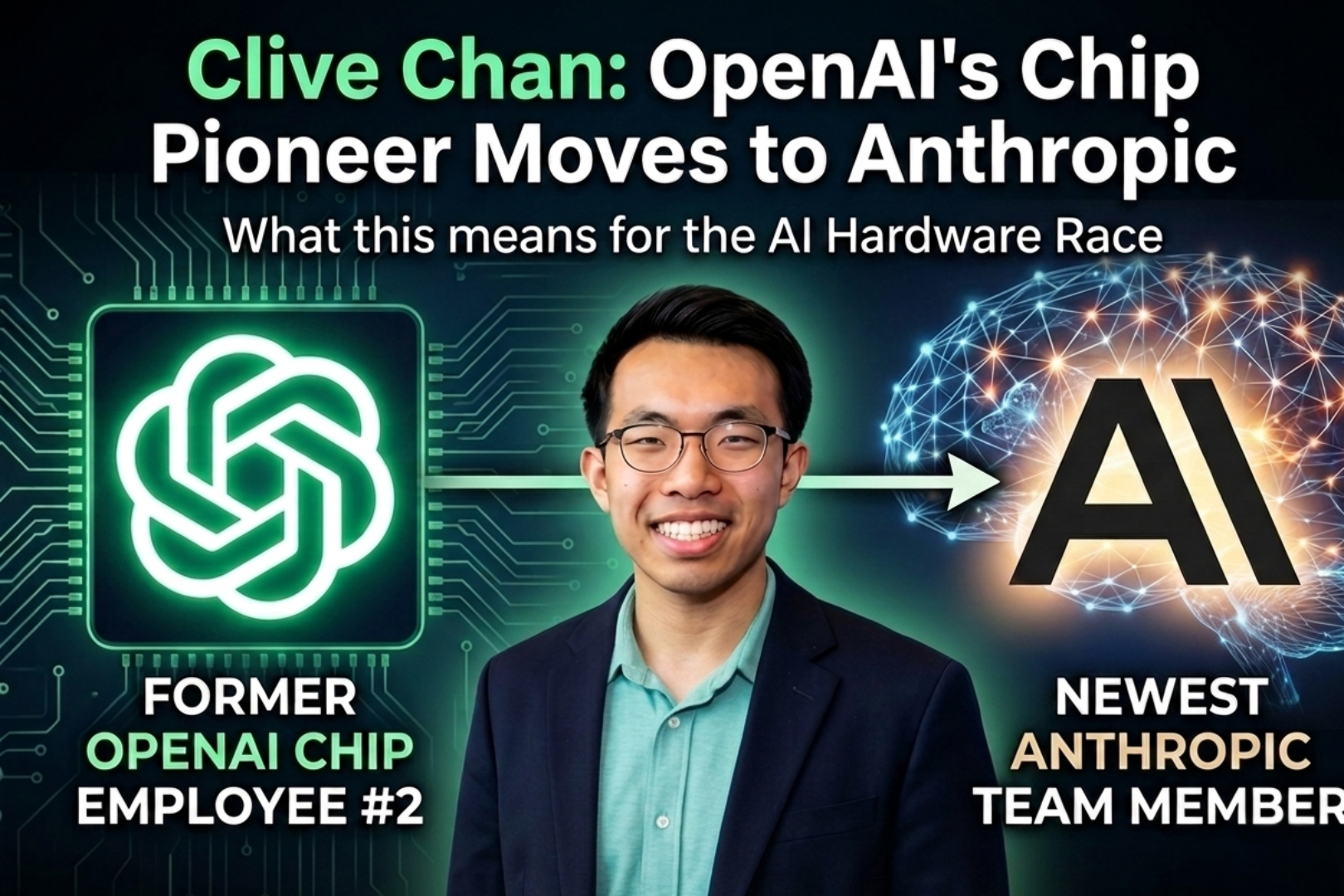
The artificial intelligence industry is no stranger to high-profile talent moves, but the latest departure from OpenAI is turning heads across Silicon Valley and beyond. Clive Chan — widely regarded as the second employee ever recruited to OpenAI's in-house chip development program — has officially announced his resignation from OpenAI and his move to Anthropic.
This is not just another job change. It is a signal of shifting tides in the race to build the world's most powerful AI hardware infrastructure.
Who Is Clive Chan?
Clive Chan is a hardware and AI infrastructure engineer with an impressive pedigree. A 2021 graduate of the University of Waterloo in Canada, Chan built his career across some of the most prestigious technology and aerospace organizations in the world — including Google, SpaceX, Tesla, and OpenAI.
During his time at Google, he focused on machine learning infrastructure. At SpaceX, he contributed to liquid rocket engine projects. After graduation, he joined Tesla's Autopilot deep-learning infrastructure team, where he spent nearly three years as a Software Engineer and then Senior Software Engineer, working on GPU optimization, cluster scheduling, data-center software, and training infrastructure.
In January 2024, Chan officially joined OpenAI as part of its hardware team — becoming the second employee recruited to the company's self-developed chip initiative. His responsibilities included matrix multiplication (Matmul), performance analysis (Roofline Analysis), and broader hardware architecture work.
The Announcement: "Climbing a New Mountain From the Bottom"
On June 7, 2026, Clive Chan posted on X (formerly Twitter), announcing his departure from OpenAI and his first week at Anthropic.
In his statement, he reflected warmly on his time at OpenAI, praising the chip team as having "an incredibly high density of talent" and calling it one of the best chip design teams in the world.
Yet despite his admiration for the team, Chan revealed he had long been driven by an irresistible impulse — "to climb a new mountain from the bottom again."
He cited Anthropic's talent, values, and ambition as the key factors that drew him in, and noted that within just a few days of joining, he had already felt an "extremely intense work rhythm." His closing words were simple and telling: "It's time to build."
What About OpenAI's Chip Project?
Chan's departure naturally sparked questions about the status of OpenAI's self-developed chip program. When pressed by followers on X, he confirmed he could not disclose details beyond what OpenAI has already made public — but he did point to the OpenAI–Broadcom cooperation blog published in October 2025 as a key reference point.
According to that announcement, OpenAI and Broadcom are jointly building a 10GW-scale AI accelerator system. OpenAI is responsible for chip and system design, while Broadcom handles accelerator and network system development and deployment. The first batch of racks is planned for delivery in the second half of 2026, with the full project expected to run through the end of 2029. This was the first time OpenAI officially disclosed a concrete timeline for its custom chip ambitions. Chan added that the public "will soon see more relevant progress."
Anthropic: The New Magnet for AI Talent
Chan's move is part of a broader and accelerating pattern. Anthropic has rapidly become the top destination for talent leaving OpenAI. Just weeks before Chan's announcement, Andrej Karpathy — a co-founder of OpenAI and one of the most respected AI researchers in the world — announced he was also joining Anthropic, sending shockwaves through the industry.
The timing is also notable from a financial perspective. On June 1, 2026, Anthropic closed a Series H funding round of up to $65 billion USD, pushing its post-investment valuation to approximately $965 billion USD — just a hair's breadth away from the trillion-dollar club.
This staggering valuation has not gone unnoticed. Netizens were quick to point out the irony in Chan's "starting from the bottom" framing — joining a company worth nearly a trillion dollars is hardly a humble beginning. One commenter drew a football analogy: "It's like leaving Real Madrid to join Barcelona." Another quipped: "Every time I see 'I've decided to leave OpenAI', I know the next sentence will mention Anthropic."
Why This Matters: The Hardware War Is Heating Up
The significance of this talent move extends well beyond personal career choices. As AI companies race to reduce their dependence on NVIDIA and build proprietary silicon, chip engineering talent has become one of the most strategically valuable resources in the industry.
OpenAI is betting heavily on custom silicon to power its future AGI ambitions. Anthropic, meanwhile, is aggressively building out its own infrastructure capabilities. The fact that a founding-era chip engineer has crossed the aisle suggests Anthropic is not just competing on models and products — it is now competing at the deepest levels of the AI hardware stack.
For the broader industry, the talent flow between these two companies is a microcosm of a larger battle: who will control the compute that powers the next generation of artificial intelligence?
Conclusion
Clive Chan's move from OpenAI to Anthropic is more than a career pivot — it is a statement about where the most ambitious engineers believe the future is being built. With Anthropic's near-trillion-dollar valuation, its aggressive hiring spree, and its growing hardware ambitions, the company is positioning itself as a serious long-term rival to OpenAI — not just in AI models, but in the foundational infrastructure that makes those models possible.
The mountain is being climbed. And the race has never been more intense.
Stay in the loop
Keep up to date with the latest news and updates