What is KV Cache? A Beginner's Guide to Faster AI Inference
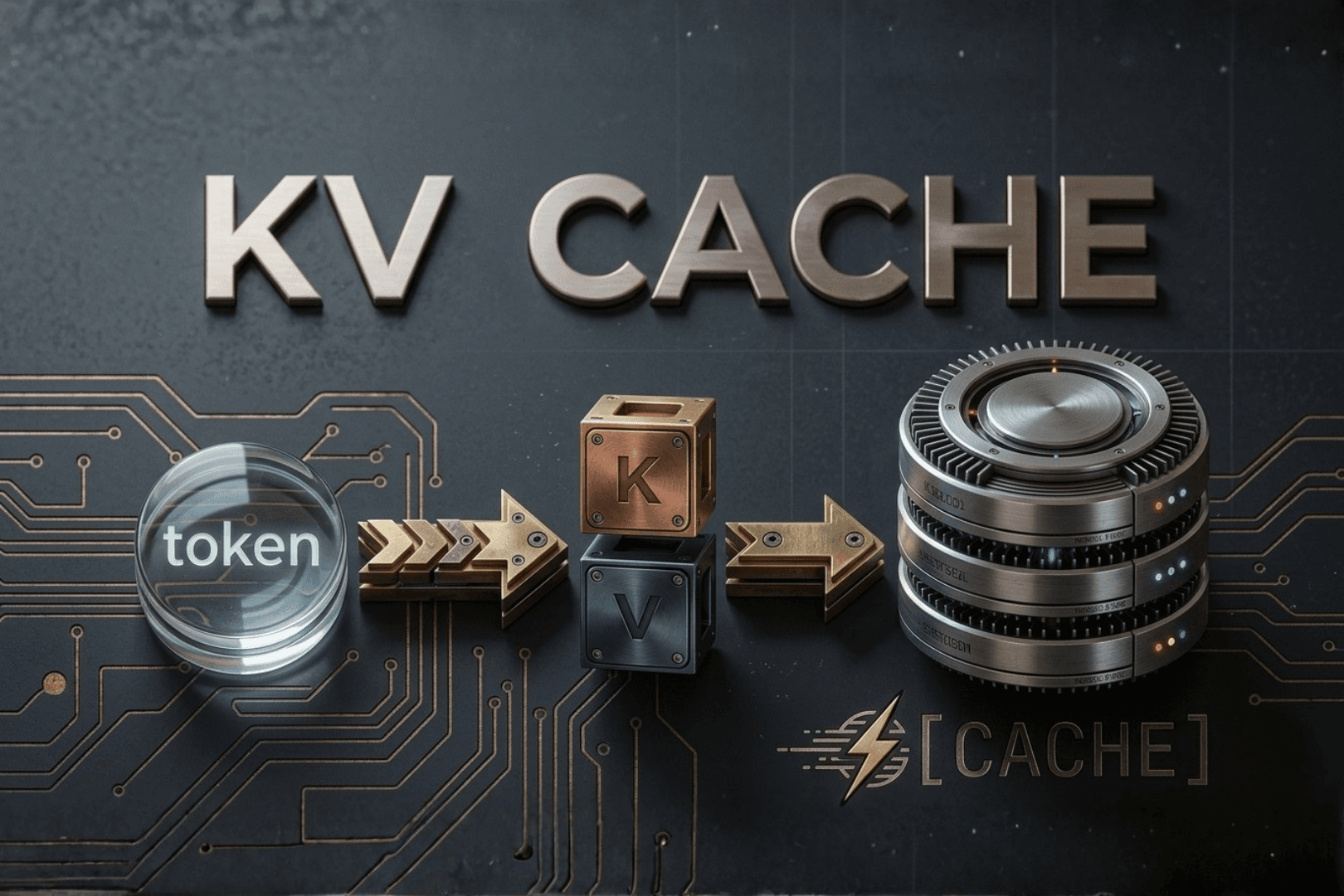
If you've ever used ChatGPT, Claude, or any AI chatbot, you've probably noticed that it responds pretty quickly — even when writing out long, detailed answers. Have you ever wondered how that's possible?
One of the biggest reasons is a technique called KV Cache. It's one of those behind-the-scenes engineering tricks that most people never hear about, but without it, modern AI would be painfully slow.
In this post, we'll break it down from scratch. No PhD required.
First, Let's Talk About How AI Generates Text
Before we can understand KV Cache, we need to understand a small but important detail about how AI language models work.
Models like GPT don't write out an entire sentence all at once. Instead, they generate text one word (or token) at a time. Every single word is a separate prediction. To predict the next word, the model looks at every word that came before it.
So imagine the model is generating the sentence: "The cat sat on the mat."
- To generate "cat" → it looks at "The"
- To generate "sat" → it looks at "The cat"
- To generate "on" → it looks at "The cat sat"
- To generate "the" → it looks at "The cat sat on"
- ...and so on
This means the same early words — like "The" and "cat" — get processed over and over again with every new word. By the time the model is generating the 100th word, it has re-read and re-processed the first word nearly 100 times.
That's a lot of wasted effort.
The Math Behind the Problem
Here's why this gets serious at scale.
To generate a response that is 100 words long, the total number of processing steps looks like this:
1 + 2 + 3 + ... + 100 = 5,050 steps
For 1,000 words? That's over 500,000 steps. The work grows quadratically — meaning it doesn't just double when you double the length, it multiplies much faster than that.
For a model handling thousands of users simultaneously, each generating long responses, this becomes a massive computational bottleneck. Something had to be done.
Enter KV Cache
To understand KV Cache, we need to peek inside the attention mechanism — the core engine of modern AI models.
When a Transformer model processes a token, it creates three things for that token:
- Query (Q): What this token is looking for — what context does it need?
- Key (K): What this token offers — how should other tokens identify it?
- Value (V): The actual content this token contributes to the output
The model uses these Q, K, and V vectors to figure out which words are most relevant to each other. For example, in the sentence "The animal didn't cross the street because it was too tired," the model uses these vectors to figure that "it" refers to "animal," not "street."
Here's the crucial insight: once a token has been processed, its Key and Value vectors never change. They are fixed. They don't depend on what comes next in the sentence.
Yet in the naive approach, the model throws away these vectors after each step and recalculates them from scratch the next time around. That's like solving the same math problem ten times and throwing away your work sheet each time instead of just keeping it.
KV Cache simply says: don't throw it away. Store it. Reuse it.
How KV Cache Works, Step by Step
Here's what actually happens when KV Cache is enabled:
Step 1 — Prefill Phase
When you send a prompt to the model (say, "Explain gravity to me"), the model processes every word in your prompt and computes the Q, K, and V vectors for each one. The K and V vectors are saved into a dedicated memory space — the KV Cache.
Step 2 — Decode Phase
Now the model starts generating its response, one token at a time. For each new token:
- It computes only the Query vector for that new token
- It pulls the Keys and Values for all previous tokens straight from the cache — no recalculation needed
- It generates the next word using this information
- It adds the new token's own K and V to the cache for future steps
Step 3 — Repeat
This continues until the response is complete. The cache grows with each new token, but the heavy lifting of recomputing old tokens is completely eliminated.
A simple illustration:
Token 1 generated → Cache: [K1, V1]
Token 2 generated → Cache: [K1, K2], [V1, V2]
Token 3 generated → Cache: [K1, K2, K3], [V1, V2, V3]
...
Each step only does a small amount of new work, instead of redoing everything from scratch.
What's the Real-World Impact?
The difference is significant. With KV Cache:
- Speed: Inference can be 3 to 5 times faster, depending on the model and hardware
- Latency: Responses feel snappier, especially for long outputs
- Scalability: Servers can handle more users simultaneously with the same hardware
This is why every major AI inference framework — vLLM, TensorRT-LLM, HuggingFace TGI — implements KV Cache as a core feature. It's not optional. It's essential.
The Trade-Off: It Costs Memory
Nothing in engineering is free. KV Cache trades computation for memory.
Every token's K and V vectors need to be stored in GPU memory (VRAM) for every layer of the model. For a large model processing a long conversation, this cache can easily consume several gigabytes of VRAM.
This creates real constraints:
- Longer conversations = larger cache = more memory needed
- Bigger models = more layers = more memory per token
- More users at once = more caches running in parallel = even more memory
AI engineers have to carefully balance how long a context window they support, how many users they serve at once, and how much GPU memory they have available. It's one of the central challenges of running LLMs in production.
Beyond the Basics: How the Industry Is Pushing Further
Researchers haven't stopped at basic KV Cache. Here are some advanced techniques built on top of it:
- Multi-Query Attention (MQA) — Instead of storing separate K and V vectors for every attention head, all heads share the same K and V. This dramatically cuts cache size with minimal quality loss.
- Grouped-Query Attention (GQA) — A middle ground between full caching and MQA. Used in models like LLaMA 3 and Mistral, it groups attention heads to share K/V vectors in clusters.
- Sliding Window Attention — Rather than caching every token forever, only the most recent N tokens are kept in the cache. This caps memory usage for very long sequences.
- PagedAttention — Used in vLLM, this technique manages the KV Cache like an operating system manages virtual memory — allocating and freeing memory in pages to dramatically improve GPU utilization and throughput.
Putting It All Together
Let's recap what we've learned:
- LLMs generate text one token at a time, and each new token requires looking at all previous tokens
- Without optimization, this creates quadratic computational complexity — it gets very slow, very fast
- The attention mechanism computes Query, Key, and Value vectors for each token
- Key and Value vectors never change once computed — so there's no reason to recompute them
- KV Cache stores these vectors in memory and reuses them, cutting out enormous amounts of redundant work
- The result is 3–5× faster inference, at the cost of higher GPU memory usage
- Advanced techniques like GQA and PagedAttention push the efficiency even further
KV Cache is one of those ideas that sounds almost too simple — just save your work and reuse it. But the impact on real-world AI performance is enormous. Next time you get a fast response from an AI, you'll know one of the key reasons why.
Further Reading
- Hugging Face Blog — KV Caching Explained
- Sebastian Raschka — Coding the KV Cache from Scratch
- Alain Airom — Demystifying the Key-Value Cache
- Machine Learning Mastery — KV Caching: A Guide for Developers
Stay in the loop
Keep up to date with the latest news and updates