Zeabur Environment Variable Leak: Stolen API Keys Drain Claude & OpenRouter Balances
Zeabur · API Security · PaaS · Cybersecurity
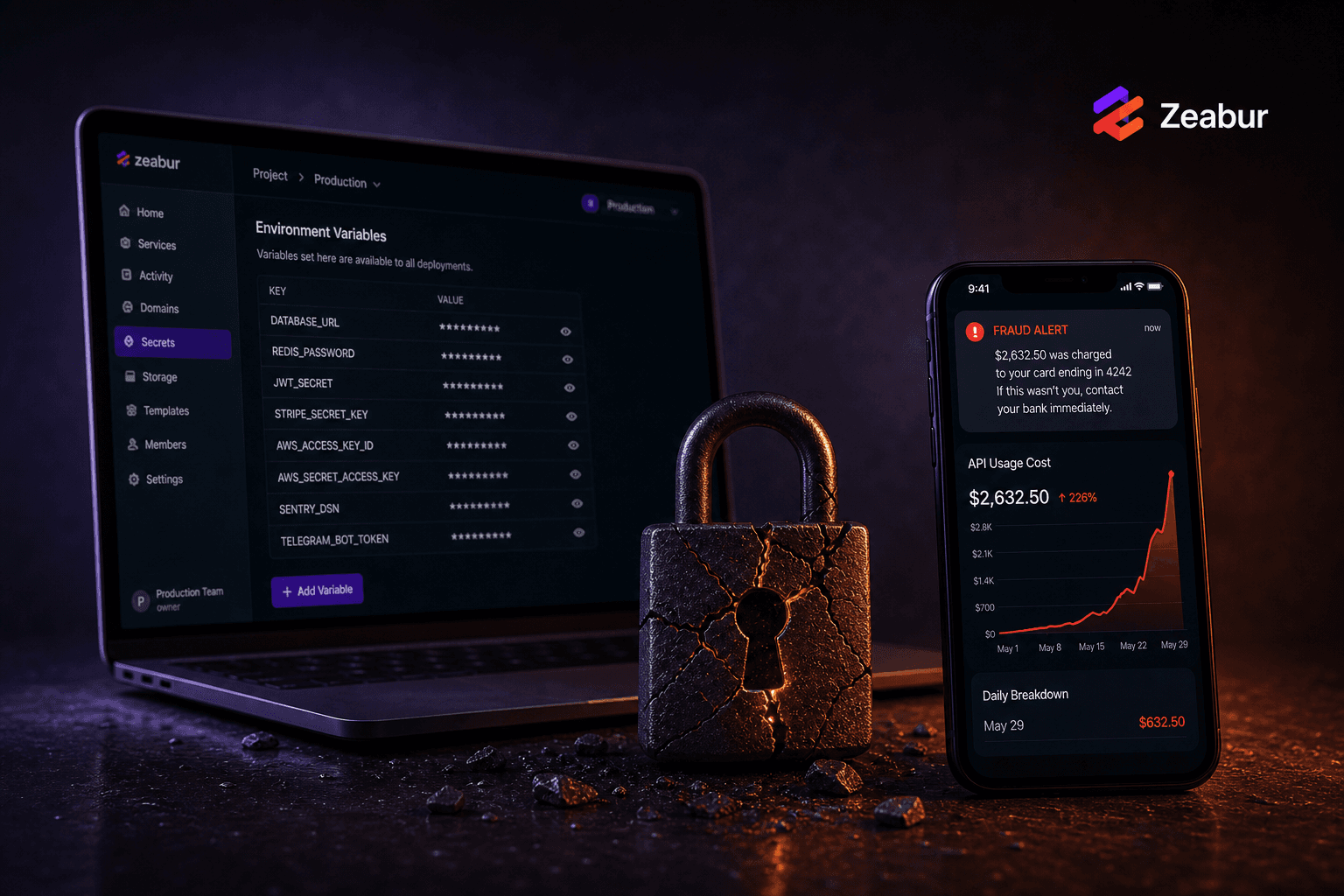
For many Zeabur users, the first sign of trouble was not an email — it was a credit-card decline, an OpenRouter auto-recharge alert, or an Anthropic usage spike that looked nothing like normal traffic. Only later did the Taiwan-founded deployment platform confirm what developers had already started to suspect: an internal service credential was misused to query a database holding project environment variables, potentially exposing API keys, access tokens, and other secrets customers had stored in Zeabur's Variables panel.
If you deploy on Zeabur and store LLM or payment keys there, treat every credential in that panel as compromised until you rotate it.
What Zeabur Confirmed
On August 27, 2026, Zeabur's monitoring detected unauthorized use of an internal service credential, according to a user notification email sent the following day (subject line: urgent action required). The company said attackers used that credential to connect to a database and run queries against stored project environment variables.
Zeabur stated that some variable data — including user-configured API keys, access tokens, and third-party credentials — may have been retrieved. It did not report evidence that Zeabur account passwords, personal profile data, server logs, other project files, or payment card numbers were accessed.
On status.zeabur.com, the incident is listed as "Unauthorized Access to Project Environment Variable Data." As of the latest update, Zeabur also suspended AI Hub services as a precaution while investigating suspicious LiteLLM-related activity. A full post-incident report was promised but had not been published at the time of writing.
Note: This is separate from an earlier Zeabur CLI issue (fixed in April 2026) where variable list could print plaintext secrets to stdout. The August incident involved backend database access via a stolen internal credential — a different attack path entirely.
Timeline: Bills Before the Bulletin
| Time (HKT) | Event | Source |
|---|---|---|
| Aug 27 | Monitoring detects unauthorized internal credential use; credential revoked same day | Zeabur user email |
| Aug 28, early morning | Users report credit-card blocks and sudden API billing spikes | Community reports (Threads) |
| Aug 28, afternoon | Support reportedly tells at least one reporter no abnormal access in prior 48 hours | Community reports (Threads) |
| Aug 28, ~4:55 PM | Zeabur sends "immediate action" email to affected users | Zeabur user email |
| Aug 28, ~6:11 PM | linux.do thread reposts official notice; more users report drained balances | Community reports |
| Aug 28, evening | V2EX users describe OpenRouter balances wiped; logs show Claude Opus usage | Community reports (V2EX) |
| Aug 28, ~6:53 PM UTC | Status page updated; AI Hub suspended pending LiteLLM investigation | status.zeabur.com |
The sequence matters: several developers said they flagged abnormal usage before receiving Zeabur's formal notice — and in at least one public account, received a "no anomaly" reply from support hours earlier.
Reported User Impact (Community-Sourced)
These claims come from public posts on Threads, Discord, V2EX, and linux.do around August 28, 2026. They are user-reported, not independently verified by AlphaMatch.
| Source | Service | Reported impact |
|---|---|---|
| lidien.fu (Threads) | Anthropic | Multiple API charges; daily usage approached ~10× normal |
| dolphin_su319 (Threads) | Anthropic | Batch of unexpected API fees overnight |
| Drizzt (Discord) | xAI | Several prepaid balance charges |
| Vic Chang (Discord) | Gemini | Key-exposure notification received |
| Visoar (Discord, V2EX) | OpenRouter | Balance drained in minutes; logs show Claude Opus on leaked keys |
Visoar noted that the affected OpenRouter key was used only on a Zeabur-deployed app — a detail several reporters used to narrow the leak to platform-stored secrets rather than a public repo.
Three Gaps in the Initial Disclosure
Unknown scale
Zeabur's email did not state how many projects or users were affected. Without a count, every customer must assume their Variables panel could be in scope.
Late public status update
For much of Aug 28, the status page showed all systems operational. The incident appeared on status.zeabur.com only after community screenshots spread — meaning email recipients were the primary early warning channel.
Notification list vs. actual theft
Visoar reported receiving a warning about Stripe keys while OpenRouter was already being drained. If the email list is incomplete, rotating only named variables leaves active stolen keys in the wild.
If You Use Zeabur: Action Checklist
Zeabur's email suggested rotating variables it flagged by key type. Community reports indicate the list may not match what attackers actually used. Assume every secret ever saved in Zeabur's Variables panel is exposed.
| Action | Why do it now |
|---|---|
| Revoke and re-issue — do not only add a new key | A new key without revoking the old one leaves the stolen credential valid |
| Rotate all env vars, not just those in the email | Mismatch between notice and billing has been reported |
| Include non-AI secrets — DB passwords, OAuth tokens, webhook secrets | They lived in the same variable store |
| Audit usage from Aug 27 onward | Usage dashboards are your best self-service evidence |
| Disable auto-recharge; set hard spending caps | Auto top-ups can fund an attacker's continued inference |
| Contact your card issuer on fraud | Early dispute filing can limit liability |
| Save screenshots with timestamps | Email, usage logs, and charge times support disputes |
If you duplicated keys in both Zeabur and a Git repository, rotate both copies. Updating the platform alone leaves the repo copy live.
Platform-Managed Secrets: Who Pays the Bill?
Zeabur's pitch is convenience: skip local .env files, paste secrets into the dashboard, and let the platform inject them at deploy time. That centralization means one compromised internal credential can expose keys across many projects — not just one app.
The financial hit, however, typically lands on upstream API providers (Anthropic, OpenRouter, Google, xAI) and then on your linked payment method — not on Zeabur's platform bill. Developers who catch spikes early may stop the bleeding; those who only review monthly statements may not notice until costs have multiplied.
This pattern echoes the Vercel April 2026 breach, where OAuth supply-chain access exposed customer environment variables that were not encrypted at rest unless explicitly marked sensitive (GitGuardian analysis). Different platform, same lesson: PaaS-managed secrets are only as safe as the platform's internal access controls.
Sources
- Zeabur Status — Unauthorized Access to Project Environment Variable Data
- Zeabur docs — Setting Environment Variables
- GitGuardian — Vercel April 2026 incident (parallel context)
Stay in the loop
Keep up to date with the latest news and updates