China Just Dropped 30% Subsidies on Domestic AI Chips—Here's Why It Matters
If you've been watching the AI chip wars, buckle up. China just made a move that could fundamentally reshape the semiconductor landscape, and it's not subtle about it.
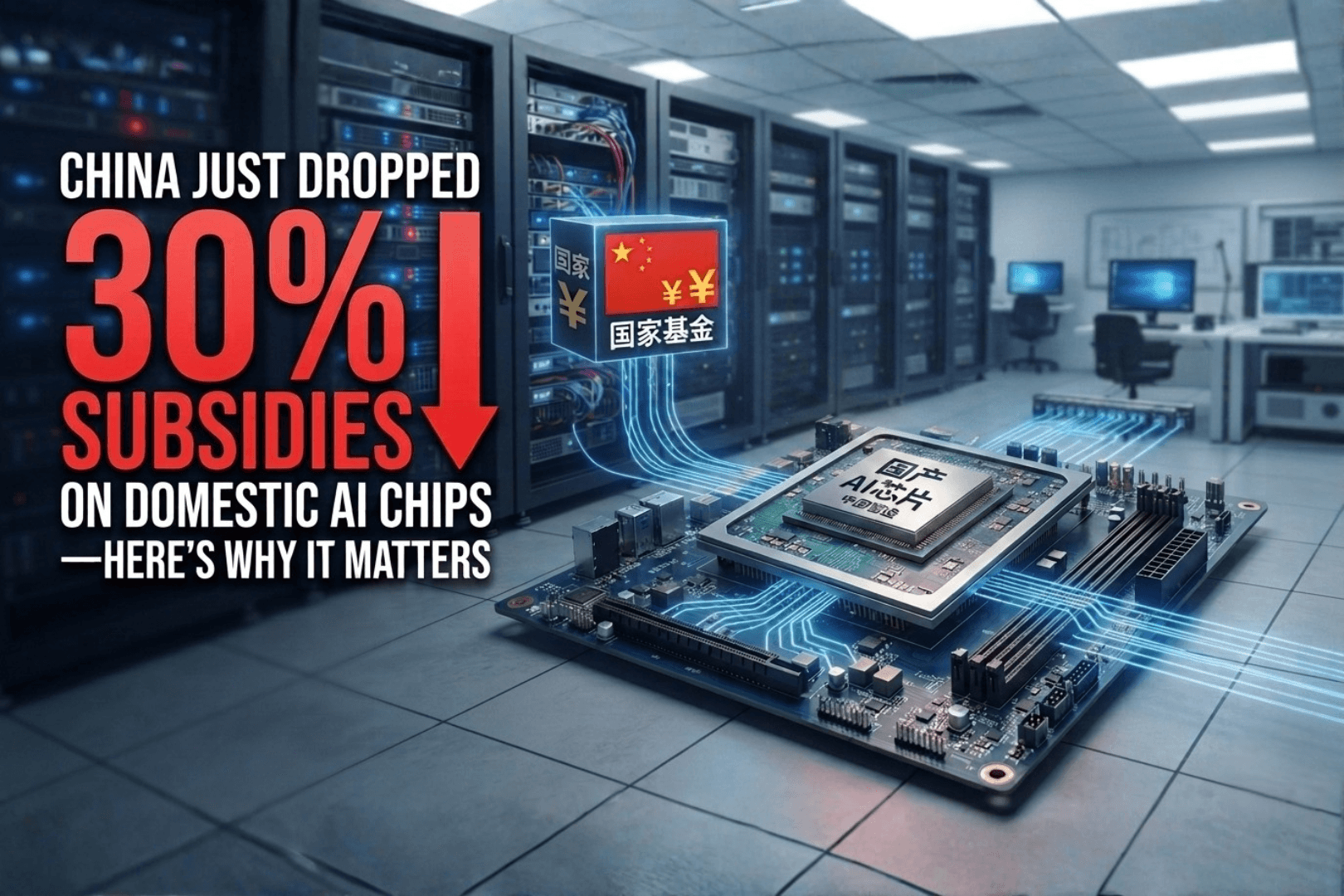
The Chinese government is now offering up to 30% subsidies for intelligent computing centers in Guizhou province that buy domestic AI chips. But that's just the opening salvo. When you stack the electricity discounts, computing vouchers, and other incentives, we're looking at a policy package that could cut operational costs by nearly half for companies willing to go all-in on Chinese chips.
Let me break down what's actually happening here—and why you should care.
The Numbers Are Wild
% Off Your Chip Purchase? Yes, Really.
Here's the deal: build an intelligent computing center in Guizhou, buy Chinese AI chips, and the government will cover up to 30% of the cost. We're talking about a 1 billion RMB project potentially getting 300 million RMB back. That's not a rounding error—that's a business model.
But Wait, There's More: 50% Electricity Subsidies
Data centers are power-hungry beasts. Electricity can make or break your margins. China's solution? Cut your power bill in half if you're using domestic chips.
The catch? If you're running NVIDIA chips, you get nothing. Zero. Zilch. The subsidy explicitly excludes foreign chip manufacturers. For qualifying centers with energy efficiency above 30%, you're looking at 0.1-0.3 RMB per kilowatt-hour in subsidies, plus up to 5 million RMB if you hit "National Green Data Center" status.
This isn't just incentivizing domestic chips—it's making foreign chips economically painful.
The "Computing Power Voucher" Sweetener
Guizhou threw in another twist: computing power vouchers worth 30% for companies training large AI models. Think of it as a discount coupon for renting compute time, except it's backed by provincial government money.
Stack all three together—30% chip subsidy, 50% electricity discount, 30% computing voucher—and you've got a cost structure that's almost impossible to compete with using foreign hardware.
Who's Winning Here?
The Obvious Winners: Chinese Chip Makers
- Huawei Ascend: Already the frontrunner in China's AI chip race, this policy is rocket fuel
- Hygon: Domestic server processors just got a lot more attractive
- Cambricon: The AI chip specialist that's been waiting for this moment
But it's not just chips. The policy covers the entire stack:
- Domestic servers
- Optical modules
- Storage equipment
China's building a complete ecosystem, not just subsidizing one component.
This Just Got Real: 10,000-Card Cluster Goes Live
Here's where policy meets reality. On July 9, 2026—literally five days ago—the Greater Bay Area fired up a 10,000+ card domestic AI computing cluster in Shaoguan. This isn't a pilot project or a proof of concept. This is production-scale infrastructure serving the Guangdong-Hong Kong-Macao region.
The phrase they're using? "Computing power autonomy." That's not accidental language.
What This Actually Means
For Chinese AI Companies
You'd be crazy not to take this deal. The economics are overwhelming. Even if domestic chips are 20-30% less performant than NVIDIA's latest (and that gap is closing), the cost savings obliterate the performance delta for most workloads.
For NVIDIA and Foreign Chip Makers
This is a market-share bloodbath in slow motion. China represents a massive chunk of global AI infrastructure spending. Being explicitly excluded from subsidies while your competitors get 30-50% discounts? That's not a competitive disadvantage—that's a market exit signal.
For the Global AI Race
China just made a massive bet that it can build a self-sufficient AI infrastructure stack. The subsidies buy time for domestic chips to improve while making them economically viable today. It's industrial policy 101, executed at scale.
The Bigger Picture
This isn't just about chips. It's about:
- Supply Chain Sovereignty: Every layer of the stack, from silicon to software, increasingly Chinese-made and Chinese-controlled.
- Market Bifurcation: We're watching the AI world split into distinct ecosystems. Chinese companies will optimize for Ascend and Hygon. Western companies will optimize for NVIDIA and AMD. Cross-compatibility will be an afterthought.
- Technology Nationalism: When subsidies are this aggressive and this explicitly tied to domestic production, we're past "industrial policy" and into "technology nationalism" territory.
What Happens Next?
Watch for:
- Other provinces copying Guizhou's playbook—this won't stay regional
- Domestic chip performance benchmarks—companies will need to prove the hardware actually works
- Foreign company responses—does NVIDIA try to partner with Chinese firms, or do they accept market loss?
- AI model architecture shifts—if Chinese chips have different strengths, expect Chinese AI models to be architected differently
Bottom Line
China just made domestic AI chips economically irresistible for Chinese companies. The 30% chip subsidy is the headline, but the real story is the full-stack approach: subsidize the hardware, discount the electricity, voucher the compute time, and build massive production clusters to prove it works.
For anyone building AI infrastructure in China, the calculus just changed. For anyone competing with Chinese AI companies, the cost structure just shifted dramatically. And for anyone watching the global technology competition, this is a clear signal: China's playing for keeps on AI self-sufficiency.
The subsidy numbers are eye-popping. But the strategic intent? That's what should really get your attention.