Why Google Stock Plunged 6%: The AI Spending Paradox That's Shaking Tech Giants
The Shocking Drop: Strong Earnings Can't Save Google
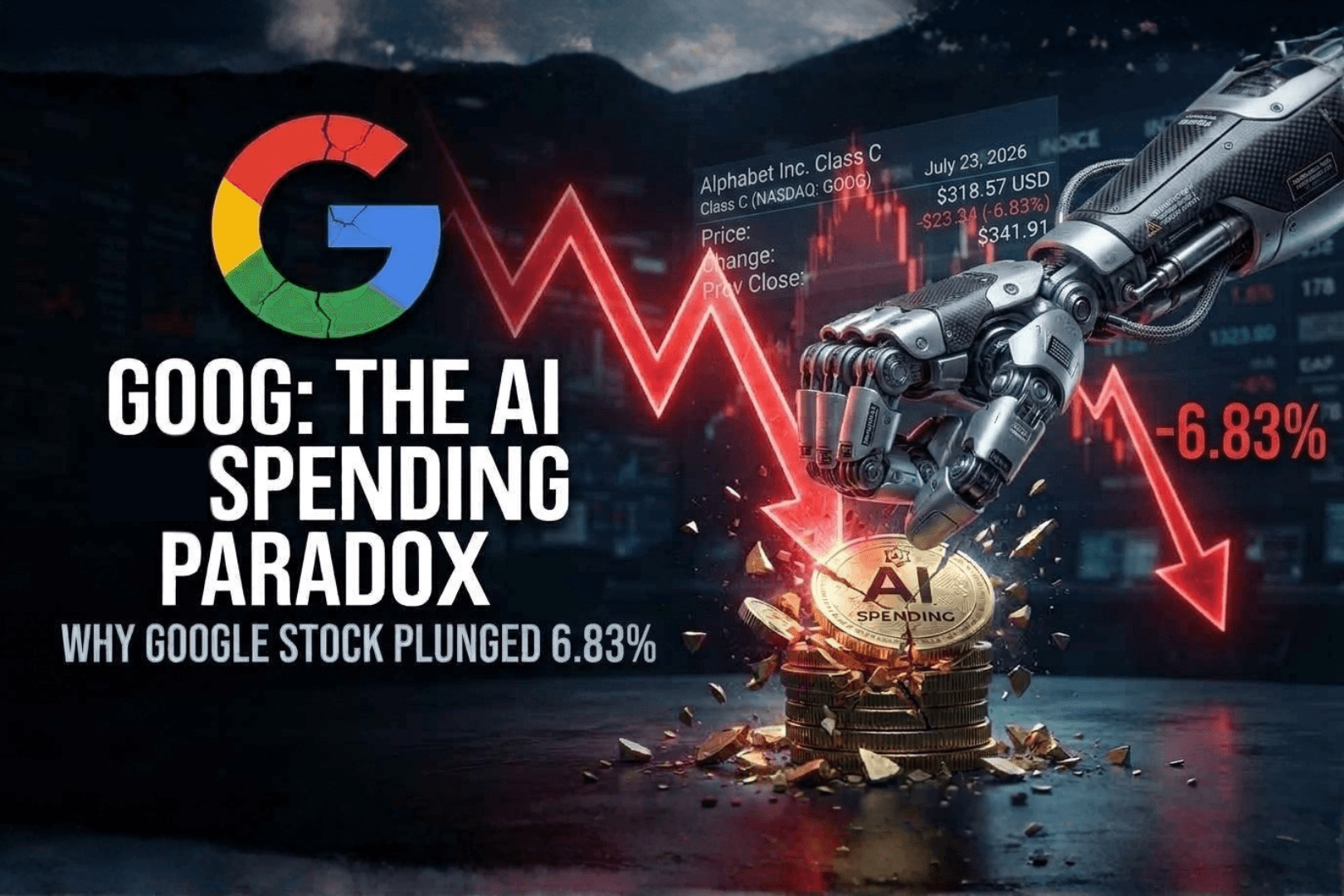
In a surprising turn of events, Alphabet (GOOGL) shares plummeted 6% on Thursday, July 23, 2026, despite posting impressive quarterly results that would typically send stocks soaring. The tech giant's Class A shares fell to $321.65, while Class C shares dropped to $320.76 in morning trading.
The paradox is striking: Alphabet reported total revenue of $119.8 billion, up 24% year-over-year, with Google Cloud revenue surging an extraordinary 82% to $24.77 billion. The company boasted 950 million monthly active users on Gemini and a massive Cloud backlog of around $514 billion. Yet investors fled.
The Real Culprit: Unprecedented AI Infrastructure Spending
The market's negative reaction centers on one alarming figure: Alphabet raised its full-year 2026 capital expenditure guidance to a staggering $195 billion to $205 billion, up from the previous range of $180 billion to $190 billion. Even more concerning, the company signaled that capex will rise again in 2027.
This represents one of the largest capital expenditure commitments in corporate history. To put this in perspective, Alphabet's 2026 capex could exceed the entire GDP of many developed nations. The company is essentially betting its future on AI infrastructure—data centers, chips, and computing power—at a scale never before seen.
The Profitability Problem: Spending Outpaces Returns
While Google Cloud's 82% revenue growth is impressive, the company's Q2 free cash flow came in at negative $5.9 billion. This negative cash flow, combined with escalating capex, raises a critical question: When will these massive AI investments actually generate returns?
The reported earnings per share of $9.11 was heavily inflated by a roughly $99 billion equity-securities gain, meaning the core operating performance wasn't as strong as headline numbers suggested. Investors are increasingly skeptical about whether AI spending will translate into sustainable profits.
Wall Street's Mixed Signals
Analyst reactions reflect the market's ambivalence. Cantor Fitzgerald lowered its Alphabet price target to $420 from $435 while maintaining an Overweight rating, acknowledging strong Google Cloud Platform performance but expressing concern over higher AI infrastructure spending and limited EBIT upside.
Raymond James similarly cut its price target to $400 from $425 while keeping a Strong Buy rating, noting that results were largely in line with YouTube and Cloud outperforming, though Search showed slight weakness. The pattern is clear: analysts remain bullish long-term but are tempering near-term expectations.
The Broader Tech Contagion
Alphabet's decline didn't happen in isolation. The stock's drop dragged down other social media and tech stocks, with Meta Platforms (META) and Snap (SNAP) following lower. The NASDAQ 100 fell 1.36% on the same day, reflecting broader concerns about AI spending across the tech sector.
This mirrors earlier market reactions when Meta and Microsoft faced similar scrutiny over AI investments. In January 2026, Meta's stock plummeted 11.33% after announcing increased AI spending commitments, while Microsoft struggled to convince investors that its AI investments would pay off.
What This Means for Investors
Short-Term Implications
- Volatility Ahead: Expect continued stock price fluctuations as the market digests AI spending announcements from tech giants
- Margin Pressure: Higher capex will compress profit margins in the near term
- Cash Flow Concerns: Negative free cash flow could limit share buybacks and dividend potential
Long-Term Considerations
- AI Arms Race: Companies that don't invest heavily risk falling behind in the AI revolution
- Winner-Takes-Most: The massive spending creates barriers to entry, potentially benefiting established players
- Infrastructure Value: Data centers and AI infrastructure could become valuable assets if monetization strategies succeed
The Investment Dilemma: Risk vs. Reward
Alphabet faces what CEO Sundar Pichai has called a "keep him up at night" scenario: the risk of underinvesting in AI is potentially greater than the risk of overinvesting. However, investors are now demanding proof that these investments will generate returns.
Google Cloud's 82% growth and operating income more than tripling to $8.8 billion provides some validation. The platform is approaching a $100 billion annual run rate, demonstrating that AI investments can drive real business results.
Conclusion: A Pivotal Moment for Tech
Alphabet's stock drop represents a pivotal moment in the AI revolution. Investors are no longer willing to accept massive spending on faith alone—they want to see clear paths to profitability. The company's ability to monetize its AI investments over the next 12-18 months will likely determine whether this spending spree was visionary or reckless.
For now, the market has spoken: impressive growth isn't enough if it comes at the cost of unsustainable spending. The question remains whether Alphabet can prove that its $200+ billion bet on AI will pay off before investor patience runs out.