Colibri: The Revolutionary AI Engine Running 744B-Parameter Models on Just 25GB RAM
What Makes Colibri Special in AI?
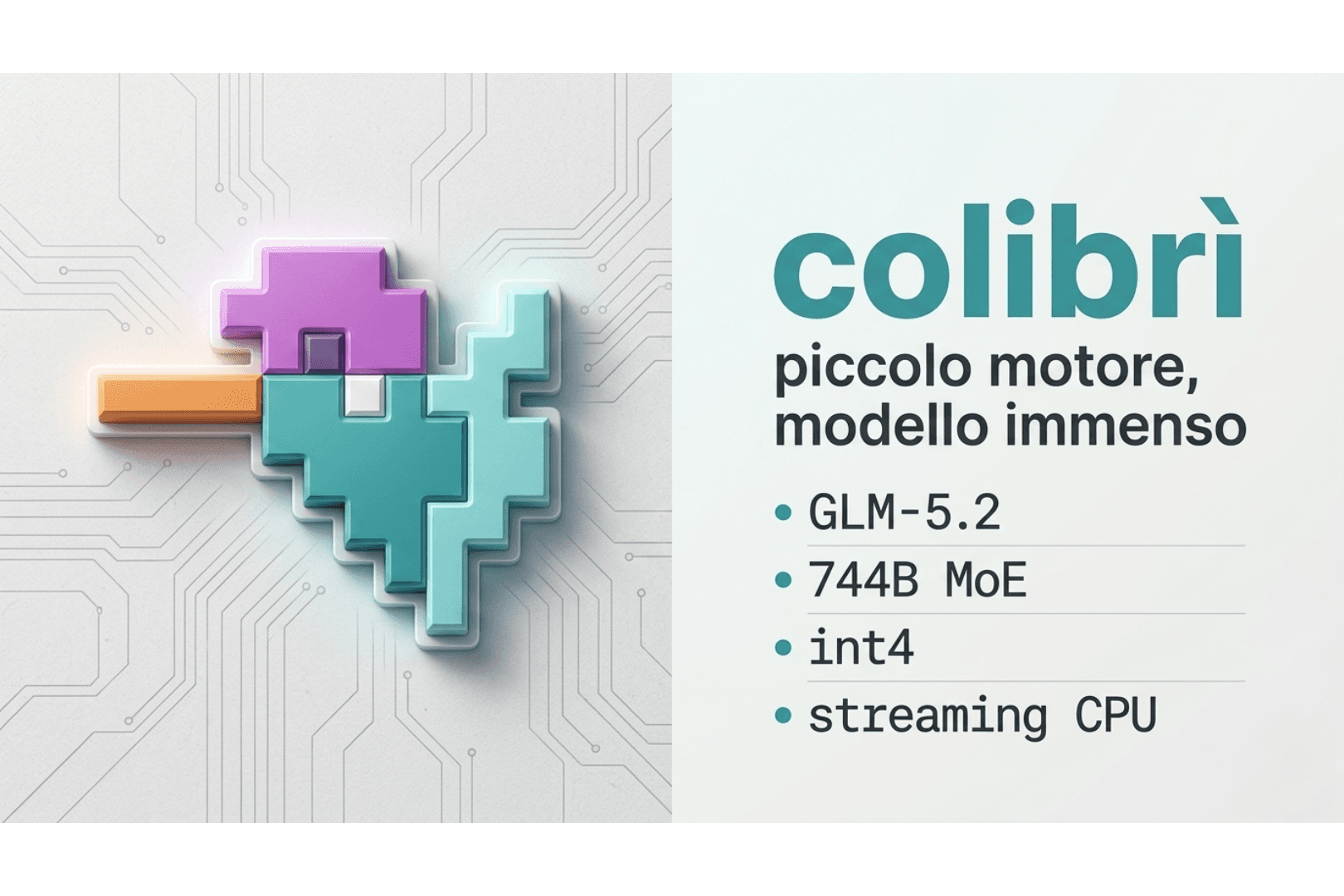
Colibri (colibrì) is a groundbreaking open-source AI inference engine developed by JustVugg that achieves the seemingly impossible: running GLM-5.2, a massive 744-billion parameter Mixture-of-Experts (MoE) model, on consumer hardware with only ~25 GB of RAM. This tiny engine with an "immense model" represents a paradigm shift in making state-of-the-art AI accessible to everyday users without requiring expensive GPU infrastructure.
The innovation lies in its elegant architecture: Colibri keeps only the dense parts of the model (attention layers, shared experts, embeddings — approximately 17B parameters) resident in RAM at int4 quantization (~9.9 GB), while streaming the 21,504 routed experts (totaling ~370 GB) from disk on demand. Written in pure C with zero dependencies and no Python runtime required, the entire engine is contained in a single ~1,300 line C file.
Revolutionary Technical Innovations
Expert Streaming Architecture
Unlike traditional inference engines that require the entire model to fit in memory, Colibri exploits the fundamental property of MoE models: only ~40B parameters are activated per token, with just ~11 GB of routed experts changing between tokens. The engine implements a sophisticated per-layer LRU cache with optional pinned hot-store and leverages the OS page cache as a free secondary cache layer.
Multi-Token Prediction (MTP) Speculative Decoding
Colibri implements GLM-5.2's native multi-token-prediction head for speculative decoding, achieving 2.2–2.8 tokens per forward pass with 39–59% draft acceptance rates when using int8 quantization for the MTP head. This lossless acceleration technique maintains quality even under sampling through rejection sampling.
Compressed KV-Cache with MLA Attention
The engine implements Multi-head Latent Attention (MLA) with compressed KV-cache, storing only 576 floats per token instead of 32,768 — a 57× reduction that makes long-context inference feasible on limited RAM.
Optimized Integer Kernels
Colibri features custom AVX2-optimized integer dot-product kernels (Q8_0-style int8 activations with maddubs instructions) that achieve 119 GFLOP/s, making int8 matmuls 1.4–2.5× faster and int4 operations 1.8× faster in batch mode.
Real-World Performance and Impact
Performance metrics demonstrate Colibri's practical viability: on a development box with WSL2, 25 GB RAM, and ~1 GB/s NVMe storage, the engine achieves 0.05–0.1 tokens/second when cold, scaling up to approximately 1 token/second on an Apple M5 Max with 128 GB RAM and faster storage. While not matching GPU speeds, this represents a democratization of access to frontier AI models.
The engine starts up in approximately 32 seconds with only 9.9 GB resident memory, making it immediately usable on mid-range consumer hardware. The async expert readahead system ensures that while one block of experts is being processed, the next is already being loaded from disk, minimizing I/O bottlenecks.
Why Colibri is Gaining Massive Popularity
Democratizing AI Access
Colibri has captured the AI community's imagination by proving that state-of-the-art models don't require $10,000+ GPU setups. Users praise it as "a step toward local AI accessibility" that brings 744B-parameter models to ordinary laptops. This democratization is particularly significant for researchers, developers, and enthusiasts in regions with limited access to cloud computing resources.
Open Source and Zero Dependencies
The project's pure C implementation with zero external dependencies makes it incredibly portable and easy to audit. The Apache 2.0 license ensures commercial viability while maintaining open access. With 241 stars and 25 forks on GitHub, the project has rapidly gained traction in the local AI community.
Technical Excellence
The implementation demonstrates exceptional engineering — from faithful GLM-5.2 forward pass validation (token-exact against transformers oracle) to sophisticated features like batch-union MoE in prefill, byte-level BPE tokenizer in C, and automatic RAM safety with cache auto-sizing from MemAvailable. This attention to detail has earned respect from technical users.
Community Momentum
The project has sparked discussions across Reddit's r/LocalLLM and r/LocalLLaMA communities, Facebook AI groups, and tech news sites like Gigazine. Users are actively sharing benchmarks, optimization tips, and use cases, creating a virtuous cycle of improvement and adoption.
The Future of Local AI
Colibri represents more than just a technical achievement — it's a proof of concept that challenges the assumption that frontier AI requires cloud infrastructure. The developer is actively working on implementing DSA (sparse attention) with lightning-indexer weights, which will further improve performance for long-context scenarios.
The offline FP8→int4 converter that downloads and processes one shard at a time (avoiding the need to store the full 756 GB FP8 checkpoint) demonstrates thoughtful design for users with limited storage. This attention to real-world constraints makes Colibri not just innovative but genuinely practical.
As the project continues to evolve with community contributions and optimizations, Colibri is poised to become a standard tool for local AI inference, inspiring similar innovations across the ecosystem and proving that the future of AI doesn't have to be centralized in massive data centers.