Hong Kong Courts: Stop Putting Case Files in Public AI
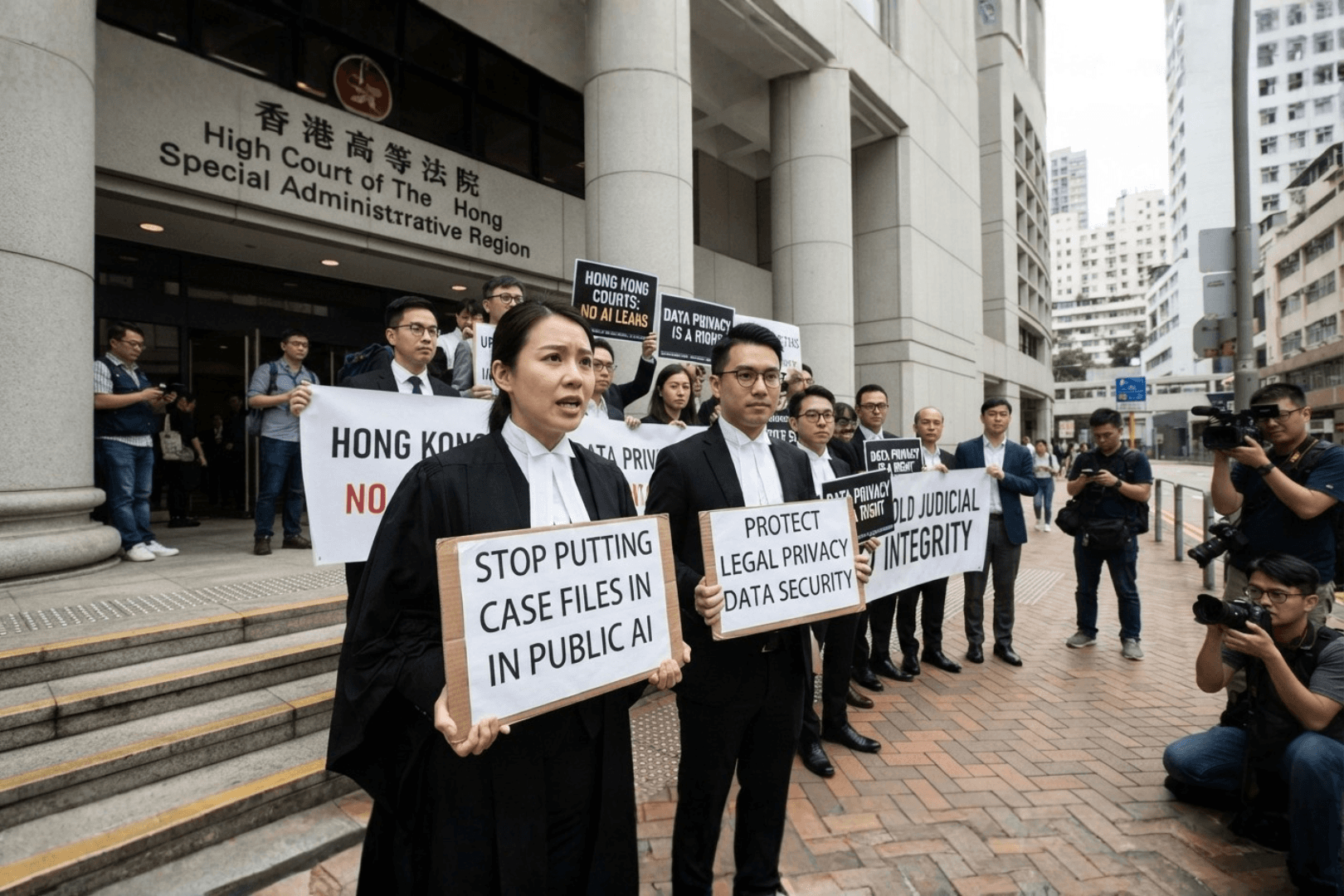
Hong Kong’s Judiciary has drawn hard lines on AI. Law firms should treat them as the floor for internal policy — not as rules that only apply inside the courtroom.
The Easy Shortcut Just Got Riskier
Public AI tools are everywhere in professional life. An associate pastes a tricky paragraph into a chatbot. A trainee asks for a case summary. A partner drafts overnight with a consumer model because the deadline is brutal.
Hong Kong’s Judiciary has made the boundary clear for judges and support staff — and the logic travels straight into private practice. Sensitive case material does not belong in public AI. Accuracy is not optional. And AI does not get to decide cases.
This piece walks through the Judiciary’s core boundaries and turns them into a practical checklist for law firms in Hong Kong (with lessons that also travel to Singapore and the UK).
Zero Delegation: AI Assists. Humans Decide.
The Judiciary’s position is unambiguous: AI can never replace human adjudication or perform core judicial functions.
For firms, the parallel is equally sharp. AI may draft, summarise, compare clauses, and surface candidates for review. It must not:
- Decide strategy without a responsible lawyer
- Replace professional judgment on advice to the client
- Stand in for the advocate’s duty to the court
Treat every AI output as a junior’s first pass — useful, never final. Supervision is not a nice-to-have; it is the product.
Accuracy Checks: Assume Hallucination Until Proven Otherwise
System users must verify all facts, quotes, and citations because AI can hallucinate. That is not a vendor disclaimer. It is operational reality.
Build verification into the workflow:
- Facts — check against the file, not the model’s confidence
- Quotes — open the source and match the text
- Citations — confirm the authority exists, says what you claim, and remains good law
If your tool cannot show what it read, your verification burden goes up, not down. Prefer systems that retrieve from a controlled corpus and expose sources over black-box chat that “sounds right.”
Data Restriction: Case Files Stay Out of Public Models
Entering non-public, classified, or sensitive case information into public AI models is strictly prohibited for Judiciary users. Firms should adopt the same bright line.
That means:
- No pasting pleadings, advice, or client documents into consumer chatbots
- No “anonymous” dumps that still contain identifiable facts, strategies, or sealed material
- No assuming a free-tier privacy policy is a privilege waiver
If the matter is non-public, the tool must be under firm control — private retrieval, approved vendors, clear data-processing terms, and access scoped to the people who need it. Convenience is not a defence when confidentiality is the job.
Upcoming Rules: Prepare for Disclosure Now
The Judiciary is actively drafting new sectoral guidelines and consulting practitioners on whether mandatory AI disclosures should be required in court submissions.
You do not need to wait for the final text to prepare:
- Log when AI assisted a draft or research step
- Keep a short internal note of tools used and human reviewers
- Decide who signs off that citations and quotes were checked
- Align engagement letters and internal policies with honest disclosure if courts require it
Firms that invent disclosure workflows after a practice direction lands will scramble. Firms that already supervise AI like junior work will adapt in a week.
What Law Firms Should Copy From the Court Playbook
| Judiciary boundary | Firm equivalent |
|---|---|
| Zero delegation of adjudication | AI assists; lawyers own advice and filings |
| Mandatory accuracy checks | Verify facts, quotes, citations before send |
| Ban on sensitive data in public AI | Private corpus / approved tools only |
| Sectoral guidelines & possible disclosure | Policies, logs, and sign-off ready now |
These are not anti-AI rules. They are anti-unsupervised AI rules. The firms that win will use AI heavily — inside boundaries courts and clients can respect.
Practical Checklist for Hong Kong Firms
- Publish a one-page AI policy — what tools are approved, what data is forbidden in public models, who must review outputs.
- Block the easy mistake — train staff that consumer chatbots are off-limits for matter content.
- Prefer retrieve-and-cite systems — private knowledge bases beat paste-into-ChatGPT for research and drafting.
- Require human sign-off — no filing or client send without a named reviewer on facts and authorities.
- Pilot disclosure logging — even before it is mandatory, know what you would tell the court.
- Review vendor contracts — training use, retention, subprocessors, and jurisdiction of data.
The Bottom Line
Hong Kong courts are not asking lawyers to abandon AI. They are asking for the same things the profession already owes clients and the court: human judgment, verified accuracy, and control of sensitive information.
Stop putting case files in public AI. Build private, supervised workflows instead. When disclosure rules arrive, you will already be practising what the Judiciary is writing down.
See how AlphaMatch approaches controlled legal document automation for Hong Kong, Singapore, and UK teams: legal document automation.