Gemini Embedding 2: The Dawn of Truly Unified Multimodal AI
Published: March 14, 2026
The Problem Nobody Wanted to Talk About
For years, the AI world quietly accepted an awkward truth: embedding models were fundamentally broken for the real world. You had one model for text, another for images, yet another for audio — and if you wanted them to "talk" to each other, you were left stitching together pipelines with metaphorical duct tape. The vectors lived in different spaces, trained on different objectives, and comparing them was like measuring temperature in Celsius against a ruler.
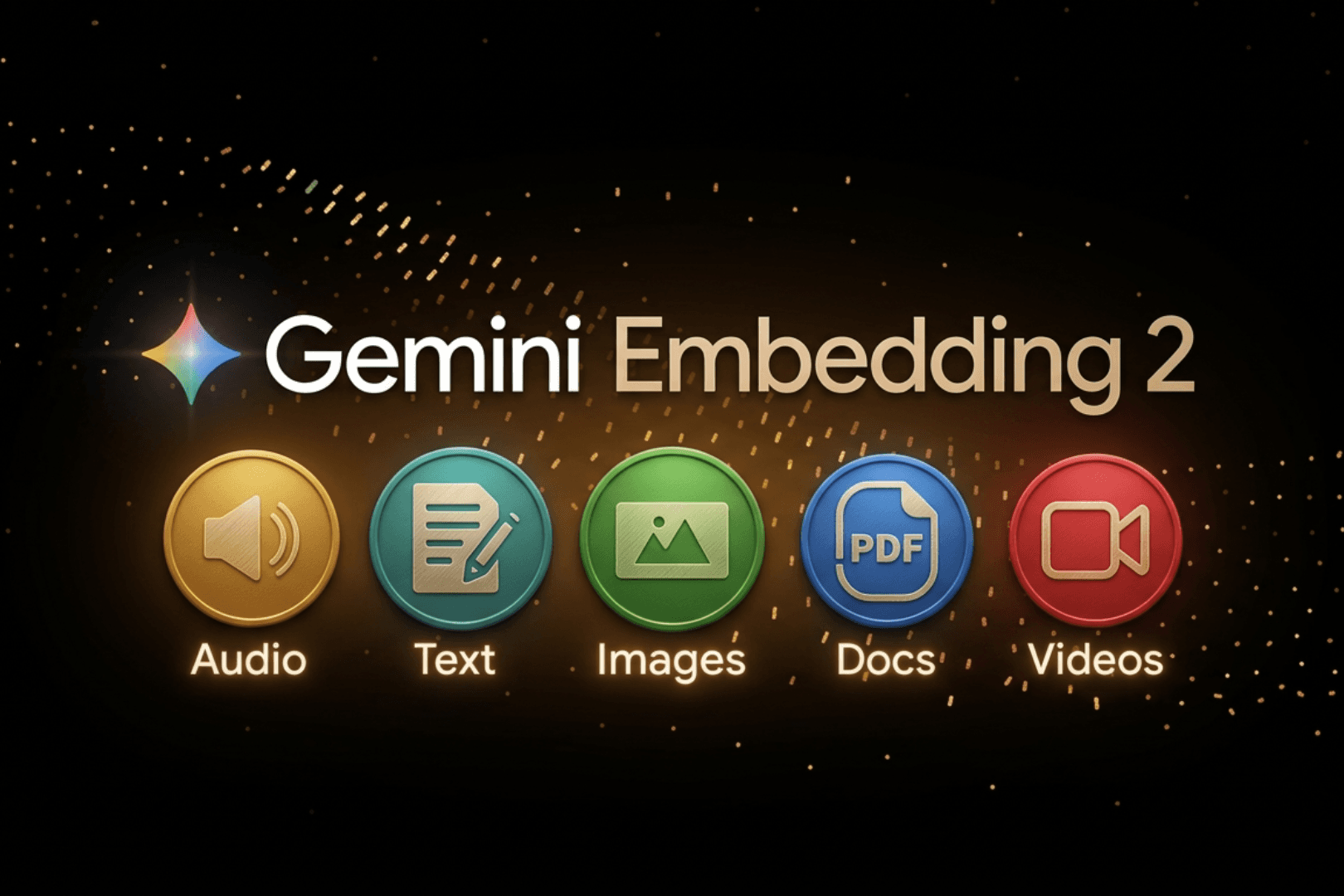
Google just tore up that playbook. Gemini Embedding 2 — released in Public Preview via the Gemini API and Vertex AI — is Google's first natively multimodal embedding model. It doesn't bolt modalities together after the fact. It was architected from the ground up on the Gemini foundation to understand text, images, video, audio, and documents as first-class citizens, all mapped into one single, unified vector space.
What Exactly Is an Embedding Model? (And Why Should You Care?)
Before diving into what makes Gemini Embedding 2 special, it's worth grounding ourselves. An embedding model takes raw content — a sentence, a photo, a podcast clip — and converts it into a long list of numbers called a vector. These numbers act like coordinates on a high-dimensional map.
Think of it like a magical library where books aren't organized by the Dewey Decimal System, but by meaning. A biography of Steve Jobs would fly across the room to sit next to a Macintosh technical manual. A poem about a sunset would drift toward a photography book of Pacific coastlines. That's what embeddings do — they organize information by semantic essence, not by format.
This invisible technology powers:
- Search engines — finding results based on intent, not just keywords
- Recommendation systems — Netflix knowing you'll love that obscure documentary
- Enterprise RAG — AI assistants that actually read your company's internal PDFs before answering
What Makes Gemini Embedding 2 a Genuine Leap Forward
1. Natively Multimodal — Not a Patchwork
The word natively is doing a lot of heavy lifting here, and it deserves attention. Previous "multimodal" embedding solutions were often CLIP-style hybrids: a text model and a vision model trained separately, then aligned through projection layers. The seams showed.
Gemini Embedding 2 was built differently. It leverages the Gemini architecture's best-in-class multimodal understanding to create embeddings across:
| Modality | Capability |
|---|---|
| Text | Up to 8,192 input tokens |
| Images | Up to 6 images per request (PNG, JPEG) |
| Video | Up to 120 seconds (MP4, MOV) |
| Audio | Natively ingested — no transcription needed |
| Documents | PDFs up to 6 pages long |
The audio capability is particularly striking. Most systems that "handle" audio actually just transcribe it to text first, then embed the text. Gemini Embedding 2 understands audio as sound — capturing nuances, tone, and context that a transcript would lose.
2. Interleaved Multimodal Input
Here's where it gets genuinely exciting. You can send a request containing both an image of a vintage car and the text "What is the engine type?" — and the model doesn't process them separately. It treats them as a single, unified concept. The meaning lives in the intersection of what you see and what you say.
This unlocks cross-modal retrieval that simply wasn't possible before:
- Use a text query to find a specific moment in a video
- Use an image to retrieve a matching PDF document
- Use an audio clip to surface related images
3. Matryoshka Representation Learning (MRL)
Named after Russian nesting dolls, MRL is a technique that "nests" information by dynamically scaling down embedding dimensions. The default output is 3,072 dimensions, but developers can scale down to 1,536 or 768 dimensions — trading a small amount of quality for significant savings in storage and retrieval speed.
4. Performance That Backs Up the Claims
Gemini Embedding 2 doesn't just promise multimodal coverage — it delivers measurable benchmark improvements. It outperforms leading models in text, image, and video tasks, and introduces strong speech capabilities that set a new standard. For enterprises, early access partners have reported latency reductions of up to 70% compared to previous multi-pipeline approaches.
Real-World Applications: What Can You Actually Build?
The practical implications are broad. Developers are already exploring:
- Image matching & face retrieval — Building person-identification systems without training a custom CNN, using Gemini Embedding 2 purely as a semantic feature extractor
- Multimodal RAG pipelines — Letting enterprise AI assistants reason over mixed-format knowledge bases (PDFs, videos, images) in a single retrieval step
- Cross-modal semantic search — Searching a video archive with a text description, or finding a document using an image as a query
- Sentiment analysis & data clustering — Grouping diverse media by topic or tone across formats
The best part? No custom training pipeline required. No annotation-heavy workflows. Just the API, your data, and cosine similarity.
Getting Started
Gemini Embedding 2 is available now in Public Preview via:
- Gemini API and Google AI Studio
- Vertex AI for enterprise workloads
- Integrations with LangChain, LlamaIndex, Haystack, Weaviate, QDrant, ChromaDB, and Vector Search
Here's a taste of the API:
from google import genai
from google.genai import types

client = genai.Client()

with open("example.png", "rb") as f:
    image_bytes = f.read()

result = client.models.embed_content(
    model="gemini-embedding-2-preview",
    contents=[
        "Describe the mood of this image",
        types.Part.from_bytes(data=image_bytes, mime_type="image/png"),
    ],
)

print(result.embeddings)
The Bigger Picture
The history of embeddings stretches back to the 1950s with linguist John Rupert Firth, through the Word2Vec revolution at Google in 2013, and into today's competitive landscape where OpenAI, Cohere, and Google are all racing to define the next standard.
But Gemini Embedding 2 feels like a genuine inflection point — not because it's marginally better at text, but because it reframes the question. The old question was: "How do I embed this text?" The new question is: "How do I embed this world?" By bringing semantic meaning to the diverse, messy, multimodal data that actually exists in enterprises and in life, Gemini Embedding 2 provides the foundation for AI systems that understand the world the way humans do — not as separate streams of text, images, and sound, but as one interconnected, meaningful whole.
Exploring Multimodal Embeddings or Enterprise RAG?
Planning to evaluate Gemini Embedding 2 or deploy unified multimodal search in your organization? Contact us for expert guidance on embedding strategy, Vertex AI integration, and RAG deployment.