Manus Exits Meta and Purges User Task Data: What the Forced Separation Means for AI Buyers
An ownership unwind erased agent work product — not a breach, not a privacy complaint
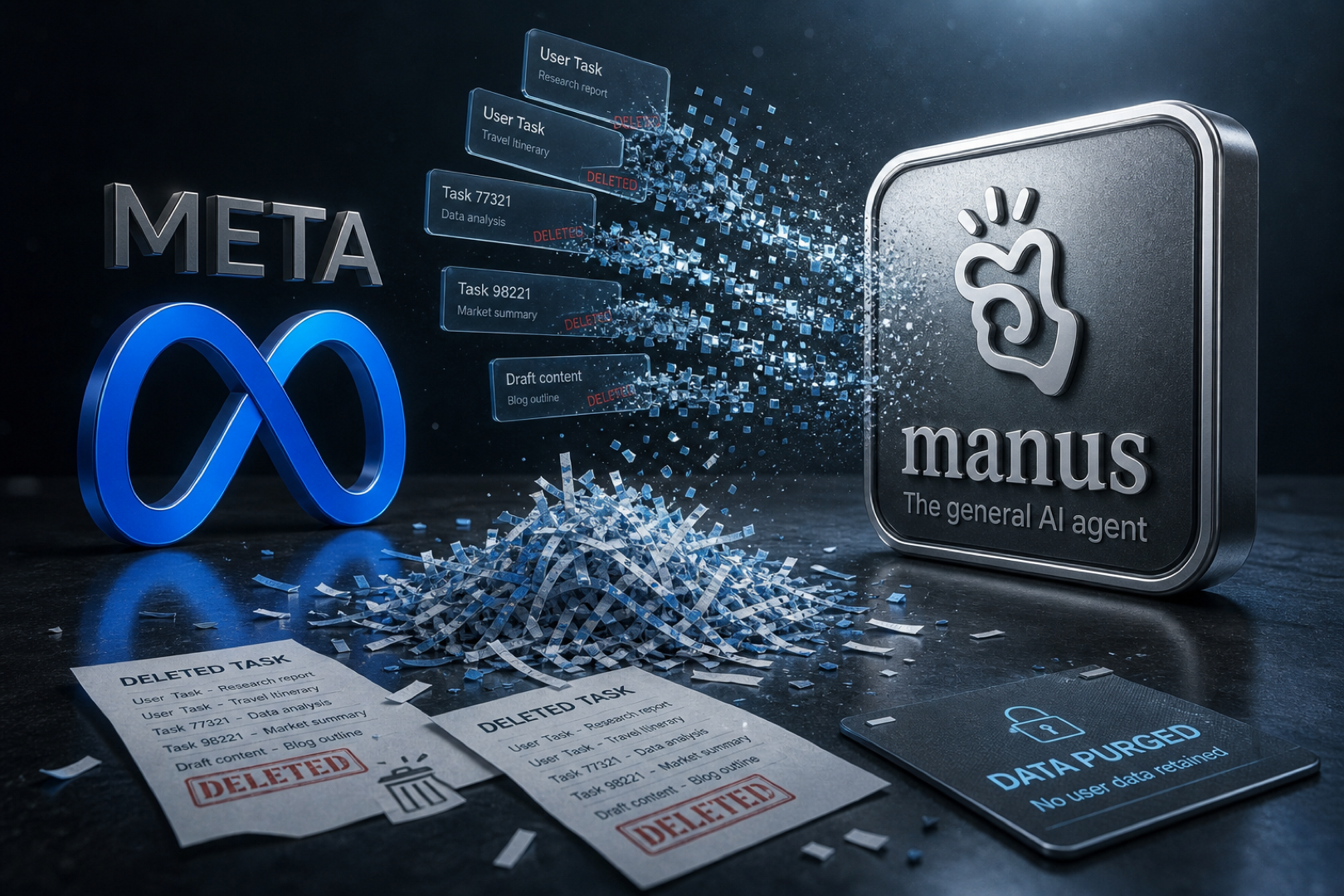
On August 25, 2026 (Singapore time), Manus reopened its restoration portal after roughly 48 hours of service disruption for affected accounts. The company had just permanently deleted task data — and, for some users, entire accounts — created during Meta's ownership window. Manus says this was not a security incident. It was a regulatory separation step as the AI agent platform returns to independent operations after Beijing ordered Meta's roughly $2 billion acquisition unwound. [1][2]
For teams that treat AI agents as production infrastructure, the lesson is blunt: who owns your vendor can decide whether your work product survives. Contracts that promise backups and export rights do not always survive a forced equity unwind. We previously covered the NDRC block and the broader Manus–Meta saga; this piece is about what happened to user data once the unwind became operational.
From $2B Close to Forced Exit
Meta completed its acquisition of Butterfly Effect — the company behind Manus — on December 29, 2025, aiming to fold the agent technology into Meta AI. Manus had already rebranded around a Singapore operating base in mid-2025 after earlier roots in China. That offshore move did not keep the deal outside Beijing's reach. [2][6]
In April 2026, China's National Development and Reform Commission (NDRC) publicly ordered the transaction unwound under the 2021 Measures for the Security Review of Foreign Investment — widely described as China's first public use of that regime to reverse a consummated cross-border AI deal. Legal analyses from Morgan Lewis and others stress a substance-over-form test: where the technology was developed, where engineers built expertise, and how IP left the original Chinese entity. [4][7]
Meta began cutting data interconnection and internal system access around June 2026. By July, reporting pointed to a Tencent-led consortium — alongside early backers such as HSG (formerly Sequoia China) and ZhenFund — preparing to buy Manus back at Meta's original purchase price. Manus then told users it would resume independent operations and that some accounts would lose Meta-era data. [5][3]
What Was Deleted — and Who Was Hit
Manus's help center is the clearest primary source. For affected users, data generated from acquisition day (December 29, 2025, 12:00 a.m. PT) through 7:59 a.m. SGT on August 23, 2026 was slated for deletion during a window from 8:00 a.m. August 23 through August 24, with restoration opening at 8:00 a.m. August 25 SGT. The company framed the step as necessary "to comply with regulatory requirements in specific jurisdictions" — without naming those jurisdictions. [1][2]
| Date (SGT unless noted) | Event |
|---|---|
| Dec 29, 2025 | Meta closes acquisition; Meta-era data clock starts |
| Apr 2026 | NDRC orders the deal unwound |
| Jun 2026 | Meta cuts data links and internal access |
| Jul 2026 | Tencent-led buyback framework reported |
| Aug 11, 2026 | Independent-ops notice; backup window opens |
| Aug 23, 8:00 a.m. – Aug 25, 7:59 a.m. | Deletion / downtime for affected regions |
| Aug 25, 8:00 a.m. | Restoration portal opens; service returns |
Impact depended on account type. Simplified from Manus's A / B / C framework: [1]
| Type | Who | What happens |
|---|---|---|
| A | Pre-acquisition account; no Pro, or Pro started before close | Account kept; post-close task data & connectors deleted; some Pro users get one month of extra credits |
| B | Pre-acquisition account; Pro started on/after close | Account kept; those subscriptions cancelled with pro-rata refund; Meta-era task data deleted |
| C | Account created on/after close, or email/profile changed after close | Full account wipe (tasks, subscriptions, associated data) |
The backup window ran from August 11 through 7:59 a.m. SGT on August 23. Users who did not export could lose task data and Manus-generated artifacts. Type C users who skip restore stay locked out and must create a new account. Manus also described automatic refunds for cancelled or residual balances within about seven days. [1]
Why Equity Unwinds Can Force Data Destruction
The trigger was not a leak and not a GDPR-style erasure request. It was a change of control that regulators would not accept. In that setting, transferring Meta-era user work product to a new shareholder structure can be harder than deleting it. Manus's own language ties the purge to regulatory requirements in specific parts of the world, while leaving the map blank. [2]
That opacity is itself a procurement risk. Enterprises cannot pre-score whether they sit inside the next "specific jurisdiction" bucket if the vendor will not list them. The practical backup window was roughly twelve days — short for any team whose agent history is operational memory rather than disposable chat.
Three Takeaways for Cross-Border AI Buyers
- Vendor ownership is a data-retention risk. Cap tables and foreign investment review can erase work product even when product uptime looks fine.
- Offshore domicile is not a firewall. Manus's Singapore shift did not stop substance-over-form review. Legal commentators now treat "frictionless" China-origin AI M&A as over. [4]
- Export early; assume restore is your job. Manus opened a restore portal, but only for what users backed up. Type C accounts that miss the window effectively start from zero.
Separately, reporting during the Meta period described sharp revenue growth for Manus — often framed as rising from roughly $100 million annualized toward several hundred million — before the asset was steered back into a structure Chinese regulators can reach. Growth did not protect user task history from the unwind mechanics. [5]
Bottom Line
Manus is back as an independent agent platform with a restore path for users who exported in time. The deeper story is structural: when geopolitics forces an AI acquisition to unwind, user work product can be treated as contaminated inventory — safer to destroy than to migrate. If your roadmap depends on cross-border agents, treat supplier ownership, jurisdiction, and portable backups as first-class requirements, not afterthoughts in the MSA appendix.
Sources
- [1] Manus Help Center — Service Change Overview
- [2] South China Morning Post — Meta to unwind $2B Manus deal; data deletion notice
- [3] TechNode — Manus to resume independent operations
- [4] Morgan Lewis / JDSupra — The Manus Decision and cross-border AI investment
- [5] The Insight — Manus deal nears unwinding; founders / Chinese investors
- [6] CNBC — China blocks Meta–Manus deal
- [7] O'Melveny — China unwinds Meta's Manus acquisition