Ponytail: The AI Coding Skill That Saves Tokens by Writing Less Code
Introduction: The Problem With AI Agents That Over-Code
If you've ever asked an AI coding agent to build something simple — say, an email validator — and received back a 27-line EmailValidator class, a wrapper function, a custom regex, and an unsolicited discussion about edge cases, you already understand the problem.
AI agents are trained to be helpful. But "helpful" often translates to over-engineered, bloated, token-heavy code that no senior developer would ever write. Every extra line of generated code costs you tokens. Every token costs you money and time.
Enter Ponytail — an open-source AI coding skill that puts a "lazy senior developer" inside your AI agent, forcing it to write only what is truly necessary.
What Is Ponytail?
Ponytail is an open-source plugin/skill for AI coding assistants — including Claude Code, Codex CLI, GitHub Copilot, Cursor, Windsurf, Cline, Aider, OpenCode, Gemini CLI, and more — created by developer DietrichGebert on GitHub.
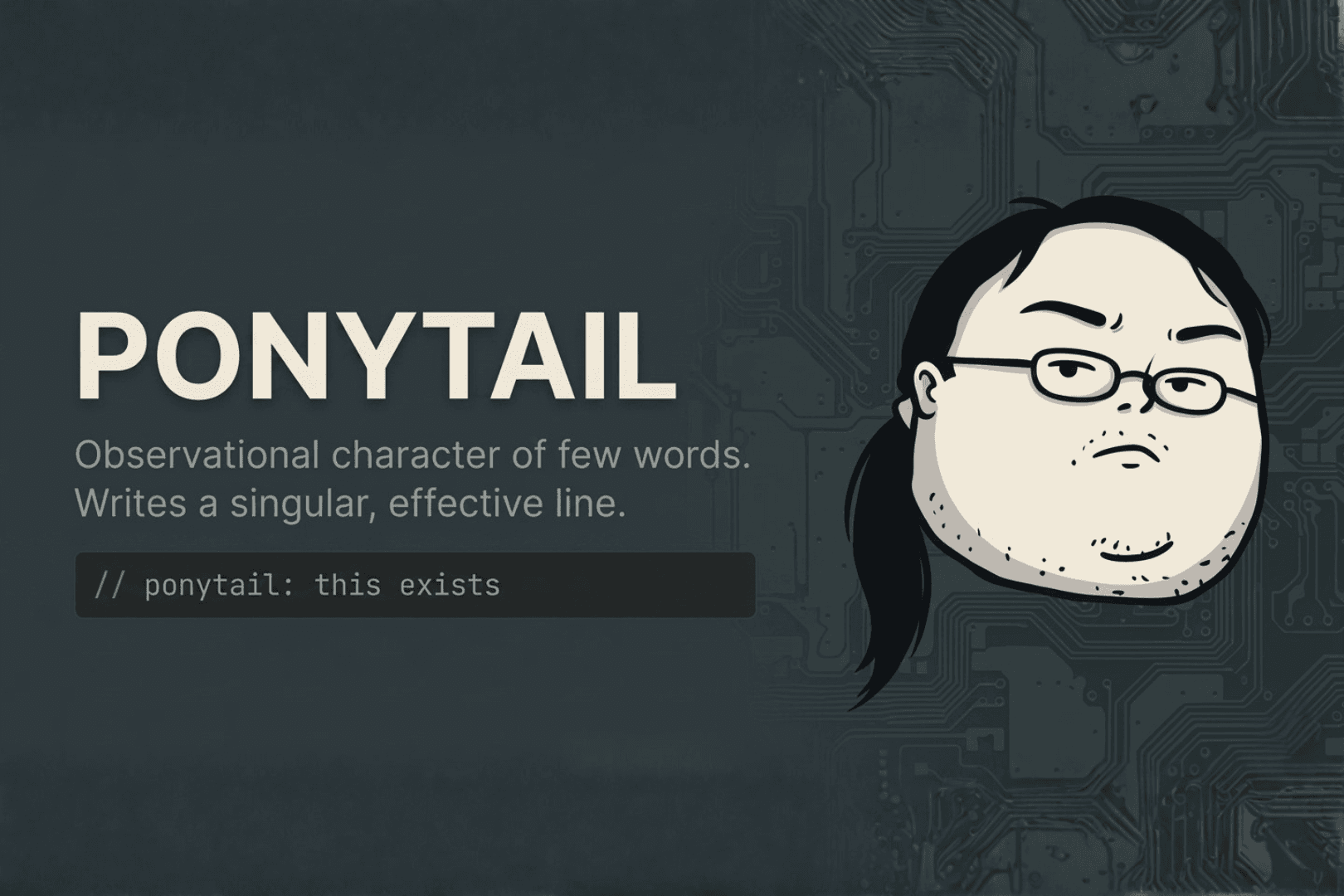
The name and concept come from a familiar archetype: the senior developer with a long ponytail and oval glasses who has been at the company longer than version control. You show him fifty lines of code. He looks at them, says nothing, and replaces them with one.
Ponytail puts that developer inside your AI agent.
"He says nothing. He writes one line. It works." — Ponytail README
How Ponytail Works: The Decision Ladder
Before writing a single line of code, Ponytail forces the AI agent to stop and climb a decision ladder — a sequential checklist of the simplest possible solution:
1. Does this need to exist?       → No: skip it (YAGNI)
2. Does the stdlib do it?         → Use it
3. Is there a native platform feature? → Use it
4. Is there an installed dependency?   → Use it
5. Can it be one line?            → One line
6. Only then: write the minimum that works
This is the core philosophy: lazy, not negligent. Trust-boundary validation, data-loss handling, security, and accessibility are never cut. Only unnecessary complexity is eliminated.
A Real Example
You ask for a date picker. A standard AI agent will:
- Install flatpickr
- Write a wrapper component
- Add a stylesheet
- Start a discussion about timezones
With Ponytail:
<!-- ponytail: browser has one -->
<input type="date">
One line. Done.
The Token & Cost Savings: Benchmark Results
This is where Ponytail truly shines. The benchmarks are striking and reproducible.
Benchmark Setup
- 5 everyday tasks: email validator, debounce, CSV sum, countdown timer, rate limiter
- 3 AI models: Claude Haiku, Sonnet, and Opus
- 3 test arms: no skill, a basic "caveman" skill, and Ponytail
- 10 runs per cell, median reported
Results
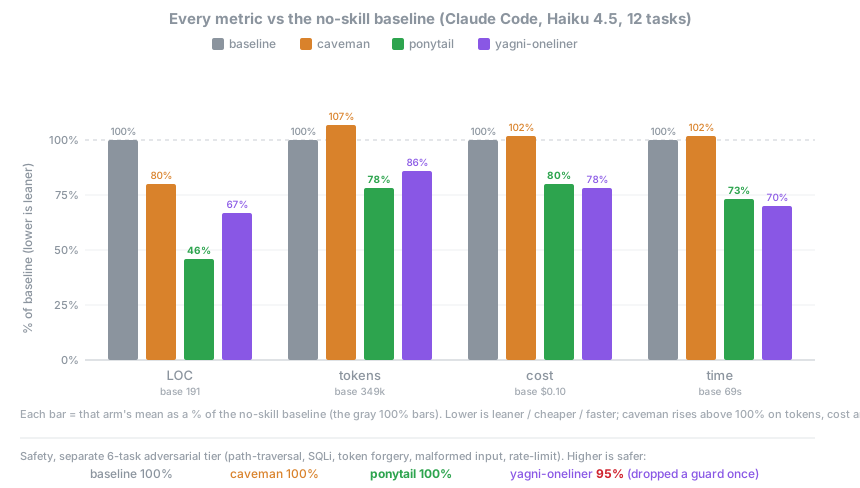
Figure 1: Every metric vs the no-skill baseline (Claude Code, Haiku 3.5, 12 tasks). Ponytail cuts lines of code to 46% of baseline while maintaining 100% safety on adversarial tests.
Key highlights from this run (Ponytail vs baseline):
- LOC: 46% of baseline (191 lines → ~88 lines)
- Tokens: 78% of baseline
- Cost: 80% of baseline ($0.15 base)
- Time: 73% of baseline (65s base)
- Safety: 100% on adversarial tier (path traversal, SQLi, token forgery, etc.) — vs yagni-one-liner at 83% (dropped a guard case)
| Metric | Improvement vs. No-Skill Agent |
|---|---|
| Lines of Code | 80–94% less |
| API Cost | 47–77% cheaper |
| Speed | 3–6× faster |
| Token Usage | ~16% fewer tokens per task |
One standout example: on the countdown timer task, the no-skill agent built a 190-line countdown "dashboard" with animations nobody asked for. Ponytail delivered 13 lines.
"293 lines of code dropped to 47. The 246 lines nobody wrote have never caused an incident." — Ponytail creator on Reddit
Benchmarks show that filtering the agent's generation process through Ponytail's constraints results in up to 94% less code written. Less code means fewer tokens consumed, which directly translates to lower API costs — especially relevant when using per-token billing on models like Claude Haiku, Sonnet, or Opus.
Why Fewer Tokens Matter
Every token your AI agent generates or reads costs money on the API. When an agent writes bloated code:
- More output tokens = higher cost per call
- More code in context = more input tokens on follow-up turns
- Longer responses = slower latency
- More complexity = more bugs, more maintenance
Ponytail's ruleset re-injects every turn, meaning the "lazy senior dev" constraint is always active. The result is a compounding saving: less code written now means less code read back later.
How to Install Ponytail
Ponytail supports virtually every major AI coding environment:
Claude Code
/plugin marketplace add DietrichGebert/ponytail
/plugin install ponytail@ponytail
Codex CLI
codex plugin marketplace add DietrichGebert/ponytail
codex plugin install ponytail@ponytail
GitHub Copilot CLI
copilot plugin marketplace add DietrichGebert/ponytail
copilot plugin install ponytail@ponytail
Gemini CLI
gemini extensions install https://github.com/DietrichGebert/ponytail
OpenClaw (ClawHub)
clawhub install ponytail
For Cursor, Windsurf, Cline, and Aider, plain rules files are available in the repository.
Ponytail Modes
Ponytail supports multiple intensity levels to suit your needs:
| Mode | Description |
|---|---|
| lite | Light touch — gentle nudges toward simplicity |
| full | Default — full ladder enforcement every turn |
| ultra | For when the codebase has wronged you personally |
| off | Disable Ponytail for the session |
Set your default mode via environment variable:
export PONYTAIL_DEFAULT_MODE=full
Or configure it in ~/.config/ponytail/config.json.
Who Should Use Ponytail?
Ponytail is ideal for:
- Solo developers who want to stretch their Claude/OpenAI API budget further
- Startups running AI coding agents at scale and watching token costs
- Senior engineers who are tired of reviewing AI-generated bloat
- Any developer who values clean, minimal, maintainable code
If you're paying per token on the Claude API or OpenAI API, Ponytail can cut your coding-task costs by nearly half — without sacrificing correctness or safety.
Conclusion
Ponytail is one of the most practical open-source tools to emerge from the AI coding ecosystem. It doesn't fight against AI agents — it disciplines them, channeling their power into the smallest, most efficient solution possible.
80–94% less code. 47–77% lower cost. 3–6× faster. Those aren't marketing numbers — they're reproducible benchmarks you can run yourself with npx promptfoo eval -c benchmarks/promptfooconfig.yaml.
The senior dev with the ponytail has been writing minimal code for decades. Now, so can your AI agent.