The Chip That Could End the GPU Cluster Era — Skymizer HTX301 LPU Explained
A tiny Taiwanese startup just dropped a bombshell ahead of Computex 2026. Here's why the AI world should pay attention.
Published: May 19, 2026
Tags: Skymizer, HTX301, LPU, AI Inference, Computex 2026, Taiwan, On-Premises AI, HyperThought
The Problem Nobody Wanted to Talk About
For years, running a truly large AI model — think 700 billion parameters — on your own hardware was simply not a realistic option for most enterprises. You needed a fleet of NVIDIA H100s wired together with NVLink/NVSwitch fabric, a data center with serious cooling infrastructure, and a capital budget that only hyperscalers or well-funded research labs could justify. Even then, every query you ran in the cloud came with a per-token bill that quietly bled your AI budget dry. This "hidden tax" forced engineering teams to ration how often they called their own AI systems.
Skymizer, a Taiwanese AI compiler and silicon company, just announced something that directly challenges this status quo.
What Is the HTX301?
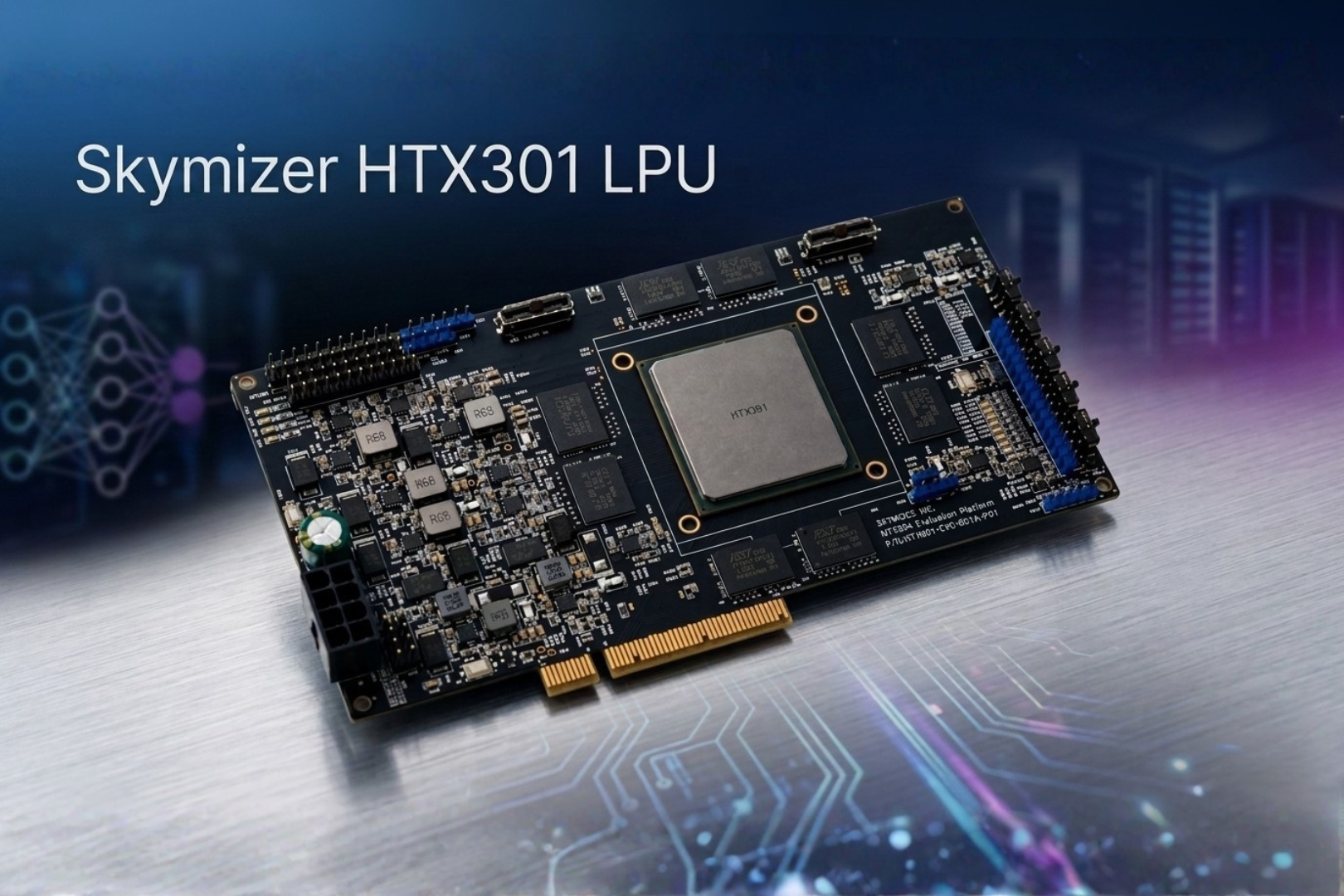
The HTX301 is an LPU (Language Processing Unit) inference chip — the first reference chip built on Skymizer's HyperThought™ platform, a software/hardware co-design architecture first introduced at Computex 2025. Unveiled ahead of Computex 2026, the HTX301 is not trying to be a general-purpose GPU. It is laser-focused on one thing: running large language model inference as efficiently as possible.
The headline spec is genuinely jaw-dropping:
| Spec | Detail |
|---|---|
| Form Factor | Single PCIe card |
| Chips per card | 6× HTX301 |
| Memory | Up to 384 GB (LPDDR4/LPDDR5) |
| Max Model Size | 700B parameters |
| Power Draw | ~240W per card |
| Process Node | 28nm |
| Throughput | ~30 tokens/sec at 0.5 TOPS |
| Bandwidth | ~100 GB/s |
To put that in perspective: NVIDIA's RTX PRO 6000 Blackwell consumes roughly 600W for comparable inference tasks, and AMD's Instinct MI350P PCIe card draws considerably more power than Skymizer's offering. The HTX301 does all of this at less than half the power of leading PCIe AI accelerators from AMD and NVIDIA.
The Secret Sauce: Old Tech, New Thinking
Here's the twist that makes the HTX301 genuinely fascinating — and slightly controversial: it uses 28nm chips and standard LPDDR4/LPDDR5 memory, not cutting-edge 3nm silicon or expensive HBM. In an industry obsessed with the latest process nodes, Skymizer went the other direction entirely.
Why does this work? Because LLM inference is not a compute-bound problem — it is a memory-bandwidth problem. When a model is generating tokens one by one (the "decode" phase), the bottleneck is how fast you can move model weights through memory, not how many FLOPS your chip can perform. Skymizer's HTX301 is architected as a decode-first chip, optimised specifically for this memory-bandwidth-intensive phase.
The underlying platform, HyperThought, is powered by LISA™ (Language Instruction Set Architecture) — Skymizer's proprietary ISA purpose-built for transformer inference. On top of that, HyperThought includes:
- A KV-cache manager
- A phase-aware scheduler
- A dynamic placement engine that rebalances prefill and decode pools in real time
The software stack also employs aggressive compression techniques for both model weights and KV cache, reportedly outperforming open-source llama.cpp by 9% to 17.8% in weight compression.
Why This Architecture Is Clever (Not Just Cheap)
A critical nuance that most headlines miss: the HTX301 is not designed to replace GPUs entirely. It is designed to work alongside them. GPUs are excellent at the "prefill" phase (processing your input prompt in parallel). HTX301 takes over for the "decode" phase (generating the output tokens). This prefill/decode disaggregation is a smart architectural bet — it means enterprises can keep their existing GPU investments while offloading the most power-hungry, continuous inference workloads to HTX301 cards.
This is a more credible claim than trying to beat NVIDIA at everything simultaneously. It is a wedge strategy — own the decode-heavy, on-premises, privacy-sensitive inference market that NVIDIA's pricing and allocation model leaves underserved.
The Real-World Impact: Killing the "Per-Token Tax"
Perhaps the most compelling business argument for the HTX301 is economic, not technical. Cloud-based LLM inference charges per token. For agentic AI workflows — where an AI agent might make thousands of LLM calls autonomously to complete a task — this per-token billing becomes a serious constraint. Teams end up throttling their agents, rationing queries, and designing around the cost rather than around the capability.
With HTX301, once the card is deployed, inference is unlimited at a fixed infrastructure cost. No more per-token anxiety. No more rationing. This is transformative for use cases like:
- Financial services — compliance, fraud detection, portfolio reasoning
- Healthcare — clinical decision support, drug interaction analysis
- Manufacturing — predictive maintenance, quality inspection
- Legal — contract review, confidential knowledge retrieval
- IC Design / Software Engineering — private code copilots, RTL generators, verification agents running entirely on-prem without exposing proprietary IP to the cloud
The Taiwan Angle: A Historic Shift
There is a bigger story here beyond the chip specs. Taiwan has historically been the world's foundry — making the silicon that becomes NVIDIA H100s, AMD MI300Xs, and Apple M-series chips — but rarely competing in the branded AI accelerator market itself. Skymizer's HTX301 represents a genuine push into branded accelerator territory from a Taiwanese AI company, timed perfectly to a moment when enterprise buyers are actively hunting for alternatives to NVIDIA.
Skymizer is not alone in this space — Groq targets inference speed, Cerebras targets large model capacity, Tenstorrent and SambaNova are carving out their own niches. But Skymizer's combination of deep manufacturing proximity, software co-design expertise via LISA, and a full-stack product (not just a chip spec sheet) makes it a serious contender to watch.
The Caveat: Extraordinary Claims Need Extraordinary Proof
To be fair: all current performance numbers are vendor-provided figures from pre-release materials. No independent third-party benchmarks exist yet. Computex 2026 in late May will be the first opportunity for independent verification. The history of challenger AI chip startups is littered with impressive spec sheets that never survived contact with production workloads.
What to watch for at Computex:
- Independent benchmarks on real LLM families (Llama 3, Qwen, DeepSeek, etc.)
- Sustained power under production workloads (not just peak specs)
- Software ecosystem compatibility (HuggingFace, vLLM, etc.)
- Pricing and commercial availability timeline
Bottom Line
The HTX301 is the most interesting AI chip announcement of 2026 so far — not because it is the fastest, but because it challenges the fundamental assumption that frontier-scale AI inference requires hyperscale infrastructure. If it delivers even 80% of what Skymizer claims, it will meaningfully reshape the on-premises AI market. A single PCIe card, 240W, 384GB of memory, 700B parameters. That is a sentence that should not be possible in 2026 — and yet here we are.
Stay in the loop
Keep up to date with the latest news and updates