Moonshot AI Unveils Kimi K2 Thinking: China's Open-Source Challenge to OpenAI
The AI arms race just got more interesting. Chinese startup Moonshot AI has thrown down the gauntlet with Kimi K2 Thinking, a powerful open-source reasoning model that directly challenges the proprietary systems from OpenAI and Anthropic. This launch represents another bold move from China's rapidly evolving AI ecosystem, demonstrating that cutting-edge AI innovation is no longer the exclusive domain of Silicon Valley giants.
The New Contender: What is Kimi K2 Thinking?
Moonshot AI describes Kimi K2 Thinking as their flagship open-source reasoning model—a sophisticated "thinking agent" designed to process problems step-by-step while dynamically utilizing various tools. Unlike traditional large language models that generate responses in one pass, K2 Thinking employs extended reasoning chains to tackle complex, multi-faceted challenges.
Core Capabilities at a Glance
Extended Reasoning
Maintains coherent thinking across hundreds of sequential steps, enabling complex problem-solving that mimics human analytical processes.
Autonomous Tool Usage
Executes 200-300 sequential tool calls without human intervention, seamlessly integrating search, code execution, and data verification.
Adaptive Planning
Dynamically adjusts its approach based on intermediate results, demonstrating genuine problem-solving flexibility.
Open-Source Access
Available via kimi.com and API access, democratizing advanced reasoning capabilities for developers worldwide.
Benchmark Performance: How Does It Stack Up?
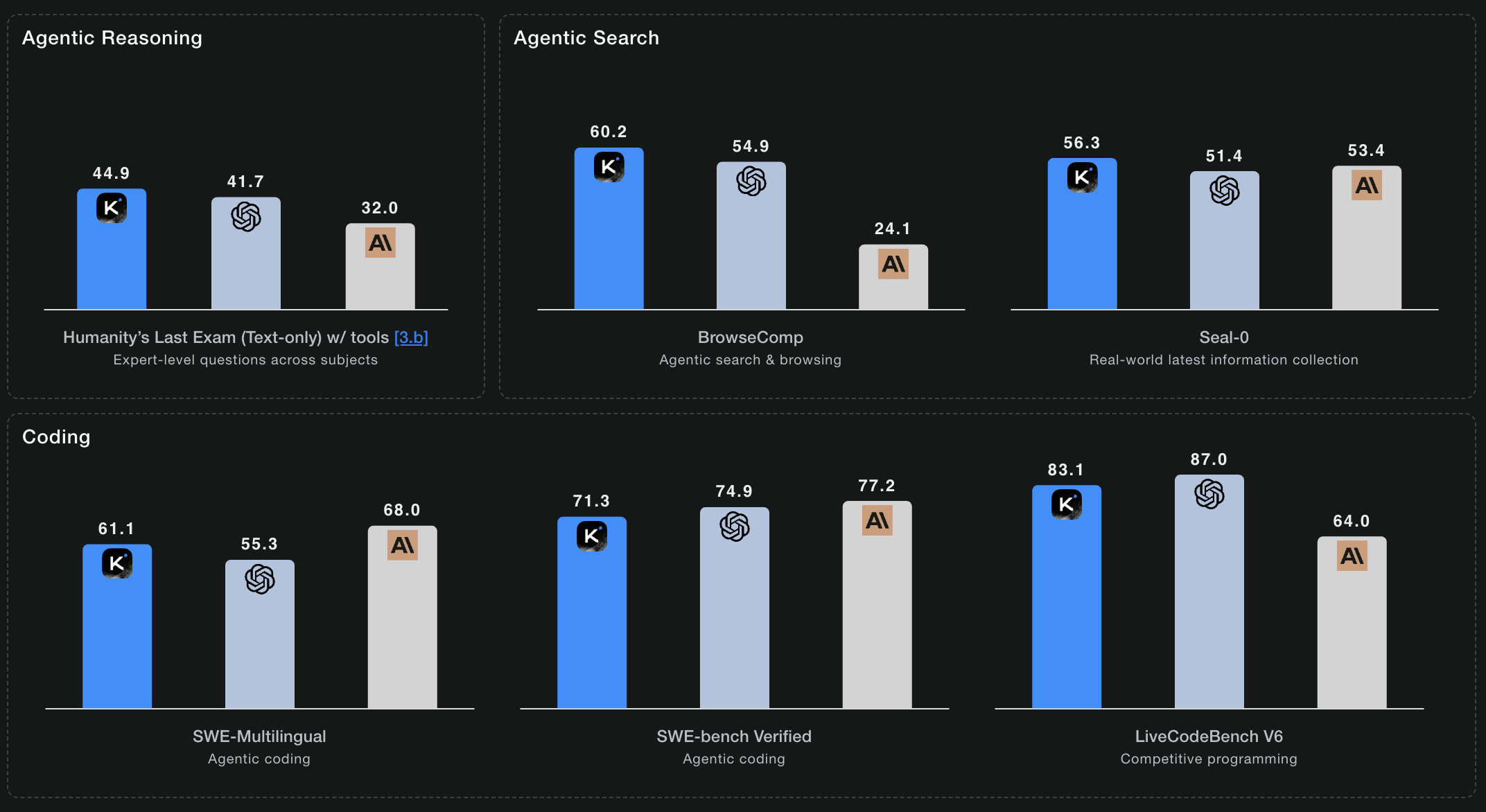
Moonshot AI hasn't just released another model—they've delivered impressive benchmark results that put K2 Thinking in direct competition with industry leaders. The numbers tell a compelling story of technical achievement.
On Humanity's Last Exam (HLE), which features thousands of expert-level questions spanning over 100 disciplines, K2 Thinking achieved 44.9%—demonstrating strong general knowledge and reasoning across diverse domains. In the BrowseComp benchmark testing continuous browsing and research capabilities, the model scored 60.2%, significantly outperforming the human baseline of 29.2% and showcasing superior information gathering and synthesis abilities.
For software engineering tasks, K2 Thinking excelled with 71.3% on SWE-Bench Verified, indicating practical utility for real-world development work. The model also achieved 61.1% on SWE-Multilingual, with particular strength in HTML, React, and frontend development tasks, demonstrating specialized expertise in modern web development workflows.
Real-World Applications: Beyond the Benchmarks
While benchmark scores are impressive, the true test of any AI model lies in practical applications. Moonshot AI has demonstrated K2 Thinking's capabilities across several compelling use cases that showcase its versatility.
Advanced Mathematical Problem-Solving
K2 Thinking tackled a PhD-level hyperbolic geometry problem through an impressive display of multi-step reasoning:
- Conducted 23 nested reasoning and tool calls
- Searched and analyzed relevant scientific papers
- Executed Python code for computational verification
- Validated intermediate results at each step
- Derived a closed mathematical formula as the final solution
This demonstrates the model's ability to combine literature review, computation, and logical reasoning—a workflow that mirrors how human researchers approach complex problems.
Full-Stack Web Development
From a single prompt, K2 Thinking can generate complete, production-ready applications:
Responsive Websites
Creates fully functional, mobile-responsive websites with modern design patterns and best practices.
Complex Applications
Builds sophisticated applications like Word clones with multiple features and component interactions.
Complex Research and Information Synthesis
Moonshot AI demonstrated K2 Thinking's research capabilities with a challenging multi-criteria search:
The Challenge: Identify an actor who has a university degree, played in the NFL, appeared in a sci-fi movie, acted in a prison drama, and made specific interview statements.
K2 Thinking's Approach:
- Conducted over 20 targeted searches across multiple criteria
- Cross-referenced information from Wikipedia, IMDb, and interview archives
- Systematically verified each criterion against candidate profiles
- Successfully identified Jimmy Gary Jr. and his role as Rudy Cox
- Synthesized findings into a coherent, well-documented answer
This exemplifies "long-horizon planning"—the ability to maintain focus on a complex goal through dozens of intermediate steps and adaptive reasoning.
The Strategic Significance: Open Source vs. Proprietary
K2 Thinking's launch highlights a fundamental strategic divide in the AI industry. While OpenAI and Anthropic guard their reasoning models behind proprietary walls, Moonshot AI has chosen the open-source path—a decision with far-reaching implications.
Open-Source Advantages
- Accessibility: Developers worldwide can integrate and customize the model
- Transparency: Research community can examine and improve the underlying technology
- Cost-Effectiveness: Lower barriers to entry for startups and researchers
- Innovation Velocity: Community contributions accelerate development
- Trust: Open inspection builds confidence in model behavior
Proprietary Model Benefits
- Competitive Moat: Protected intellectual property and techniques
- Revenue Control: Direct monetization through API access
- Safety Management: Centralized control over model deployment
- Quality Assurance: Consistent user experience across applications
- Resource Investment: Justifies massive R&D expenditures
China's AI Offensive: A Pattern Emerges
K2 Thinking isn't an isolated development—it's part of a broader Chinese strategy to challenge Western AI dominance. Recent months have seen multiple Chinese companies launching competitive models with aggressive pricing and open-source availability.
Recent Chinese AI Milestones
MiniMax's Cost Revolution
Recently launched an open-source model at one-tenth the cost of US competitors, dramatically lowering the economic barrier to advanced AI.
Moonshot AI's K2 Thinking
Delivers reasoning capabilities comparable to OpenAI and Anthropic while maintaining open-source accessibility.
Strategic Pattern
Chinese companies are systematically targeting key AI capabilities with open-source alternatives, democratizing access while building domestic AI infrastructure.
Test-Time Scaling: The New Frontier
K2 Thinking represents a shift in AI development philosophy. Rather than simply making models larger during training, the focus is now on "test-time scaling"—allowing models to "think longer" when solving problems by using more reasoning tokens and tool calls.
Understanding Test-Time Scaling
Traditional Approach
Models generate responses in a single forward pass, with quality primarily determined by training data and model size.
Test-Time Scaling Innovation
Models can allocate more computational resources during inference, extending reasoning chains and tool usage to solve harder problems. Like giving a student more time to think through a difficult exam question.
Competitive Implications
This becomes the new battleground in AI development—not just who has the biggest model, but who can most effectively scale reasoning at inference time.
Market Impact: What This Means for the AI Industry
The arrival of K2 Thinking has immediate and long-term implications for the competitive landscape of AI development. Several key dynamics are now in play.
-
Pressure on Proprietary Models — OpenAI and Anthropic now face open-source alternatives that deliver comparable reasoning capabilities. This challenges their pricing power and may force faster innovation cycles.
-
Developer Ecosystem Expansion — Open-source availability means more developers can experiment with advanced reasoning capabilities, potentially accelerating application development and innovation.
-
Geopolitical AI Competition — China's strategic push in open-source AI models represents a different approach to AI leadership—democratizing access rather than controlling proprietary technology.
-
Cost Structure Disruption — Following MiniMax's pricing revolution and now K2 Thinking's open-source release, the economics of AI deployment are fundamentally shifting, potentially enabling new business models.
Technical Differentiation: What Sets K2 Thinking Apart
Beyond benchmark scores, K2 Thinking demonstrates several technical capabilities that distinguish it from traditional large language models and position it as a genuine reasoning system.
Key Technical Innovations
Dynamic Tool Integration
Seamlessly cycles through thinking → searching → browser usage → code execution → verification, adapting its approach based on what each step reveals.
Long-Horizon Planning
Maintains coherent problem-solving strategies across hundreds of steps, demonstrating genuine strategic thinking rather than reactive responses.
Nested Reasoning Chains
Can build complex, multi-level reasoning structures where conclusions from one chain inform the direction of subsequent analysis.
Autonomous Verification
Actively checks its own work at intermediate steps, catching errors and adjusting course without human intervention.
The Road Ahead: Challenges and Opportunities
While K2 Thinking's launch is impressive, the model's long-term success will depend on how it performs in real-world deployments beyond controlled benchmarks. Several factors will determine its trajectory.
Challenges to Address
- Production Reliability: Consistent performance across diverse real-world scenarios
- Computational Costs: Extended reasoning chains require significant resources
- Integration Complexity: Developers need robust tools and documentation
- Safety and Alignment: Ensuring responsible behavior during autonomous operation
- Ecosystem Development: Building community and support infrastructure
Growth Opportunities
- Enterprise Adoption: Cost-effective alternative for businesses seeking reasoning capabilities
- Research Acceleration: Open access enables academic and independent research
- Specialized Applications: Fine-tuning for domain-specific reasoning tasks
- Global Accessibility: Democratizing advanced AI for underserved markets
- Community Innovation: Collective improvements and novel use cases
Conclusion: A New Chapter in AI Competition
Moonshot AI's Kimi K2 Thinking represents more than just another model release—it signals a fundamental shift in the global AI landscape. By delivering reasoning capabilities that rival proprietary systems from OpenAI and Anthropic while maintaining open-source accessibility, Moonshot has challenged the assumption that cutting-edge AI must remain behind closed doors.
The technical achievements are noteworthy: coherent reasoning across hundreds of steps, autonomous tool usage, and impressive benchmark performance across diverse domains. But the strategic implications may be even more significant. China's approach of combining technical excellence with open-source availability creates a different competitive dynamic—one that prioritizes ecosystem development and broad access over proprietary control.
For developers and businesses, K2 Thinking offers an intriguing alternative to expensive proprietary APIs. For researchers, it provides a platform for experimentation and innovation. For the AI industry as a whole, it intensifies competition in the reasoning segment and validates test-time scaling as a critical frontier for development.
The coming months will reveal whether K2 Thinking can maintain its benchmark performance in production environments and whether Moonshot AI can build the ecosystem necessary to support widespread adoption. But regardless of those outcomes, one thing is clear: the AI arms race has entered a new phase, and the competition is no longer confined to Silicon Valley. The next breakthrough could come from anywhere—and it might just be open source.