Revolutionary Breakthrough: How AUTOMEM Makes Open-Source AI Competitive with Frontier Models
"QWEN 32B Achieves Claude Opus & Gemini-Level Performance Through Optimized Memory Management"
A groundbreaking Stanford study reveals how teaching AI to manage memory like humans can unlock unprecedented performance gains.
The Game-Changing Discovery
In a remarkable development that could reshape the AI landscape, researchers at Stanford University have demonstrated that an open-source AI model, Qwen2.5-32B-Instruct, can achieve performance comparable to frontier systems like Claude Opus 4.5 and Gemini 3.1 Pro Thinking—not by making the model bigger, but by teaching it how to manage memory more effectively.
The research paper "AUTOMEM: Automated Learning of Memory as a Cognitive Skill" introduces a revolutionary framework that treats memory management as a trainable cognitive skill, similar to how humans develop metamemory—the ability to know what to remember, when to retrieve information, and how to organize knowledge.
What Makes AUTOMEM Different?
Traditional AI systems treat memory as a fixed architectural component—a static tool built into the system. AUTOMEM takes a radically different approach inspired by cognitive science: it promotes file-system operations (read, write, search, append, create) to first-class memory actions, allowing the AI model itself to decide how to manage its memory.
The Two-Loop Optimization System
AUTOMEM improves memory skills along two critical axes:
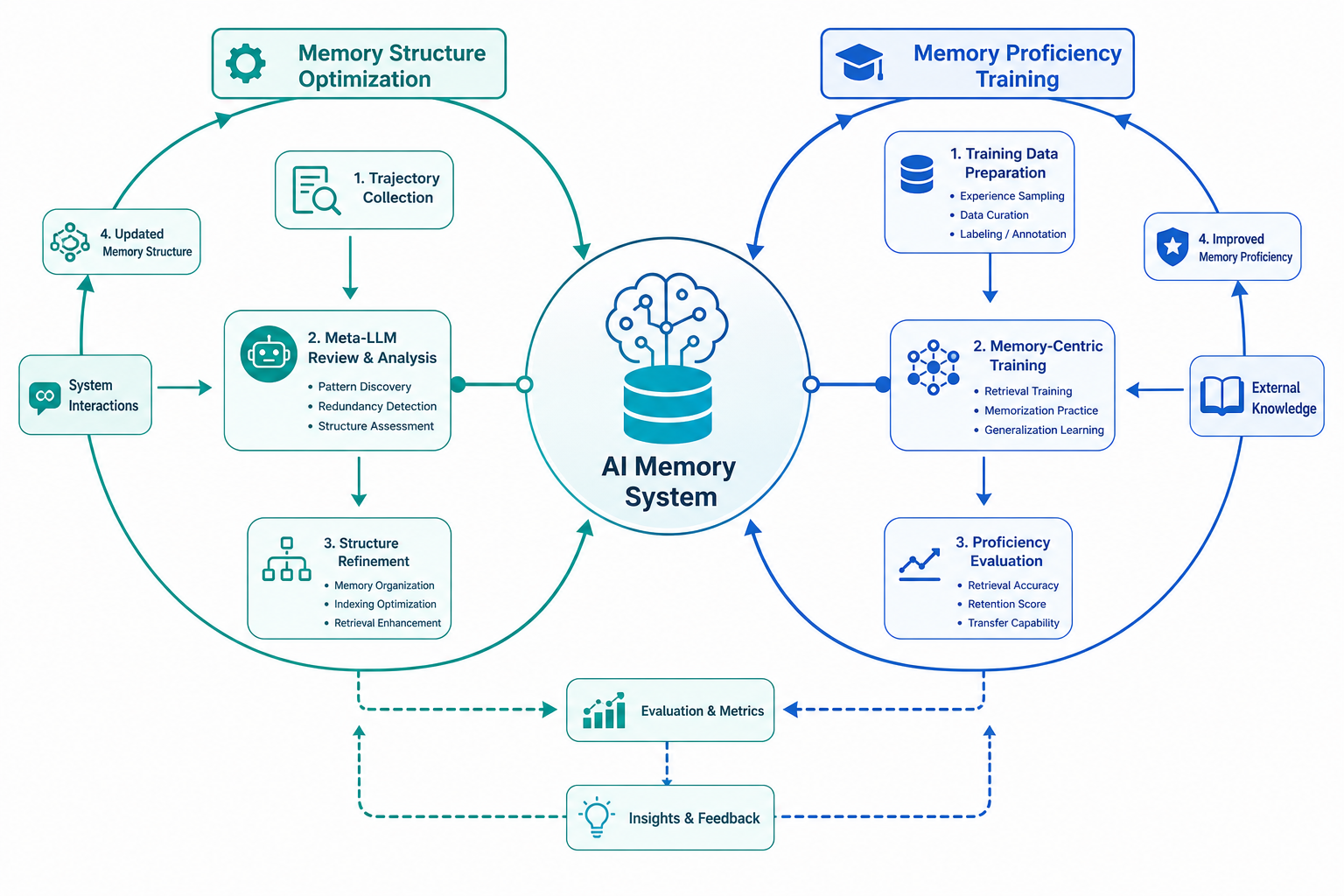
Figure: AUTOMEM's dual-loop system separates memory structure optimization from memory proficiency training.
Memory Structure Optimization
A meta-LLM reviews complete agent trajectories (spanning thousands of steps) and iteratively revises the memory structure—prompts, file schemas, and action vocabulary—that shapes how the agent interacts with memory.
Memory Proficiency Training
The agent's successful memory decisions from multiple episodes are identified and used as supervised training data to sharpen the model's memory proficiency directly, without modifying task-action behavior.
Impressive Performance Results
The results speak for themselves. Across three procedurally generated long-horizon games (Crafter, MiniHack, and NetHack), optimizing memory alone—without changing the model's core task behavior—improved the base agent's performance by 2× to 4×.
| Benchmark | Performance Gain (Memory Optimization Only) |
|---|---|
| Crafter | 2×–4× improvement |
| MiniHack | 2×–4× improvement |
| NetHack | 2×–4× improvement |
This optimization brought the 32B open-weight Qwen model to competitive levels with:
- Claude Opus 4.5 (Anthropic's frontier model)
- Gemini 3.1 Pro Thinking (Google's advanced reasoning model)
The research demonstrates that memory management is an independently learnable skill and represents a high-leverage objective that yields substantial gains on long-horizon tasks.
Why This Matters for AI Development
Democratizing Advanced AI Capabilities
This breakthrough is particularly significant for the open-source AI community. While Qwen models have shown strong performance in various benchmarks, the ability to reach frontier-model performance through optimized memory management means that advanced AI capabilities become more accessible without requiring massive computational resources.
A New Paradigm for AI Optimization
Rather than continuously scaling model size (which requires exponentially more compute), AUTOMEM demonstrates that teaching AI systems cognitive skills—like effective memory management—can unlock similar performance gains. This represents a more sustainable and efficient path forward for AI development.
Solving the Long-Horizon Task Challenge
Long-horizon tasks (those requiring thousands of steps to complete) have been a persistent challenge for AI systems. A single memory mistake early in a task can cascade into failure much later, making these problems difficult to debug and optimize. AUTOMEM's automated approach to learning from complete trajectories addresses this fundamental challenge.
The Science Behind Metamemory
The concept of metamemory comes from cognitive science, referring to humans' learned ability to manage information beyond what can be held in working memory at any moment. Just as humans use external aids—notes, files, indices—to extend cognition, AUTOMEM gives AI models the tools and training to develop similar capabilities.
The key insight is that metamemory develops with practice. By treating memory management as a skill that can be learned and refined, rather than a fixed architectural feature, AUTOMEM enables continuous improvement in how AI systems handle complex, multi-step tasks.
Practical Implications
For Developers and Researchers
- Cost-Effective Performance: Achieve frontier-model performance with smaller, open-source models
- Transparent Memory Operations: Every memory decision is traceable in the agent's trajectory
- Modular Optimization: Memory skills can be improved independently from task-specific capabilities
For Enterprise Applications
- Long-Context Tasks: Better handling of complex workflows requiring sustained attention over many steps
- Resource Efficiency: Reduced computational requirements compared to scaling model size
- Open-Source Flexibility: Greater control and customization compared to proprietary frontier models
Technical Deep Dive: How It Works
AUTOMEM's architecture separates memory management from task execution:
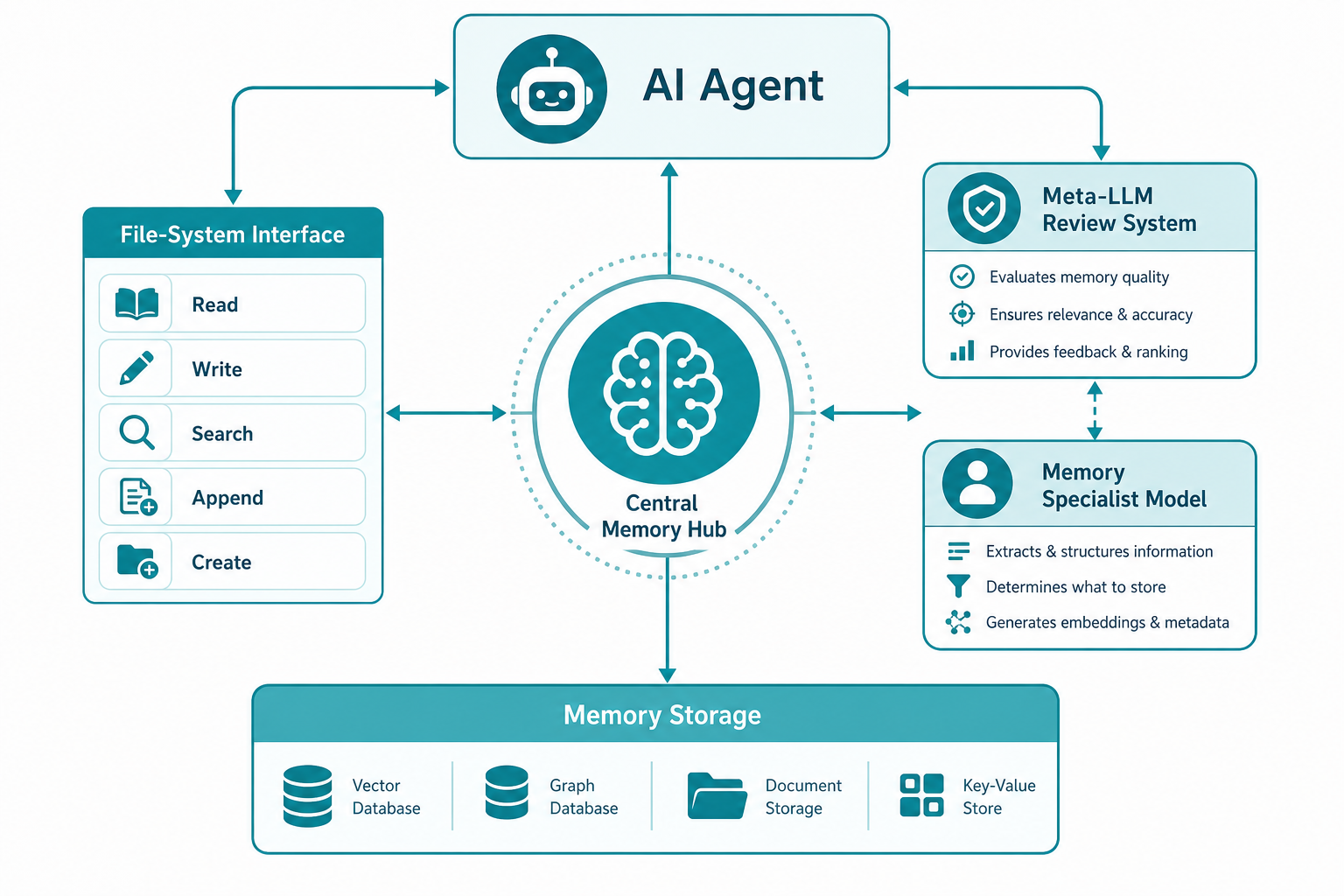
Figure: AUTOMEM agents interact with memory through standard file-system operations, making behavior observable and debuggable.
- File-System Memory Interface: The agent interacts with memory through standard file operations, making behavior observable and debuggable
- Meta-LLM Review System: A stronger LLM analyzes complete episode traces to identify memory decision patterns—both successful and problematic
- Iterative Scaffold Refinement: The system automatically revises prompts, schemas, and action vocabularies based on identified patterns
- Targeted Memory Training: A dedicated "memory specialist" model is fine-tuned on successful memory decisions, while the task-action model remains unchanged
This separation ensures that improving memory skills doesn't interfere with the model's core capabilities.
Future Directions
The Stanford research team has made their findings available on arXiv (paper 2607.01224) and established a project website for further exploration. This work opens several exciting research directions:
- Applying AUTOMEM to other open-source models beyond Qwen
- Extending the framework to real-world applications beyond games
- Investigating how memory skills transfer across different task domains
- Exploring the limits of performance gains achievable through memory optimization alone
Conclusion: A Paradigm Shift in AI Development
AUTOMEM represents more than just a performance improvement technique—it's a fundamental shift in how we think about AI capabilities. By treating memory management as a learnable cognitive skill rather than a fixed architectural feature, this research demonstrates that we can achieve frontier-model performance with smaller, more accessible open-source models.
For the AI community, this means that the path to advanced AI capabilities doesn't necessarily require ever-larger models or proprietary systems. Instead, teaching AI systems cognitive skills—starting with memory management—offers a more sustainable, transparent, and democratized approach to pushing the boundaries of what's possible.
The fact that a 32B parameter open-source model can compete with systems like Claude Opus 4.5 and Gemini 3.1 Pro Thinking through optimized memory management alone is a testament to the power of this approach and a promising sign for the future of accessible, high-performance AI.