Jev vs Laya (2026): Which System One Decision Model Should You Use?
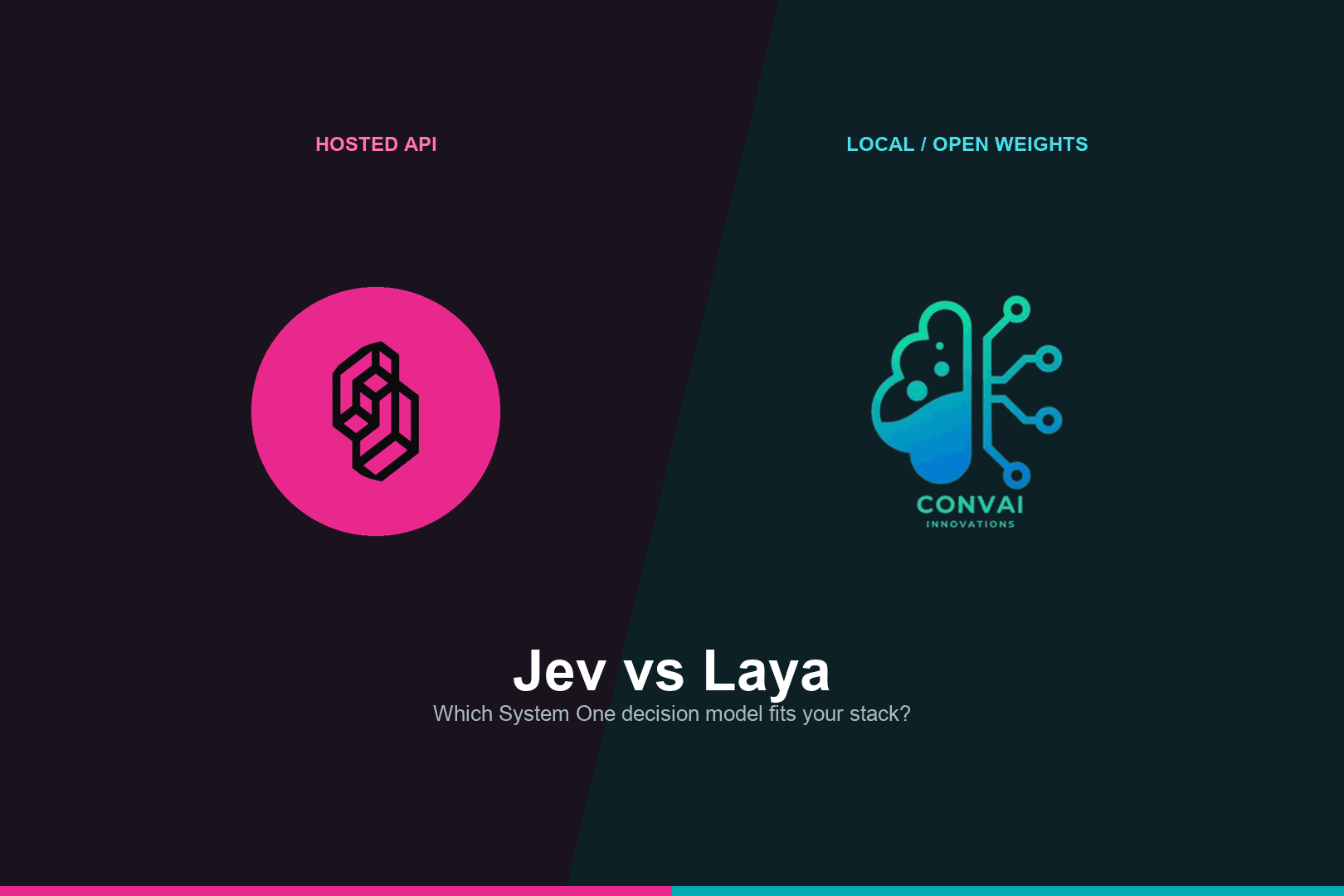
Same job. Different product.
In September 2026, typed decision models stopped being a niche research niche and became something engineers actually had to choose.
Jev (TypeSafe AI) and Laya (Convai Innovations) both sit in that new layer: you send application state and declared questions; you get back machine-usable answers with probabilities—not another paragraph to parse. Both speak the same three primitives: choice, score, and noul (yes/no probability).
That interface overlap is why the timeline keeps framing them as rivals. The operational reality is sharper. Jev is a hosted decision API. Laya is an Apache 2.0 open-weight stack you run yourself. Same shape of answer. Very different ownership model.
If you want the full Jev-only explainer first, start with our TypeSafe Jev / System One deep dive. This piece is for the decision: when to pick which.
What both models actually do
Neither product is a chatbot. Neither is trying to write your email or invent a tool name. You define the answer space up front; the model scores it.
| Primitive | What you ask | What you get back |
|---|---|---|
choice | Pick one label from a set you defined | Selected option + confidence |
score | Rate on an ordered scale you wrote | Numeric score on that scale |
noul | Yes/no question | Probability that “yes” holds |
That is why these models fit agent harnesses, routers, guardrails, triage, and escalation gates. Your code owns side effects. The model owns the fuzzy judgment.
Official framing: TypeSafe’s System One launch post and Laya’s Hugging Face model card.
Head-to-head: the differences that matter
| Dimension | Jev | Laya |
|---|---|---|
| Delivery | TypeSafe hosted API (also via gateways) | Open weights + Python package; you serve it |
| License / inspectability | Closed model; API contract | Apache 2.0 weights and code |
| Typical input budget | Documented ~64k-token request limit | Default checkpoints ~512–1,024 tokens (config and encoder depend) |
| Many options | Up to 255 options per choice | Options share a fixed head budget; publisher suggests ~<20 at defaults |
| Adaptation | Criteria, state, and provider versions | Fine-tune checkpoints + fit calibration on your data |
| Cost shape | Listed ~$0.042 / 1M input tokens; output free | Weights free; you pay compute, memory, and ops time |
| Latency story | Sub-second API path (network + service) | Local forward pass often tens of ms once loaded—on your hardware |
Independent write-ups that map the same trade-offs without pretending one leaderboard settles it: AgentGrid and Anthus.
When Jev is the better first bet
You want a hosted component today
No GPU fleet, no checkpoint management, no serving stack. An API key (or gateway route) and an HTTP client get you into the decision loop faster.
Long state or large label sets
Documented request budgets and a high option ceiling matter when a ticket includes history, or a choice question has dozens of queues. Laya can be retuned for larger heads—but that is work you own.
Zero-shot baseline without a fine-tune
Published and independent runs repeatedly show raw Laya base checkpoints need specialization for typed-decision workflows. If you have few labels yet and need something usable out of the box, start with Jev and measure.
You already optimize around a provider SLA
Rate limits, auth errors, and overload semantics are TypeSafe’s problem surface. You still handle retries—but you are not also running ModernBERT on call.
When Laya is the better first bet
Data stays on infrastructure you control
Local inference can keep tickets, emails, and traces off a third-party decision API. (Your surrounding tools still need their own privacy story.)
Volume makes token bills the wrong cost model
High-QPS routing and guardrails burn input tokens forever on a hosted meter. Spare GPU/CPU capacity + Apache 2.0 weights flips the economics—if you can operate the stack.
You will fine-tune and calibrate
Laya’s own cards are explicit: base English and multilingual checkpoints sit near chance on some typed-decision sets until specialized; the fine-tuned typed-decisions checkpoint is a different artifact. Treat Laya as a fast base to own, not a magical zero-shot twin of Jev.
Multilingual routing with an explicit router
The English root collapses on scripts it cannot read while still looking “confident.” Laya’s Router exists to dispatch English vs multilingual vs typed-decisions checkpoints—name the checkpoint you actually ran.
Benchmark honesty (read this before you switch)
Vendor tables are marketing-adjacent even when numbers are real. Three traps show up in almost every Jev vs Laya thread:
| Trap | Why it bites |
|---|---|
| Fine-tuned Laya ≠ base Laya | A 0.76-style typed-decisions score belongs to a specialized checkpoint, not the root English download. |
| Third-party Jev columns ≠ same-run head-to-head | Laya’s published comparisons often cite external Jev figures with different prompts and sample sizes—and say so. |
| Warm local ms ≠ end-to-end API latency | Comparing a loaded GPU forward pass to a networked hosted call answers two different questions. |
Anthus ran the same texts, questions, and feedback loop on both and saw Jev ahead after steering (roughly 87% vs 80% on that bench)—useful as one same-task signal, not a universal ranking. Laya’s Banking77 miss at default option budgets is equally real: high-cardinality choices are where Jev’s documented option ceiling currently looks safer without retuning.
Bottom line: evaluate on your tickets, with named checkpoints, after calibration. Do not inherit someone else’s leaderboard cell.
Laya is a family—name the checkpoint
| Checkpoint | Backbone (as published) | Rough default context | Best for |
|---|---|---|---|
convaiinnovations/laya (English root) | ModernBERT-large ~421M | ~512 tokens | English triage, guardrails |
laya-multilingual | mmBERT-base ~322M | ~1,024 (encoder can go higher) | Non-English / multi-script |
laya-typed-decisions | ModernBERT-large ~421M | ~1,024 | The specialized typed-decisions workflows |
Router().predict(...) can pick among them. Log routing.model (or your equivalent) with every eval row, or you will accidentally compare three products under one brand name.
Decision guide
| Your situation | Start with | Why |
|---|---|---|
| Need a hosted decision layer this week | Jev | Less infra; measure accuracy on your rubric next |
| Inputs regularly exceed ~512–1k tokens | Jev (or redesign the task) | Documented larger request budget |
Dozens of labels in one choice | Jev first | Option-budget cliff on default Laya heads |
| Strict data locality / air-gapped path | Laya | Weights and inference stay yours |
| High volume + spare accelerators | Laya | Tokens stop being the unit economics |
| A few hundred domain labels available | Fine-tune Laya | Specialization is the product’s intended path |
| Accuracy on your cases undecided | Either—same eval harness | Shared cases beat brand loyalty |
Practical recommendation
Do not treat “Jev vs Laya” as a morality play about open vs closed. Treat it as a deployment and evaluation choice.
- Write five to twenty synthetic cases with expected categories before you call either model.
- Keep adapters separate. Record versions, device, truncation, and checkpoint names.
- Calibrate confidence on held-out data. Confident and wrong is still wrong.
- Only then decide whether provider dependence or self-hosting ops is the cheaper long-term mistake for your team.
Jev wins when time-to-integration, long context, or large option sets dominate. Laya wins when control, volume economics, and fine-tuning ownership dominate. The useful winner is the one that mishandles your tickets in ways you can live with—at a cost you can operate.
For more on how Jev fits an agent harness, see Why TypeSafe AI’s Jev went viral.