Why TypeSafe AI's Jev Went Viral: The System One Model Changing AI Agents (2026)
Why Jev Took Over Developer Feeds Overnight
Every few months a new model drops and the timeline shrugs. Mid-September 2026 felt different. TypeSafe AI came out of stealth with Jev—and within days it was everywhere on X, GitHub, and agent-builder Slack channels.
The reason is blunt: most “AI agents” spend the majority of their budget not on clever planning, but on tiny yes/no and multiple-choice judgments—which tool to call, whether a page is relevant, whether an action is risky, whether the task is done. Those decisions happen hundreds of thousands of times a day. Paying a frontier LLM to write a paragraph for each one is how agent bills explode.
Jev was built for that layer. It is not another chatbot. It is a System One model: fast, typed decisions that software can act on directly.
What TypeSafe Means by “System One”
The name borrows Daniel Kahneman’s idea of System 1—fast, intuitive judgment—versus System 2’s slow deliberation. TypeSafe’s claim is architectural, not poetic:
- You send application state (text, structured context, a proposed tool call).
- You declare typed questions (choices, scores, booleans).
- Jev returns answers with calibrated probabilities—in parallel, not token by token.
The company is led by OpenAI veteran Diogo Almeida (a co-inventor of RLHF). After years of chat models optimized for human preference, TypeSafe trained Jev with RLCD—Reinforcement Learning for Calibrated Decisions—so confidence scores track outcomes, not vibes. The product name nods to economist William Stanley Jevons: when intelligence gets radically cheaper, demand for it tends to rise.
For the official framing, see TypeSafe’s launch post and site.
What’s Actually Special About Jev
Typed outputs, not prose
Jev does not generate free-form strings. Choices, scores, and yes/no answers come back as machine-usable types. Your code does not have to scrape a decision out of a paragraph.
Parallel questions, one request
Every question in a request is evaluated against the same state. Adding more checks barely changes latency; you mostly pay for the extra question tokens.
Calibrated confidence
Each decision ships with a probability. Act when confidence is high; escalate or retry when it is not. That is how you build automation with thresholds instead of hope.
Schema-safe by design
A successful response cannot invent a tool name or label outside the options you defined. Wrong answers are still possible—hallucinated schemas are not.
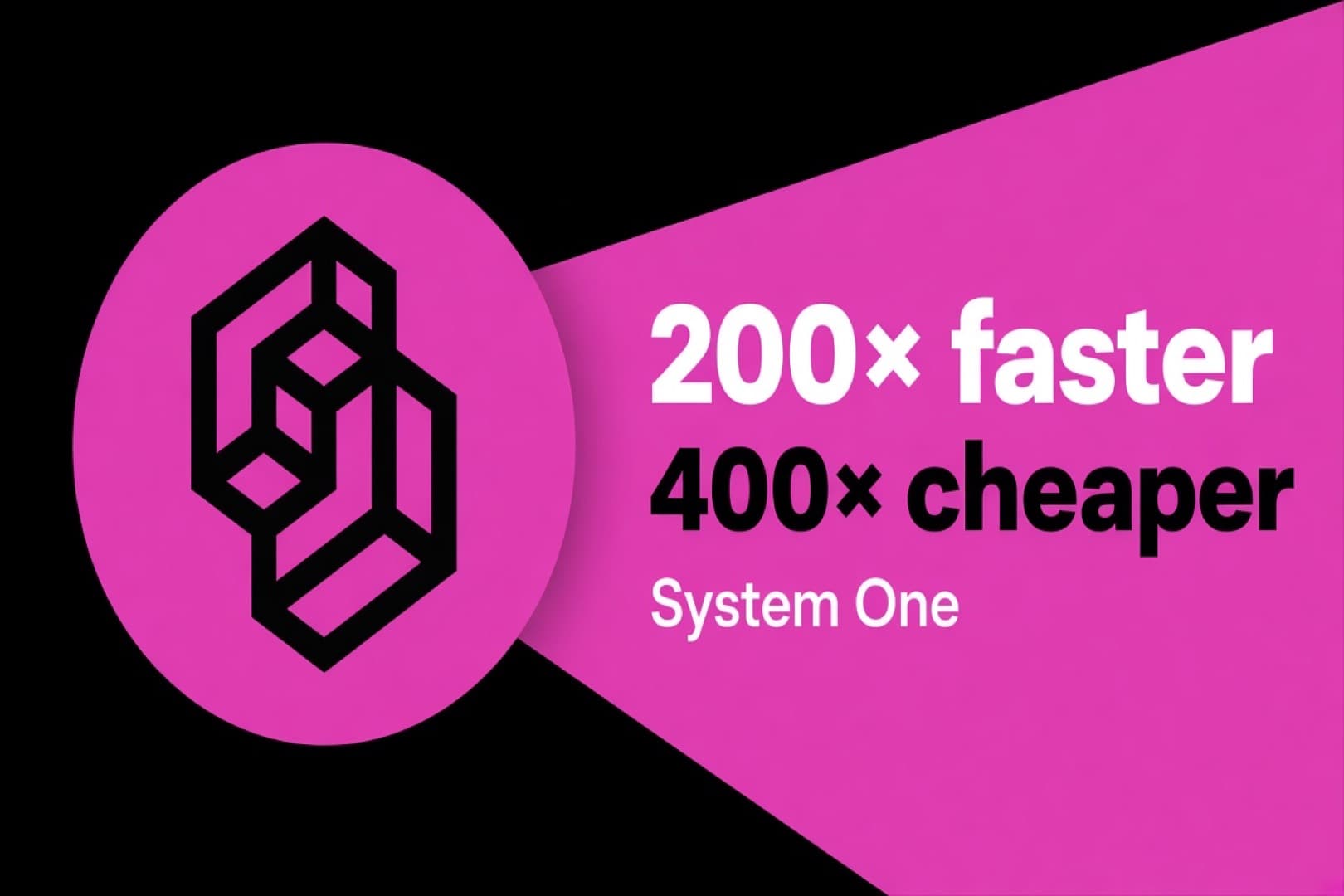
Headline numbers from TypeSafe’s own System One workflow evaluations sit around ~200× faster and ~400× cheaper than comparable LLM calls for classification-style work. Treat those as ceiling claims, not your first production benchmark—but they explain the viral energy: this is the first widely discussed model that gives up writing to win on decision throughput.
Jev vs Traditional AI Agents
A traditional agent loop leans on one generative LLM for almost everything: plan, pick a tool, narrate, verify, repeat. Jev does not replace that loop. It sits inside the harness as a bounded judgment layer while the LLM keeps open-ended reasoning and text generation. Your code still owns side effects, auth, and risk thresholds.
| Dimension | Traditional LLM agent | Jev (System One) in the harness |
|---|---|---|
| Primary job | Generate text and plans | Return typed decisions + probabilities |
| Output shape | Tokens / prose (even with JSON mode) | Choices, scores, booleans over a declared schema |
| Latency profile | Seconds, sequential tokens | Sub-second parallel answers on decision tasks |
| Cost at high QPS | Dominated by every micro-check | Built for millions of cheap judgments |
| Hallucination risk | Can invent tool names or fields | Cannot emit values outside your schema |
| Best role | Planner, writer, deep reasoner | Router, classifier, guardrail, stop/go gate |
| Standalone agent? | Yes (common pattern) | No — complement, not a chat replacement |
LangChain’s harness write-up puts it cleanly: use an LLM when you need open-ended reasoning; use Jev when the answer set is already known.
How Teams Are Actually Using It
These patterns showed up quickly after launch—mostly as a cheap decision layer inside an existing agent loop, not as a standalone chatbot.
Browser agents at fraction-of-a-cent cost
Teams building computer-use / browser agents (including work popularized around Browserbase) use Jev to choose the next UI action—click, type, navigate—without burning a full LLM call on every glance at the page.
Risk checks before tools fire
LangChain-style middleware can ask Jev whether a proposed tool call looks risky and block it before execution. That is the same “dangerous action classifier” idea coding agents ship privately—now as a composable primitive.
Email triage and intent routing
High-volume inboxes do not need a novel essay per message. They need: spam vs urgent vs needs-human, which queue, which specialist model. Jev’s choice + confidence pattern maps cleanly onto that.
Model, tool, and skill selection
When the harness already knows the candidate set, Jev ranks or picks among known tools, models, or skills—and can reject all of them when nothing fits, forcing a safer fallback.
Context filtering and “are we done?” gates
Agents retrieve too much. Jev can score relevance of snippets, verify acceptance criteria, and decide whether the loop should stop, retry, or escalate to a person.
Trading and ad-stage decisions
Early community demos include live trading agents and advertising-awareness classification—domains where latency and typed outcomes matter more than eloquent explanations.
When to Call an LLM vs When to Call Jev
| You need… | Prefer |
|---|---|
| A plan, explanation, email draft, or code patch | Frontier / specialist LLM |
| Classification, routing, rubric scoring, yes/no gates | Jev |
| Many independent checks on the same state | Jev (batch questions in one call) |
| Dependent decisions (B needs A’s answer) | Sequential Jev calls, or LLM if the step is open-ended |
| Authorization / hard security policy | Your code (Jev is not an ACL) |
| Adversarial guardrails alone | Defense in depth — Jev helps, it is not the only boundary |
The Real Shift: Agents Become Hybrid Systems
The viral moment is not “Jev kills GPT.” It is that the agent stack is finally splitting into specialized intelligence primitives. Generative models stay where language and long-horizon reasoning belong. System One models take the high-frequency decision path that used to make agents slow and expensive.
If your product already runs an agent loop, the practical next step is boring and powerful: list every micro-decision that does not need prose, give each a typed question and a confidence threshold, and let code—not chat—own what happens next.
That is why Jev felt sudden. The industry was waiting for a model that software could depend on like a function—not a conversation.