Google's Open Knowledge Format (OKF) vs. RAG: Is This the Future of AI Memory?
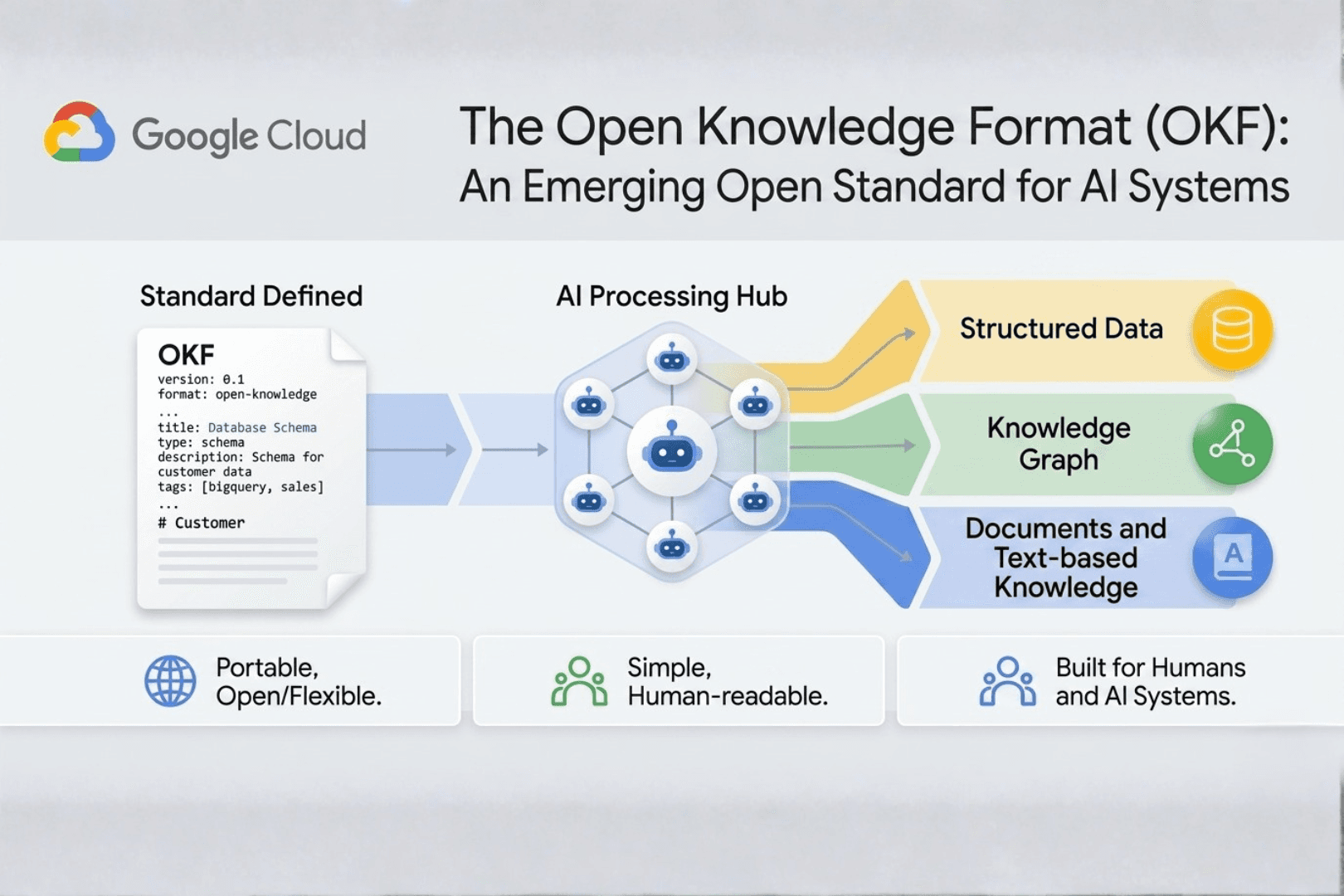
TL;DR: Google Cloud introduced the Open Knowledge Format (OKF) in June 2026 — a vendor-neutral markdown spec that challenges how AI agents retrieve and use knowledge. Here's how it compares to RAG, and why it matters.
Introduction
For the past few years, Retrieval-Augmented Generation (RAG) has been the go-to solution for giving AI systems access to external knowledge. But in June 2026, Google Cloud quietly dropped something that could reshape the entire paradigm: the Open Knowledge Format (OKF). It's not a database. It's not a new AI model. It's a format — and that's precisely what makes it so powerful.
What Is RAG, and Why Did We Love It?
RAG (Retrieval-Augmented Generation) works by connecting a large language model (LLM) to an external knowledge base. When a user asks a question, a retriever searches the knowledge base for relevant chunks of text, injects them into the model's context window, and the LLM generates a response grounded in that retrieved content.
RAG's Strengths
- Yes — Keeps LLMs up-to-date without retraining
- Yes — Reduces hallucinations by grounding answers in real documents
- Yes — Works well for large, unstructured document corpora
- Yes — Widely adopted with mature tooling (LangChain, LlamaIndex, etc.)
- Yes — Flexible — can plug into almost any vector database
RAG's Weaknesses
- No — Retrieves the same documents repeatedly for the same facts — wasteful and slow
- No — Knowledge is fragmented across incompatible silos (wikis, catalogs, code comments, people's heads)
- No — Every agent builder solves the same context-assembly problem from scratch
- No — Retrieved chunks lack structure — the model often gets raw text without metadata or relationships
- No — No standardized format means vendor lock-in and zero portability
- No — High latency at scale due to vector search overhead
What Is Google's Open Knowledge Format (OKF)?
Announced by Google Cloud on June 12, 2026, OKF is an open, vendor-neutral specification for storing organizational knowledge as a directory of markdown files with YAML frontmatter. Think of it as the USB-C cable of AI knowledge — a universal connector that anyone can produce and anyone can consume, without proprietary SDKs, APIs, or lock-in.
The core idea was inspired by AI researcher Andrej Karpathy, who articulated the "LLM Wiki" pattern: instead of using AI to search raw documents over and over (RAG), have the AI incrementally build and maintain a persistent, living wiki. As Karpathy put it:
"LLMs don't get bored, don't forget to update a cross-reference, and can touch 15 files in one pass."
How OKF Works
An OKF bundle is simply a directory of markdown files. Each file represents one "concept" — a table schema, a metric definition, a runbook, an API endpoint, anything your team needs to capture.
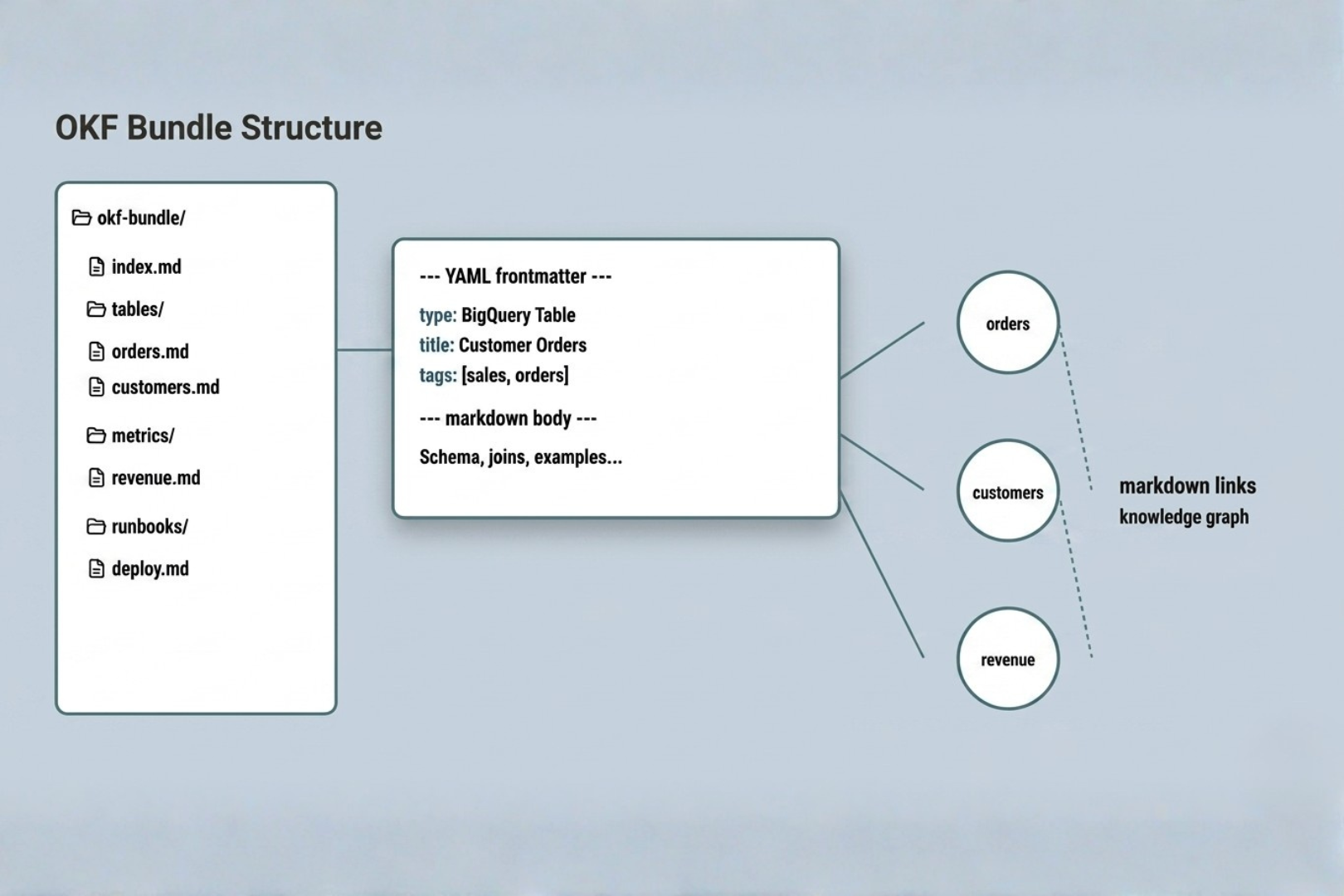
Figure: An OKF bundle is a directory of concept files — each with YAML frontmatter and a markdown body — linked into a traversable knowledge graph.
Each file has two parts:
YAML frontmatter — structured, queryable metadata:
---
type: BigQuery Table
title: Customer Orders
description: One row per completed order
resource: https://console.cloud.google.com/bigquery?...
tags: [sales, orders, revenue]
timestamp: 2026-05-28T14:30:00Z
---
Markdown body — free-form prose, schemas, examples, join paths, anything else.
Files link to each other using normal markdown links, creating a traversable knowledge graph that both humans and AI agents can navigate. Only one field is mandatory: type. Everything else is optional.
OKF's Strengths
- Yes — Vendor-neutral — no SDK, no API keys, no proprietary runtime required
- Yes — Human + AI readable — the same file works for both, no translation layer
- Yes — Version-controlled — lives in Git alongside your code
- Yes — Persistent and cumulative — knowledge grows over time instead of being re-retrieved every query
- Yes — Interoperable — wikis written by one team can be consumed by a different agent without translation
- Yes — Minimal by design — only one required field (type), everything else is flexible
- Yes — Solves context fragmentation — one standard format replaces scattered catalogs, wikis, and shared drives
- Yes — Producer/consumer independence — who writes knowledge and who reads it are fully decoupled
OKF's Weaknesses
- No — Very new (v0.1) — announced June 2026, ecosystem and tooling are still nascent
- No — Requires upfront curation — someone (human or AI) must build and maintain the wiki; it doesn't auto-generate from raw documents
- No — Not ideal for unstructured, large-scale corpora — RAG still wins when you have millions of raw documents with no pre-existing structure
- No — No built-in search or retrieval mechanism — OKF is a format, not a platform; you still need to build or integrate the serving layer
- No — Adoption risk — as a new open standard, it depends on community and vendor adoption to truly become interoperable
- No — Maintenance overhead — keeping a living wiki accurate and up-to-date requires ongoing effort, even if AI helps
OKF vs. RAG: Head-to-Head Comparison
| Feature | RAG | OKF |
|---|---|---|
| Core Approach | Search & retrieve on demand | Maintain a persistent, curated wiki |
| Knowledge Format | Unstructured chunks / vectors | Structured markdown + YAML |
| Portability | Low (vendor-locked) | High (vendor-neutral) |
| Human Readable | Partially | Yes, natively |
| Version Control | Rarely | Yes, Git-native |
| Setup Complexity | High (vector DB, embeddings, pipelines) | Low (just files) |
| Best For | Large unstructured document corpora | Curated organizational knowledge |
| Knowledge Growth | Static (re-retrieved each time) | Cumulative (wiki grows over time) |
| Interoperability | Low | High by design |
| Maturity | High (years of tooling) | Very early (v0.1, June 2026) |
Does OKF Replace RAG?
Not entirely — and that's the honest answer. OKF and RAG solve different problems at different layers. RAG excels when you have massive, unstructured document libraries and need to search them dynamically. OKF excels when you have curated, structured organizational knowledge — table schemas, metric definitions, runbooks, join paths — that agents need repeatedly and reliably.
The more accurate framing is this: OKF replaces the need for RAG in many common enterprise AI agent scenarios. Instead of re-retrieving the same facts about your data schema every time an agent runs a query, you give the agent an OKF wiki that it can read, update, and traverse. The knowledge is always there, always structured, always current.
Think of it as the difference between a library (RAG) and a well-maintained team handbook (OKF). Both are useful. But for day-to-day operations, you want the handbook.
Why This Matters for the Future of AI
The fragmented context problem is one of the biggest silent bottlenecks in enterprise AI today. Knowledge lives in incompatible silos — metadata catalogs with proprietary APIs, wikis behind login walls, code comments buried in repos, and the heads of senior engineers who might leave tomorrow. Every AI agent builder is solving the same context-assembly problem from scratch.
OKF is Google's bet that the solution is a format, not another service. By making knowledge portable, version-controlled, and agent-readable by default, OKF could become the foundation layer for how AI agents understand organizations — the way HTTP became the foundation for how the web works.
Conclusion
RAG was a brilliant solution to a real problem, and it's not going away. But OKF represents a fundamental rethink of how AI agents should relate to organizational knowledge — not as a search problem, but as a living documentation problem. If the ecosystem adopts it, OKF could make AI agents dramatically more reliable, portable, and useful in enterprise settings. The format is simple. The implications are not.
Building Reliable AI Knowledge Systems?
Need help choosing between RAG, OKF, or a hybrid approach for your enterprise agents — data catalogs, runbooks, schema docs, and serving layers? Contact us for expert guidance.