Sakana Fugu: The AI Orchestration Model That Commands All Others
Introduction
What if you didn't have to choose between the world's best AI models — and instead had one intelligent system that could pick, coordinate, and combine them all for you? That's exactly the vision behind Sakana Fugu, the bold new release from Tokyo-based AI lab Sakana AI. Announced on June 22, 2026, Fugu is not just another large language model. It is a multi-agent orchestration system disguised as a single model — and it's turning heads across the AI industry.
What Is Sakana Fugu?
At its core, Sakana Fugu is a language model trained to call, coordinate, and synthesize the outputs of other frontier AI models. Think of it as a highly intelligent conductor leading an orchestra of AI specialists. You send a single request to one API endpoint. Fugu then decides — autonomously — whether to solve the problem itself, or to assemble a team of specialized AI agents to tackle it together.
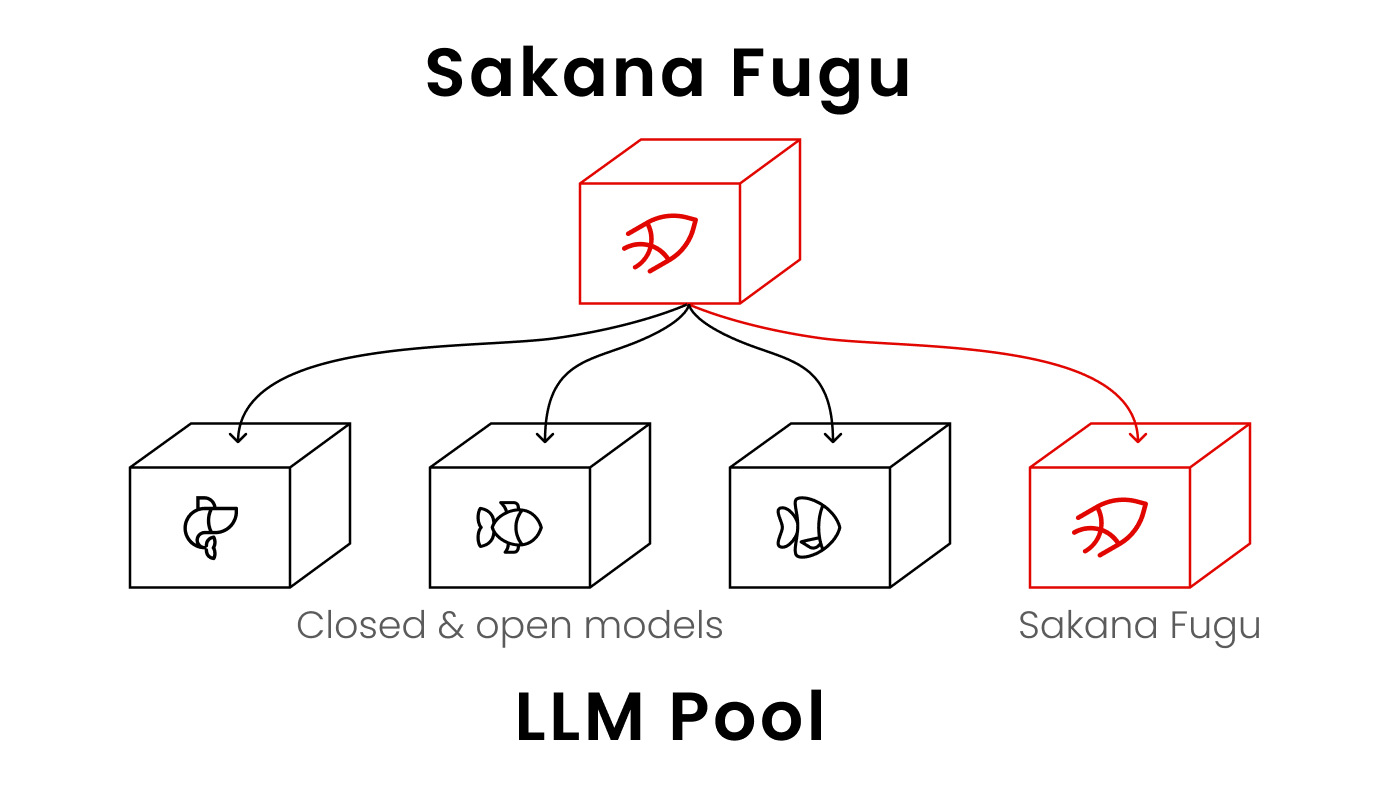
Figure: Sakana Fugu orchestrates a pool of frontier AI agents through a single OpenAI-compatible API endpoint.
This means the complexity of a multi-agent system is entirely hidden from the developer. No custom pipelines, no hard-coded roles, no brittle workflows. Just one clean, OpenAI-compatible API that delivers collective intelligence on demand.
Sakana AI's philosophy has always been that the most powerful AI systems are not isolated monoliths, but collaborative ecosystems — much like how evolution produces robust solutions through diversity and specialization rather than brute force alone.
Fugu vs. Fugu Ultra: Two Models, One API
Sakana Fugu launches with two model variants, both accessible through the same single API endpoint:
Fugu
- Optimized for speed and everyday use
- Selects a single best-fit agent per query, keeping latency comparable to a direct frontier model call
- Ideal for coding assistants, code review, chatbots, and interactive tools like Codex
- Supports agent opt-out for teams with data privacy and compliance requirements
Fugu Ultra (fugu-ultra-20260615)
- Optimized for maximum answer quality
- Coordinates a deeper pool of multiple expert agents per query
- Designed for demanding tasks: AI research, paper reproduction, cybersecurity analysis, patent investigations, and complex multi-step reasoning
- Agent pool is fixed; opt-out is not available
Benchmark Performance: The Orchestrator Beats Its Own Orchestra
The numbers speak for themselves. Across 11 major benchmarks, Fugu and Fugu Ultra post top scores on 10 out of 11, outperforming the very frontier models they orchestrate — including GPT-5.5, Gemini 3.1 Pro, and Opus 4.8.
| Benchmark | Fugu | Fugu Ultra | GPT-5.5 | Gemini 3.1 Pro |
|---|---|---|---|---|
| SWE Bench Pro | 59.0 | 73.7 | 58.6 | 54.2 |
| LiveCodeBench | 92.9 | 93.2 | 85.3 | 88.5 |
| Humanity's Last Exam | 47.2 | 50.0 | 41.4 | 44.4 |
| GPQA-D | 95.5 | 95.5 | 93.6 | 94.3 |
| CharXiv Reasoning | 85.1 | 86.6 | 84.1 | 83.3 |
Fugu Ultra even matches frontier-level performance against Anthropic's Fable 5 and Mythos Preview — models that are not even in Fugu's agent pool due to export control restrictions.
The Research Foundation: Trinity & Conductor
Fugu is not built on hype — it's grounded in peer-reviewed science. The system builds on two ICLR 2026 papers from Sakana AI:
- Trinity: A lightweight evolved coordinator that assigns dynamic roles — Thinker, Worker, or Verifier — to agents across multiple turns, enabling adaptive task delegation.
- Conductor: A reinforcement learning-trained orchestrator that discovers natural-language coordination strategies and crafts focused prompts for diverse LLM pools.
Together, these two frameworks prove that AI systems can learn how to assemble and route agents per task — replacing hand-designed, brittle workflows with emergent, learned coordination.
Why Fugu Matters: AI Sovereignty in the Age of Export Controls
Perhaps the most provocative aspect of Sakana Fugu is its geopolitical framing. Sakana AI explicitly positions Fugu as a hedge against single-vendor AI dependency — a risk that has become very real in 2026.
When Anthropic's Fable and Mythos models became subject to export controls, organizations relying on those APIs found their critical infrastructure suddenly at risk. Fugu's architecture is designed to route around such disruptions dynamically — if one provider restricts access, Fugu simply redistributes tasks to other agents in its pool.
This makes Fugu not just a technical product, but a strategic infrastructure play for enterprises, governments, and nations seeking genuine AI sovereignty.
Key Takeaways
- Sakana Fugu is a multi-agent orchestration model delivered as a single OpenAI-compatible API
- Two variants: Fugu (speed-optimized) and Fugu Ultra (quality-optimized)
- Tops 10 out of 11 benchmarks, beating GPT-5.5, Gemini 3.1 Pro, and Opus 4.8
- Built on ICLR 2026 research (Trinity & Conductor)
- Designed for AI sovereignty — resilient against export controls and vendor lock-in
- The orchestrator demonstrably outperforms the individual models it coordinates
Sources
- Sakana AI Official Release: sakana.ai/fugu-release
- Sakana Fugu Product Page: sakana.ai/fugu
- MarkTechPost Coverage: marktechpost.com
- Sakana Fugu Technical Report (arXiv): arxiv.org/html/2606.21228v1
Ready to Build Multi-Model AI Orchestration?
Need help designing agent routing, vendor-resilient LLM pipelines, or production multi-agent workflows? Our team can guide architecture selection, deployment, and integration.