HBF and HBC: The Next Generation of AI Memory Technology Challenging HBM Dominance
Introduction: The AI Memory Revolution
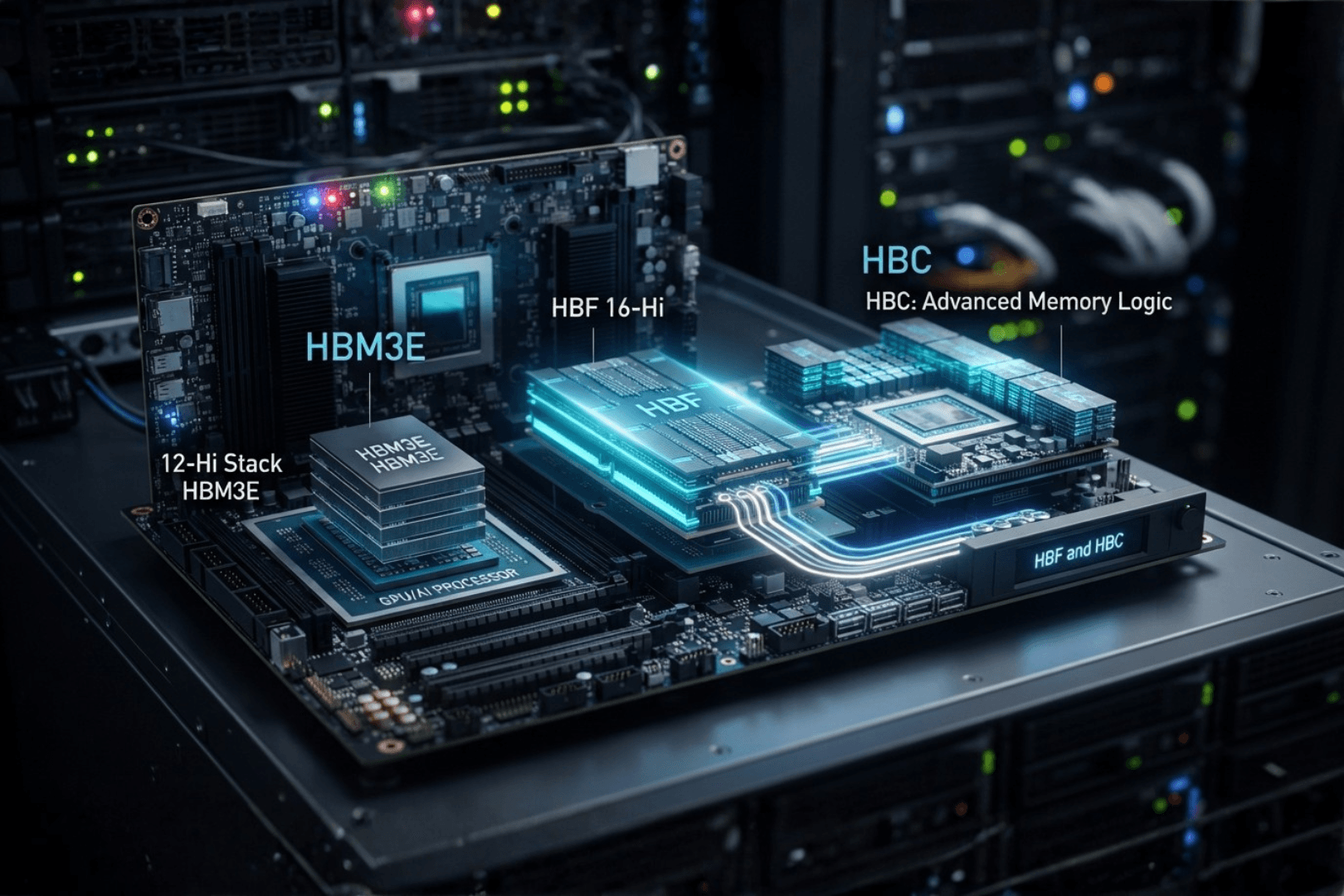
As artificial intelligence continues to advance at breakneck speed, the memory technologies powering AI systems are undergoing a dramatic transformation. High Bandwidth Memory (HBM) has long been the gold standard for AI accelerators and data center GPUs, but two emerging technologies—High Bandwidth Flash (HBF) and High Bandwidth Compute (HBC)—are poised to reshape the landscape. Industry leaders like Qualcomm, NVIDIA, and Western Digital (SanDisk) are driving these innovations to overcome HBM's limitations in power consumption, cost, and scalability.
Why HBF and HBC Are Emerging
The emergence of HBF and HBC stems from several critical challenges facing HBM technology:
Power Consumption Issues
HBM's high power requirements create significant thermal challenges in data centers and make it impractical for edge devices like smartphones and IoT equipment. HBF offers a solution by enabling AI capabilities at the edge with dramatically lower power consumption.
Cost and Supply Constraints
The complex manufacturing process of HBM has led to supply shortages that Samsung and SK Hynix warn could last until 2027 and beyond. This scarcity drives up costs and limits AI deployment.
AI Inference Bottleneck
During the inference decode phase, memory bandwidth becomes a critical bottleneck. HBC addresses this by bringing compute closer to the data, reducing data movement latency.
Understanding the Three Technologies
HBM (High Bandwidth Memory)
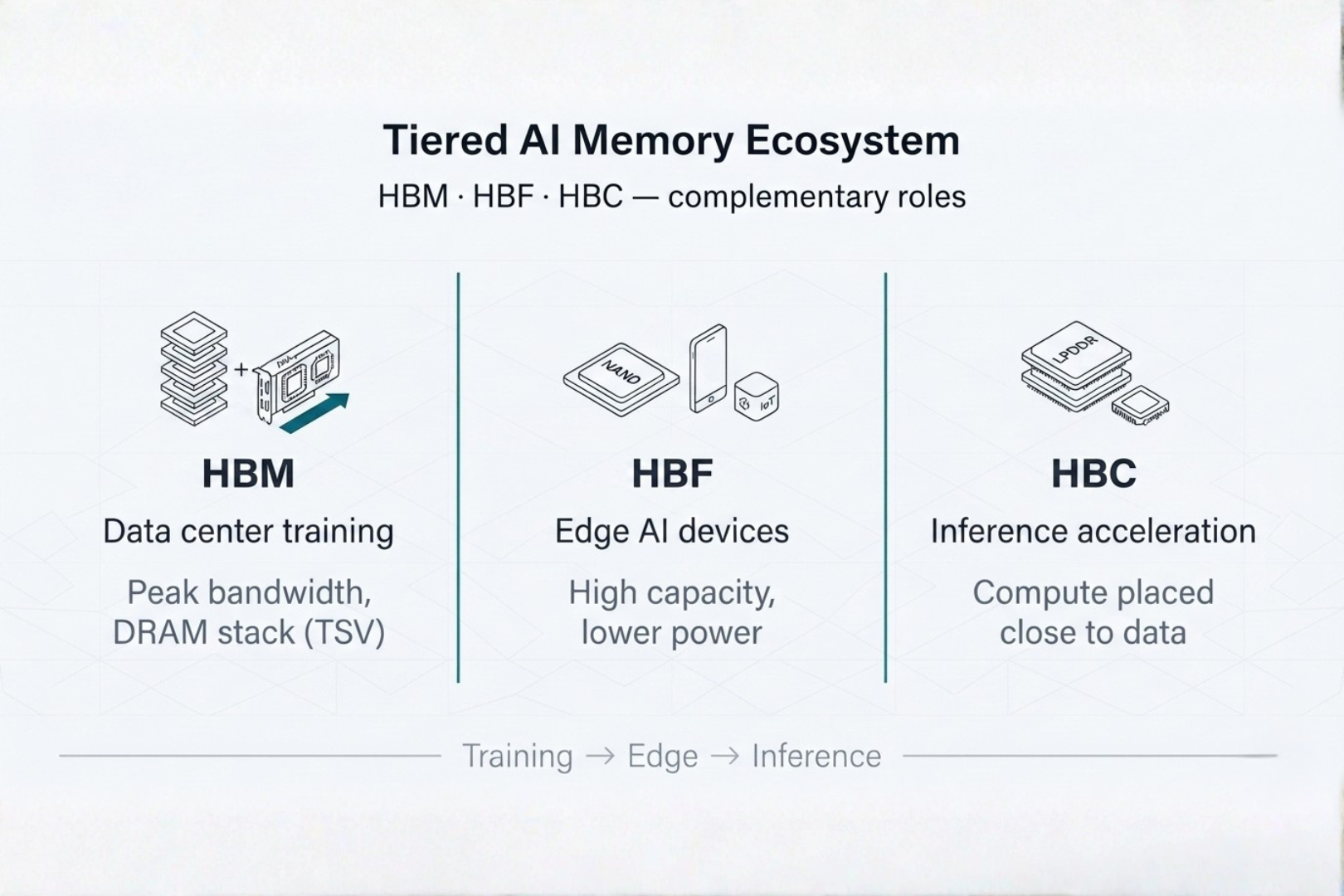
- Architecture: Vertically stacked DRAM dies connected through silicon vias (TSVs)
- Strengths: Exceptional bandwidth (up to 1TB/s in HBM3E), low latency
- Weaknesses: High power consumption, expensive manufacturing, limited to data center applications
- Use Cases: Data center GPUs, high-performance AI training
HBF (High Bandwidth Flash)
- Architecture: Flash memory technology optimized for high bandwidth operations
- Strengths: Lower power consumption, higher capacity potential, cost-effective
- Innovation: Enables AI processing at the edge (smartphones, IoT devices)
- Prediction: Expected to surpass HBM in memory demand by 2038
- Use Cases: Edge AI devices, AI-capable smartphones, embedded systems
HBC (High Bandwidth Compute)
- Architecture: Stacked low-power DRAM (LPDDR) with near-memory computing capabilities
- Strengths: Generational leap in effective memory bandwidth, reduced data movement
- Innovation: Brings compute to the data rather than moving data to compute
- Developer: Qualcomm's breakthrough technology for AI inference accelerators
- Use Cases: AI inference workloads, data center accelerators, token generation
Key Differences Comparison
| Feature | HBM | HBF | HBC |
|---|---|---|---|
| Memory Type | DRAM | Flash | LPDDR |
| Power Efficiency | Low | High | Medium–High |
| Cost | High | Lower | Medium |
| Capacity | Limited | High | Medium |
| Bandwidth | Very High | High | Very High |
| Latency | Very Low | Medium | Low |
| Primary Use | Training / Inference | Edge AI | Inference |
| Thermal Profile | High | Low | Medium |
Industry Impact and Future Outlook
The memory industry is at a pivotal moment. While HBM continues to dominate high-performance AI training applications, HBF and HBC are opening new frontiers:
- HBF is democratizing AI by making it feasible for edge devices, potentially creating a massive market for AI-capable smartphones and IoT devices
- HBC is solving the inference bottleneck that has limited AI deployment in data centers, with Qualcomm positioning it as a core technology for their Dragonfly AI accelerators
- HBM will remain critical for training large language models and high-performance computing, but its market share may decline as alternatives mature
Conclusion
The emergence of HBF and HBC represents a natural evolution in response to AI's diverse needs. Rather than completely replacing HBM, these technologies are creating a tiered memory ecosystem where each solution serves specific use cases. As we move toward 2027 and beyond, expect to see HBF dominating edge AI applications, HBC revolutionizing inference workloads, and HBM maintaining its position in high-performance training environments. The future of AI memory is not about one technology winning—it's about the right memory for the right application.