Netflix GenRec: How an LLM Ranker on vLLM Beat a Mature Recommender With 40× Less Label Data
AI Research & Recommendation Systems
Netflix just published a detailed look at GenRec — an LLM-backed recommendation ranker that verbalizes member history as text, scores the catalog with a catalog-aware head, and serves on Netflix's internal LLM stack with vLLM in prefill-only mode. Against a mature production ranker tuned over many years, GenRec delivered stronger offline ranking and statistically significant online lifts while using a fraction of the Phase-2 labeled data.
What GenRec Is — and Why It Matters
Traditional Netflix recommenders lean on thousands of hand-crafted dense and embedding features, plus specialized architectures for sequences, feature interactions, and multi-task objectives. That stack works — and it is hard to extend. Onboarding a new content type or surface often means more feature work, architecture changes, infra, and experiments.
GenRec takes a different bet: treat recommendation as an LLM-native problem. User histories, item metadata, and context become natural-language prompts. An internal foundation LLM — adapted on Netflix data, then post-trained for ranking — learns the interactions that feature engineers used to design by hand. Off-the-shelf LLMs are not enough on their own (popularity bias, out-of-catalog hallucinations, weak personalization), so GenRec constrains outputs to the Netflix catalog and aligns training with long-term member value and business goals.
The paper's inference diagram makes the serving choice explicit: history is verbalized once, then scored in a single prefill pass — not decoded title-by-title.
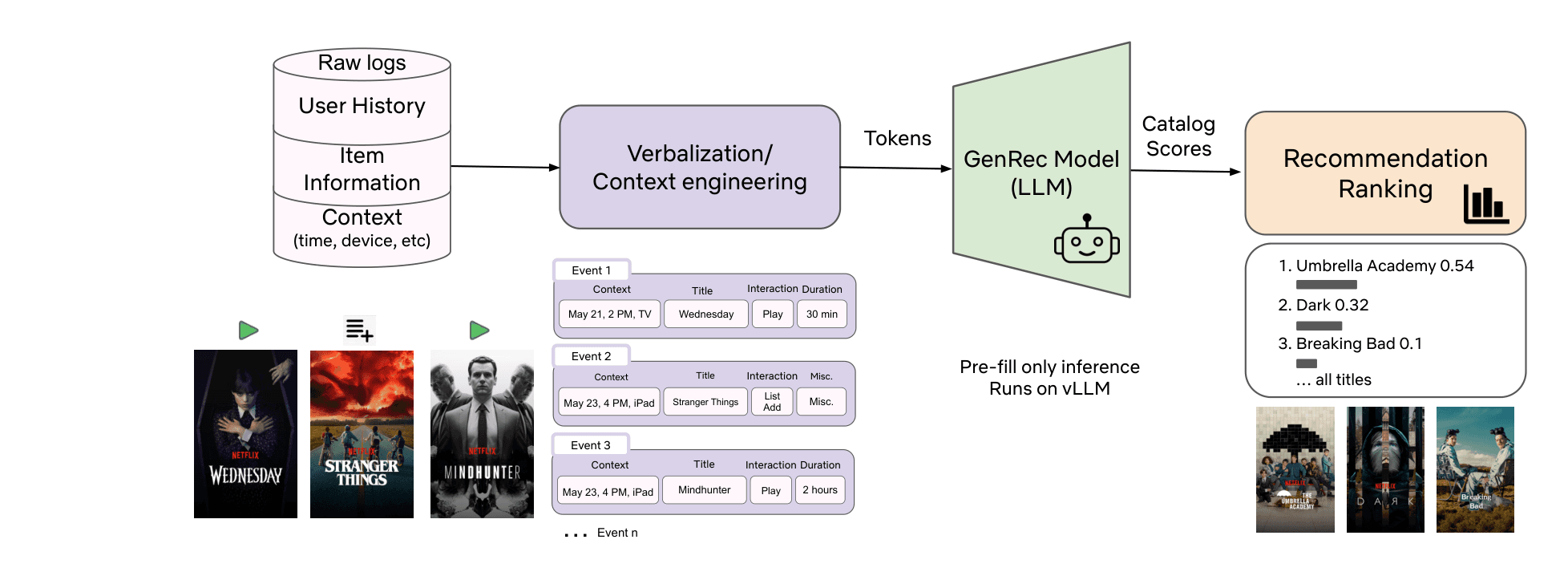
“Raw logs of user history, item metadata, and context are transformed via context engineering into natural-language prompts and fed into the GenRec model, which runs on vLLM in prefill-only mode and outputs scores for the entire item catalog, inducing a recommendation ranking.”— Li et al., GenRec (arXiv:2608.10257), Figure 1 caption
That prefill-only design is the practical hinge: autoregressive generative recommenders pay for token-by-token decoding over large candidate sets; GenRec spends compute once on the prompt, then ranks with a catalog-aware head — closer to classical ranking latency, with LLM-style context.
How It Differs From Traditional Recommenders
The core shift is not "swap a neural net for a bigger neural net." It is a change in what teams optimize:
- Feature engineering → context engineering. The prompt is the new feature vector. Teams decide which events to keep, how far back to look, and how to compress history inside a token budget — not which dense feature to ship next.
- Bespoke architectures → shared foundation backbones. GenRec rides Netflix's foundation LLM rather than inventing another two-tower or DLRM-style stack from scratch.
- ID-heavy models → verbalized semantics. Plays, thumbs, metadata, and context are written as text so the model can reuse language understanding and content knowledge.
- Generate titles → score the catalog. Despite the generative backbone, production GenRec does not decode recommendations token-by-token. A catalog-aware scoring head ranks candidates in one forward pass.
Two-Phase Training and Catalog-Aware Scoring
Phase 1 adapts an open-source LLM on proprietary Netflix corpora so it understands titles, member behavior, and language. It updates infrequently and acts as a shared backbone.
Phase 2 post-trains that backbone for ranking: conversational training data built from member engagement logs, a ranking objective over positives (long plays, strong feedback), a language-modeling objective to keep text fluency, and reward-weighted losses that pull the model toward long-term satisfaction and content-type balance — without full RL in the reported system.
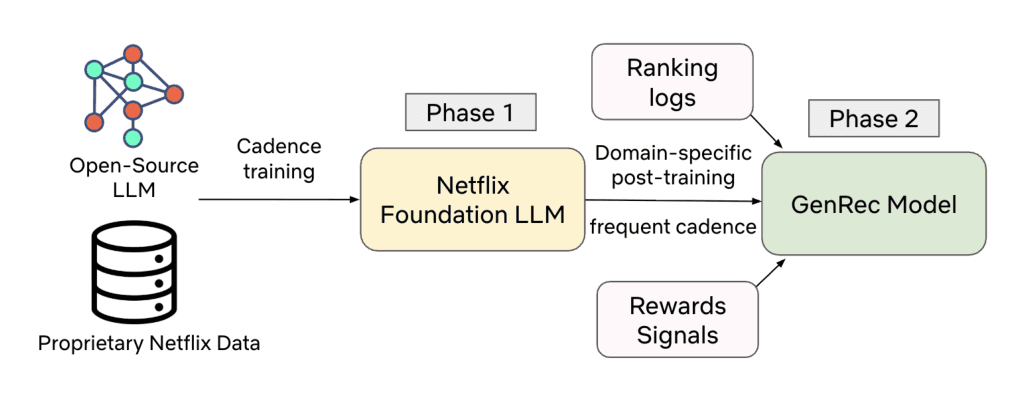
“Phase 1 trains a foundational LLM on Netflix data for user and content understanding, and Phase 2 post-trains on recommendation-ranking-specific data and objectives.”— Li et al., GenRec (arXiv:2608.10257), Figure 2 caption
The split is operational, not just architectural: Phase 1 is the shared, slower-moving backbone; Phase 2 is the high-cadence ranker that absorbs new titles, taste shifts, and reward steering — which is why cutting Phase-2 labels matters more than shaving Phase-1 pretraining.
At inference, the model pools a representation of the verbalized context and scores item embeddings. Softmax over scores becomes the ranking. That design keeps recommendations in-catalog and makes large candidate sets feasible.
Labor and Data Efficiency — What Netflix Actually Claimed
Netflix did not publish a headcount or "FTEs saved" number. The efficiency story is about labels and feature work:
- Starting from a strong Phase-1 model, GenRec matches or beats the production ranker with roughly 10–40× fewer Phase-2 labeled examples, depending on configuration.
- In the headline offline comparison, about 40× less Phase-2 data still yielded better MRR than the mature baseline.
- Far fewer hand-engineered input signals — less ongoing feature infrastructure to maintain as catalogs and surfaces grow.
That matters commercially because Phase 2 refreshes more often than Phase 1. Cutting labeled ranking data and feature pipelines is the real labor win Netflix is pointing at.
Offline and Online Evaluation
Offline: GenRec improved Mean Reciprocal Rank by about +1.6% relative versus the production ranker while using ~40× fewer Phase-2 labels and fewer input signals. Metrics kept rising as Netflix scaled Phase-2 data and enriched context.
Ablations underline the two-phase design: a Netflix-adapted Phase-1 base beats jumping straight from an off-the-shelf LLM by roughly 10–20% on offline ranking metrics; Phase-2 post-training then adds another large lift (about 35–50% near the Phase-1 cutoff, growing as Phase 1 ages).
Online: A large A/B test on batch-compute surfaces covered about 10% of Netflix traffic for ~4 weeks. In a low-data, low-signal GenRec setup, Netflix reported statistically significant gains on both short-term and long-term metrics. The paper cites about +0.006% relative on the core long-term metric; secondary coverage also notes a short-term lift on the order of ~0.115%.
Those percentages look tiny in isolation. At Netflix scale they can still be statistically significant — Netflix's own wording — because the experiment sample is enormous. Small relative moves on retention-style metrics are often how mature recommenders compete. The headline is not a giant absolute jump; it is beating a years-tuned baseline with far less Phase-2 supervision. Public writeups do not include p-values or confidence intervals.
Did Serving Cost Go Up?
Serving cost is a first-class constraint. Netflix does not claim GenRec is cheaper than classic MLP / feature-based rankers in absolute dollars. An LLM backbone is heavier; the engineering goal was to make LLM ranking viable within compute budgets on hundreds of millions of members.
GenRec runs on Netflix's internal LLM stack using vLLM. Cost is framed as roughly proportional to model size × context length, controlled with three levers:
- Smaller / distilled backbones trained on more or better-targeted data to recover quality at lower per-request cost.
- Context compaction: careful verbalization cut tokens from about ~5,000 to ~1,700 (roughly one-third) with negligible offline MRR loss — and a similar ~3× cut in GenRec's own serving cost because inference is compute-bound on context length.
- Prefill-only inference: no token-by-token decoding over the catalog. The model reads the prompt once and scores candidates in a single forward pass — critical versus autoregressive generative recommenders.
Bottom line: GenRec's serving cost was actively compressed; a clean "more expensive than the old ranker" or "cheaper than the old ranker" comparison was not published.
Implications for AI Applications
GenRec is an early signal of how production AI apps may reorganize — not only at Netflix:
- Shared foundation models can replace task-specific towers when domain post-training and rewards are strong.
- Context engineering becomes a first-class product skill — what you put in the prompt matters as much as model size.
- LLM serving infra (vLLM, GPUs, prefix caching, batching) starts to absorb workloads that used to live on classic RecSys stacks.
- Scaling laws become design guides: more Phase-2 data and larger backbones improved quality monotonically in Netflix's reported ranges — within cost Pareto limits.
- Caveat: the public A/B evidence is on batch-compute surfaces, not a claim that every Netflix ranking surface already runs GenRec.
For teams building personalization, search ranking, or content feeds, the practical lesson is blunt: you may not need thousands of hand-built features to beat a mature baseline — but you do need domain adaptation, catalog constraints, reward alignment, and a serving plan that refuses to pay for unnecessary decoding.